


 136 / 336

[
] 136
Integrated water resources management in
Peru through shared vision planning
Guillermo Mendoza and Hal Cardwell, International Center for Integrated Water Resources Management,
Institute for Water Resources of the US Army Corps of Engineers; and Pedro Guerrero, Project for Modernization
of Water Resources Management, National Water Authority of Peru, Ministry of Agriculture of Peru
W
ater is Peru’s new gold. In the past decade, Peru
has been going through a dramatic transformation
with high economic growth and a growing prosper-
ous population. However, water is in the wrong place and the
country recognizes the need to develop sustainable solutions
for water management. With more than 80 per cent of its water
falling in the Andes, hundreds of miles from the growing popula-
tion centres along the arid coast, and hydrology already being
radically altered by melting glaciers, Peru needed to act. In 2009
the country passed a new water law and set out on an ambitious
plan to develop locally-driven solutions for water sustainabil-
ity. In effect, the law states that water is both an economic
and social good, and that integrated water resources manage-
ment (IWRM) incorporates social, cultural and environmental
values with the goal to maximize social and economic well-being
without compromising the sustainability of vital ecosystems.
Easier said than done.
Shortly after the law was passed, the newly-created
National Water Authority of Peru (ANA) initiated
pilots at six basins to decentralize water resources
management, create river basin councils and imple-
ment transparent and participatory planning. A key
aspect of the pilots was the use of a collaborative, tech-
nically-informed planning process known as shared
vision planning (SVP) to develop IWRM plans that
recognized the multiple interests of a growing society.
These water resources planning efforts are history in the
making, as Peru integrates planning principles, struc-
tured participation and systems modelling to support
decision-making at river basin scales.
Peru’s major water management challenges
The challenges faced by Peru are significant on three
counts. First, it was unclear how to implement the 2009
Water Resources Law. Integration and public participa-
tion have become standard goals for water resources
management worldwide. However, the logistical,
technical and socio-institutional complexity of water
problems in Peru, as elsewhere, make it difficult to find
many successes in the implemention of collaborative
planning, trade-off analysis and decision-making for
IWRM at the river basin scale.
Second, water resources management in Peru had
historically been a centralized process largely focused
on agriculture. In contrast, the new law requires new
regional governance institutions such as river basin
councils, that have authority to develop and validate
participatory IWRM plans. The development of these
IWRM plans will require that the councils make deci-
sions on social and economic well-being trade-offs
with participation of the various interests in a basin.
Investments and planning in Peru’s water resources
will have to meet multisectoral demands on water
and Pacific draining basins, support unprecedented
economic growth, and enhance social equity because
many Peruvians, especially in the headwaters of the
basins, continue to live below the poverty line.
Third, water conflicts are real social stressors to an
economy that is one of the world’s fastest growing (gross
domestic product (GDP) grew 9.8 per cent in 2008 and
6.3 per cent in 2013), but that occurs largely along an arid
W
ater
E
ducation
and
I
nstitutional
D
evelopment
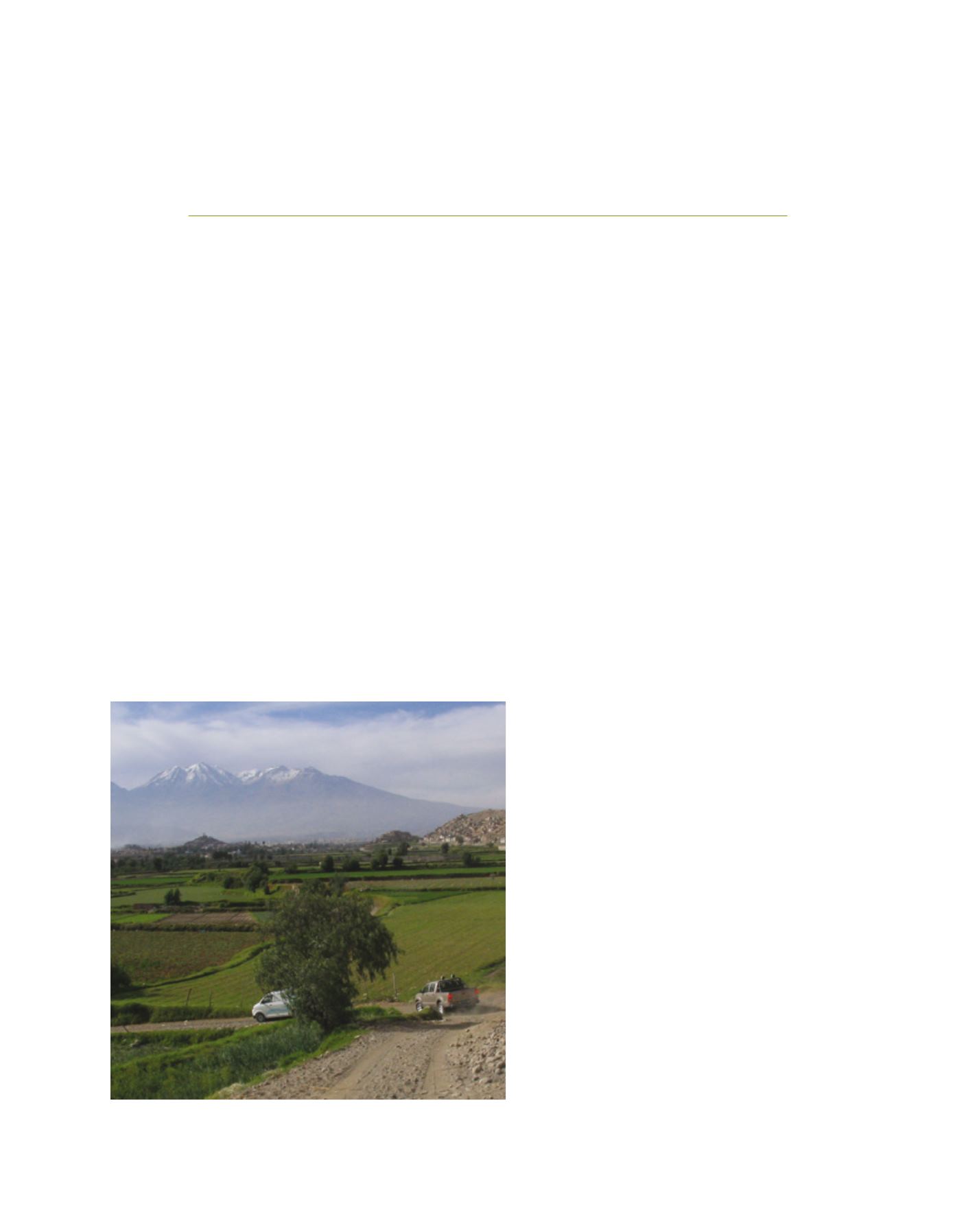
The Chili River Basin outside Arequipa: the new water law broadens stakeholder
participation and seeks to internalize the costs of water pollution
Image: Guillermo F. Mendoza