


 141 / 336

[
] 141
W
ater
E
ducation
and
I
nstitutional
D
evelopment
courses should be framed with a six-month or one-year
project, wherein students are given water resources
problems to solve after reviewing existing knowledge in
the area. This could be a research project or the devel-
opment of software integrating the latest knowledge in
the courses leading to the integrated planning, develop-
ment and management of water resources.
In order to meet the needs of short-term and long-
term plans for water resources development and
management in the country, the creation of suitable
mechanisms for education and training of hydrolo-
gists is not only necessary at degree and postgraduate
level, but also at junior levels, such as junior engineers,
technicians or observers. Adequate trained manpower
is necessary to improve the capabilities of operational
organizations at the centre and in the states with
regard to observations as well as primary and second-
ary processing of hydrological data. Though there is no
regular course for technicians training in hydrology,
meteorology and other related fields, various organi-
zations like the Central Water Commission (CWC),
India Meteorological Department (IMD), Central
Ground Water Board (CGWB) and the state irrigation
departments, which deal with subjects related to water
resources, have created facilities for on-the-job and
in-service training of personnel. However, the training
programmes for technicians and observers are highly
inadequate. There is only partial coverage of hydrology
and water resources as a subject under civil engineering
diploma courses to provide background to personnel
at junior hydrologist level. The education and train-
ing programmes for observers and technicians may be
taken up by polytechnic institutes, industrial training
as the establishment of the required laboratory and computational
facilities should be a priority. Laboratories should be well-provided
with state-of-the-art equipment. Training in traditional computer
programming is not adequate to prepare water resources students
to deal with the available computing technology. There is a criti-
cal need to formalize the computing curriculum in water resources
education to meet the challenges of this fast-growing technology.
Postgraduate education in hydrology and water resources in
India is being imparted at a number of academic organizations. The
syllabi of these postgraduate courses are revised keeping in view
past deliberations which later came up as the recommendations of
international organizations. However, a lot more needs to be done in
view of the challenges being faced in the area of hydrology and water
resources considering anthropogenic changes to global water and
energy cycles, natural periodicity and climate change. Considering
the present day requirements of water resources in the country, there
is a need to strengthen postgraduate-level programmes by includ-
ing some advanced level courses such as coastal hydrology, snow
and glacier hydrology, arid zone hydrology, forest hydrology, urban
hydrology, environmental hydrology and eco-hydrology in addition
to the conventional courses of surface water hydrology, groundwa-
ter hydrology and watershed management. Furthermore, courses
are needed on the application of modern tools and soft computing
techniques in hydrology and water resources, covering geographi-
cal information system (GIS) technology; remote sensing; isotopic
techniques; laboratory-based soil investigations; hydraulic and
hydrological investigations; water quality; hydrological instrumenta-
tion; the development and applications of software and information
technology; operational research and soft computing techniques like
artificial neural networks, fuzzy logic and genetic algorithms; basic
concepts of artificial intelligence; integrated flood management;
decision support systems (DSSs) and their applications; and inte-
grated water resources development and management. Postgraduate
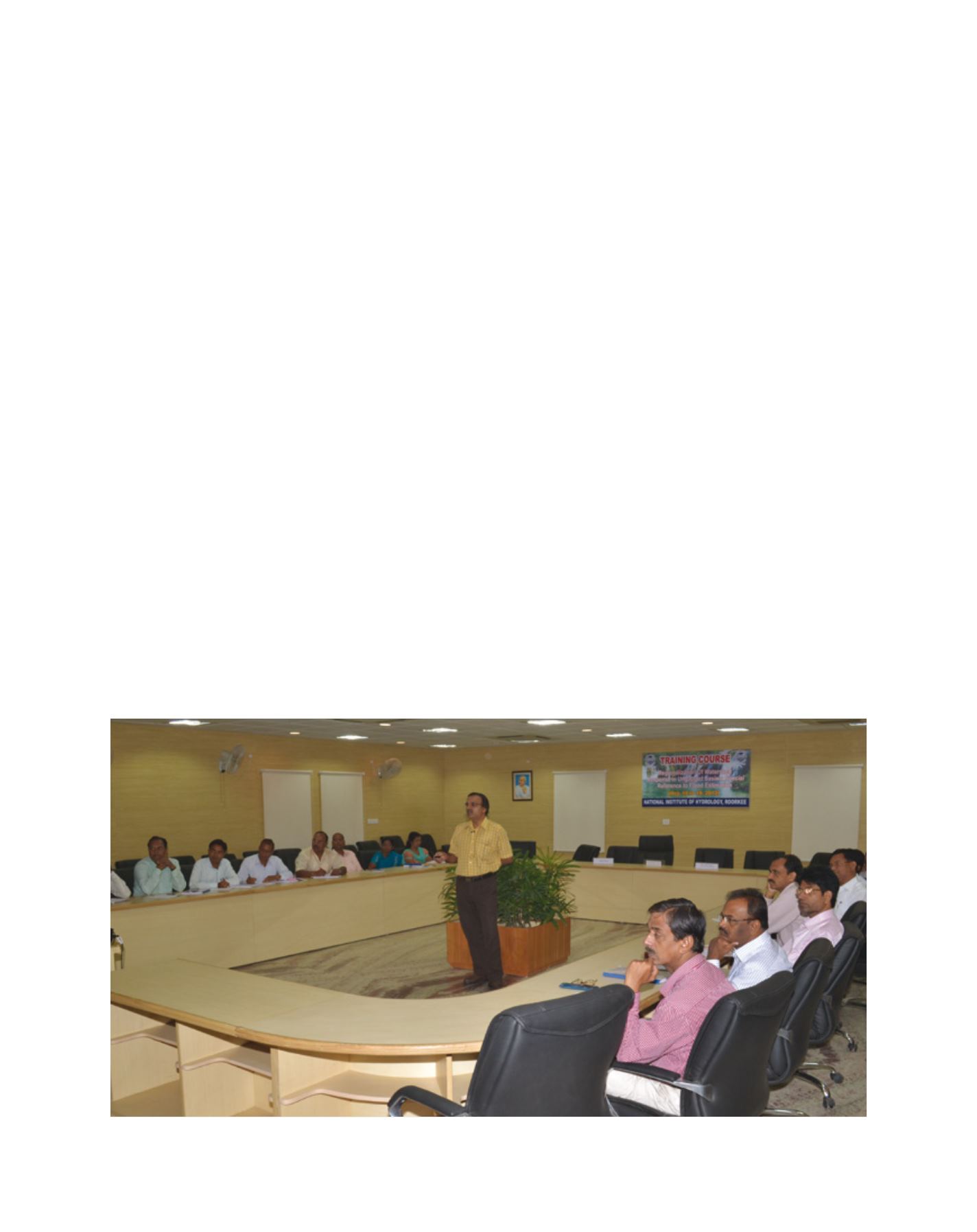
Continuing education programmes, summer courses and refresher courses are being organized by a wide range of institutions
Image: National Institute of Hydrology