

 46 / 192

[
] 46
UNESCO’s Associated Schools Project Network (ASPnet)
with a total of 8,000 schools in 177 countries.
Informal education initiatives are also part of the
Convention’s strategy. The UNCCD’s informal educa-
tion programme targets everyone from school-age
children to adults. For example, Lupo Alberto, a cartoon
book, educates young people on the importance of
combating desertification. ‘Gaia: the Game of the Earth’,
created by the Italian NGO, Ricerca e Cooperazione,
is a board game for children aged 12 years and older.
The Government of Italy financed both initiatives. In
addition, the National University of Santiago de Estero,
Argentina and a civil society organization, Fundación
del Sur (South Foundation), designed an innovative
education project on combating desertification, targeting
women aged over 60 years without prior art knowledge.
Participants in the project produced paintings under the
theme, ‘Environment Vision of El Chaco from the Visual
Arts’. Story telling, workshops and seminars are the most
common avenues for informal education.
The Convention promotes non-formal education
by encouraging the transfer of indigenous knowledge
and traditional practices across generations, through
exchange visits and activities that involve communities.
Education initiatives on combating desertification
are carried out by many other actors. For example, the
Recoleta School project was part of UNESCO’s education
activities. Local communities, such as the Guédé-Chantier
village in Senegal, have set up an eco-school programme
that educates children to combat encroaching desertifica-
tion.
3
The Africa Re-Greening Initiative is also supporting
local initiatives to re-green the Sahel region in Africa.
Measuring the success of educational activities
In their biennial reports on the implementation of the
Strategy, Parties to the Convention will report their
performance in education activities. The first reports
on this measure will be submitted at the end of 2010.
Parties will state the number and type of educational
initiatives relating to DLDD carried out by their civil
sustainable land management practices, makes it relevant for all coun-
tries. Moreover, the drivers of desertification are common to the drivers
of land degradation elsewhere. Therefore, assessments of the cost of soil
protection and restoration, as well as efforts to improve livelihoods and
the ecosystems in degraded regions, are relevant to all regions.
Good practice in education
Through education about DLDD, we learn mundane things such
as the nuances between deserts and desertification. We also learn
how to address desertification and land degradation, and to mitigate
the effects of drought in order to achieve sustainable development.
Citizens from the non-affected countries that may view desertifica-
tion as a distant issue learn how their lifestyles may cause or be
affected by desertification and drought that is in faraway places.
Land degradation, which refers to soil degradation, has far-reach-
ing consequences for many realms of life as well. Sustainable land
management is a powerful solution to many of the major challenges
of our time, including deforestation, energy deficits, food insecurity
and poverty. Citizens of drylands countries also learn how to cope
better with these challenges.
Education about DLDD occurs through formal, informal and non-
formal processes.
Formal training may be carried out during classroom instruction or
indirectly by training teachers. For example, in Chile, the Government
of the Netherlands financed an educational programme on desertifi-
cation. A local non-governmental organization, Juventudes para el
Desarrollo y la Producciòn (JUNDEP, which stands for Youth for
Development and Production), trained teachers in the local Recoleta
School in the land management of an area that was highly degraded
through mining and inappropriate agricultural practices. Then, with
the teachers, JUNDEP developed an appropriate curriculum for the
school. Its activities included theoretical learning by the pupils and
teachers, practical training through the establishment of a nursery
and an aboretum, well drilling and maintenance of gardening tools,
and reaping the rewards for these efforts through the sale of produce.
2
To support such formal initiatives, the UNCCD, in cooperation
with UNESCO, has produced a teachers’ kit, ‘Learning to Combat
Desertification’, for primary schools and a teaching resource kit for
drylands countries to be used in secondary schools. The kit is used as a
tool in the education initiatives under the DESD. It is available through
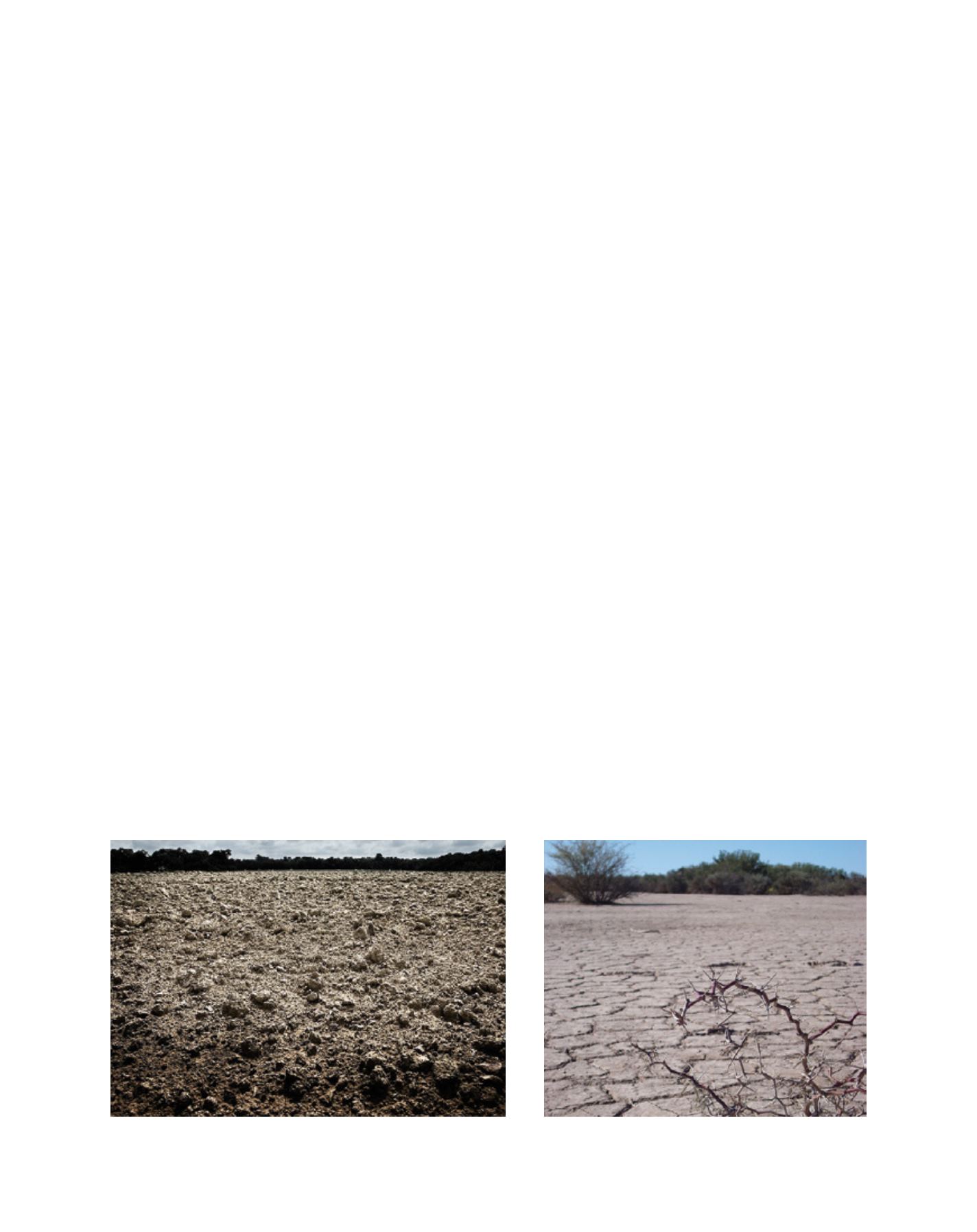
Clearing land for agribusiness
Land degradation is a global challenge
Image: © Gustavo Jononovich & UNCCD 2009 Photo Contest
Image: © Griselda Duarte & UNCCD 2009 Photo Contest