

 56 / 192

[
] 56
community component of Programme Geração Biz pivotal in reach-
ing young people.
18
At the community level, peer educators provide
educational materials and communicate messages through theatre,
dance, video sessions, audio sessions (using radio soap operas as
stimulants), group discussions and football matches. These activi-
ties usually take place in populated, open community spaces, such
as markets. Peer educators also undertake door-to-door campaigns
to address individual queries from young people. In some areas, peer
educators target specific groups, such as truck drivers in the border
areas or taxi drivers in the city.
By the end of 2009, a total of 1,366,524 young people had been
reached by the community component and a total of 441 youth
associations were involved in programme activities.
19
The clinical services component
: The school component and
community component both raise awareness and focus on provision
of information. The clinical services component provides access to
sexual and reproductive health services through youth-friendly health
services called
Serviços Amigos dos Adolescentes e Jovens
, popularly
known as SAAJ, under the Ministry of Health and integrated within
the national health care system. Peer educators and health profes-
sionals offer young people psychological support and counselling
on relationships, contraception, condom use, STIs and HIV testing.
Lectures and debates are run by peer educators in clinic waiting
rooms around issues relevant to young people and related to sexual
and reproductive health. The health practitioners are also trained to
be sensitive to, and competent in, dealing with the health needs of
young people. Two pilot initiatives that have been launched recently
as part of Programme Geração Biz are provision of antiretroviral treat-
ment to young people through the youth-friendly health services and
programme initiatives targeting key populations of young people
with a higher risk of HIV exposure, including prisoners, sex workers,
people with disabilities and men who have sex with men.
20
At the end of 2009, 244 youth-friendly clinics in Mozambique had
reached 300,000 young people. Voluntary counselling and testing
(VCT) services are already available in at least 117 of
the clinics.
21
The pedagogical diversity of the three components
described above shows how an ESD programme like
Geração Biz contributes to tackling an important
sustainability issue by increasing the quality of educa-
tion in formal and non-formal settings.
Gender issues
Programme Geração Biz takes a gender-sensitive approach
in all its activities. All programme material developed is
gender sensitive and challenges sex-role stereotypes.
Implementing partners have also benefited from, and been
enriched by, the programme. Some youth associations and
partner organizations claim that Geração Biz has helped
improve their understanding of and attitude towards
gender issues. Gender disparities are a challenge due to
traditional sex roles and females being responsible for the
majority of household chores. Attempts are being made to
address these with increased parental involvement.
Partners and their roles within the programme
Geração Biz is a multi-sectoral programme supported by
the government, a number of national and international
NGOs, youth associations and other civil society groups.
Partners at the central, provincial and district levels are
involved in planning, implementation, monitoring and
evaluation of the programme. The implementation varies
by province but a fundamental principle of Geração Biz
is that young people should participate at all stages of the
programme, from planning to implementation and evalu-
ation. The main partners and their roles are as follows:
Government Ministries
: Each of the three participat-
ing Ministries (Education, Health, Youth and Sports) is
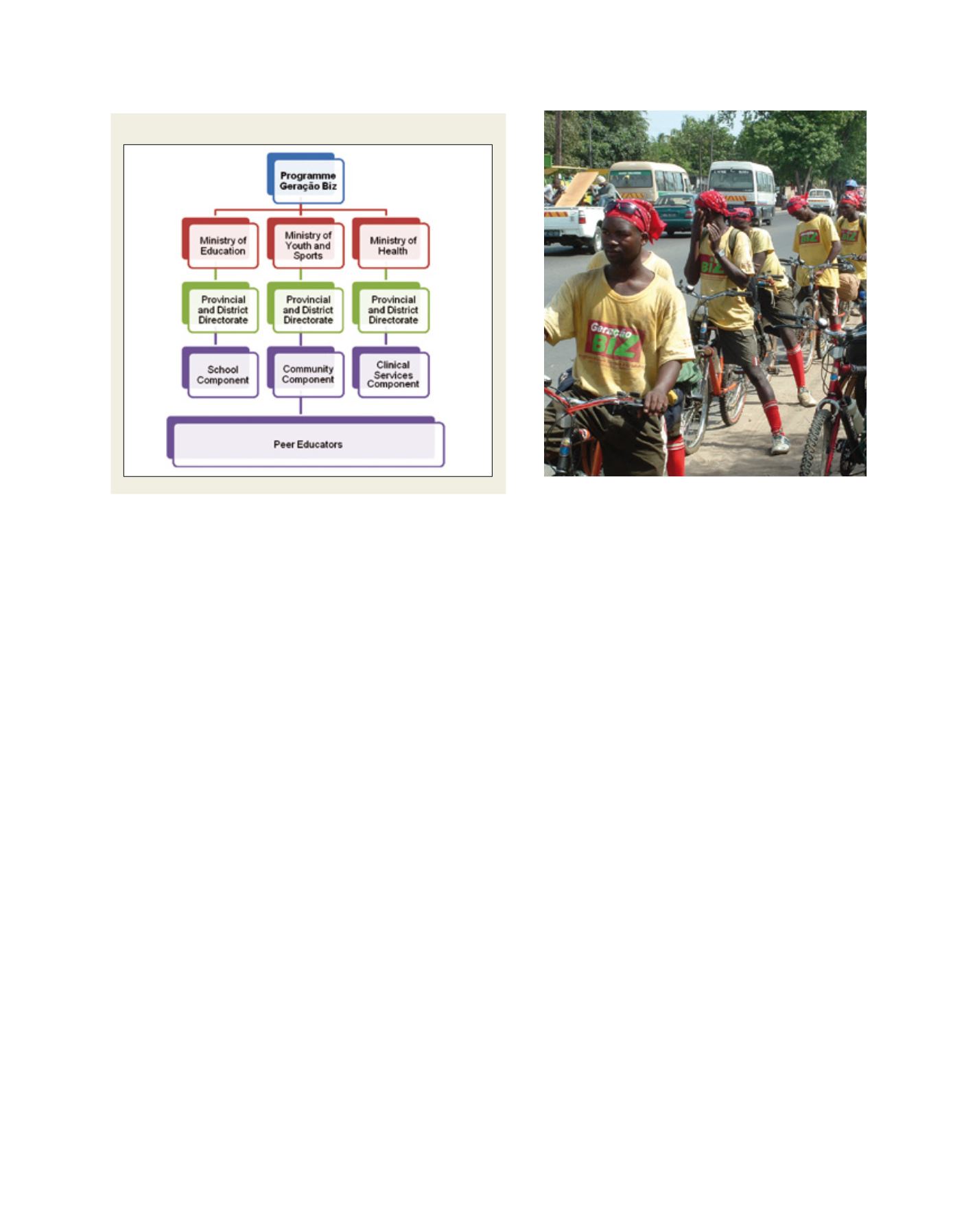
Programme Geração Biz - Structure
Source: BBC World Service Trust
World AIDS Day, 1 December 2007. Participants in a cycling event
from Niassa to Maputo to raise HIV awareness
Image: UNFPA, Mozambique