

 96 / 192

[
] 96
Changes
(2006 & 2007) published by the Institute in
collaboration with its international partners. These
volumes represent an interdisciplinary view of research-
ers from various countries on the theory and practice
of education and sustainable development, inspiring a
complementary approach and modelling the frame of
reference for implementation of the holistic concep-
tion of sustainability in education. In spring 2010 the
Institute established a new scientific journal,
Discourse
and Communication for Sustainable Education
(DCSE),
an international, peer-reviewed journal that provides
a forum for the examination of policies, theories and
practices related to discourse and communication for
sustainable education. The diversity of this journal is
apparent in the variety of its theories, methods and
approaches, and its avoidance of limitation to one
school, approach or academic branch. It welcomes
papers that explore inspirational ideas in sustainable
education and are written and presented in innovative
or experimental ways.
In 2005 the Institute established the Baltic and Black
Sea Circle Consortium in Educational Research (BBCC).
The consortium was created as a network for discourse
and communication in the international collaboration
regarding teacher education and research in education
for sustainable development. It unites teacher educa-
tion and educational research institutions, initially
drawn from the countries around and near the Baltic
Sea (Latvia, Lithuania, Estonia, Finland and Germany)
and the Black Sea (Hungary and Turkey). In 2005,
representatives of BBCC contributed their experience
to the ‘UNESCO Educational Sector Guidelines and
Recommendations for Reorienting Teacher Education
to Address Sustainability’, the preparation of which
common aim of sustainable development and to apply these insights
to enhance the dimension of sustainability in education. Orientation
towards sustainable development is compatible with the notion of
hope, which is a uniquely human capacity and emerges through
personally relevant experience as an orientation towards sustainable
goals in future aspirations.
The path chosen for the Institute’s development required a sound
scientific basis. For this reason, in 2002 the Institute established
the
Journal of Teacher Education and Training
. In time, the Journal
expanded its scope, gradually acquiring the dimension of education
for sustainable development, and in 2007 it adopted a firm focus on
sustainability in teacher education. Since 2007, the Journal has been
known as the
Journal of Teacher Education for Sustainability (JTEFS)
.
It has become a forum for the meeting of different views, ideas and
research to promote the further development of studies and practice
of teacher education in all areas of formal and non-formal education
in relation to sustainability. The articles published in JTEFS explore
the content and forms of professional and academic teacher educa-
tion, problems and tasks of teacher in-service education and other
issues to help teachers to become responsible mentors for sustain-
able development.
The editorial board of JTEFS unites more than 40 experts in the
field of teacher education and sustainability from such countries as
Latvia, Lithuania, Estonia, Finland, Norway, Germany, Hungary, the
Netherlands, Malta, USA, Canada, Brazil, Mexico, Costa Rica, Jamaica
and South Africa. Over the years, JTEFS has gained international
recognition and is now available in the electronic databases CABI
and SCOPUS and, since 2009, on the electronic platform VERSITA.
1
Presently JTEFS has positioned itself and become publicly known as
a scientific journal dedicated to the topic and mission of reorienting
teacher education to address sustainability.
More diverse scientific research and practical sustainability-related
experience has also been reflected in the two volumes of collected
articles
Education and Sustainable Development: First Steps Toward
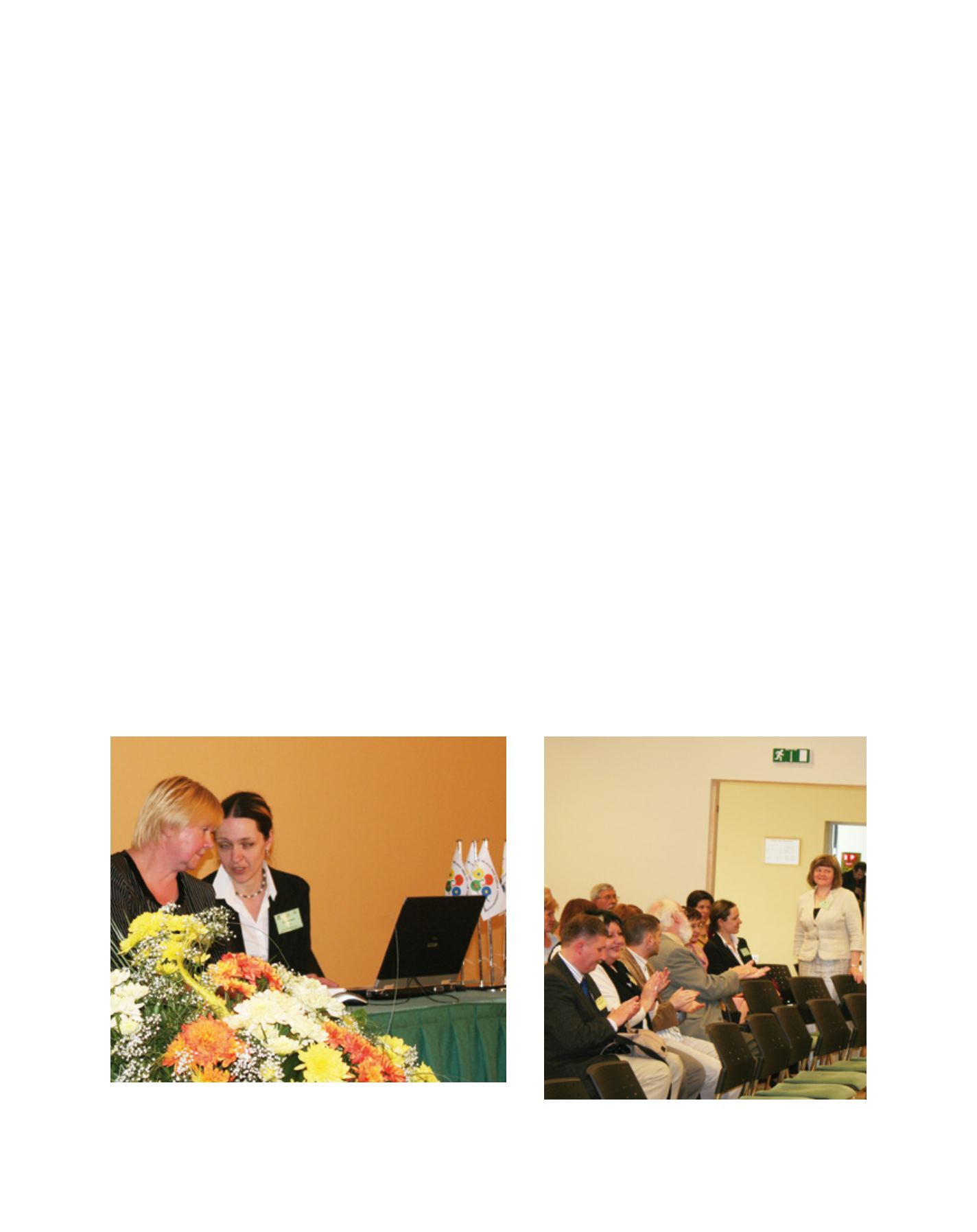
BBCC president Ilga Salite and ISE director Dzintra Iliško at the opening of the 7th
JTEFS/BBCC conference “Sustainable Development. Culture. Education”, 2009,
Daugavpils, Latvia
Welcoming Anita Pipere, the first editor of JTEFS journal, at the 7th
JTEFS/BBCC conference in Daugavpils
Images: © Inga Belousa