


 157 / 336

[
] 157
F
inancing
C
ooperation
to enable the commitment of donors and recipient countries
to achieving the MDG.
Therefore, on 22 October 2008, an agreement
was signed. Spain, through the Spanish Agency for
International Cooperation for Development (AECID),
and the IDB, through the Water and Sanitation Division,
agreed to work jointly to solve the region’s challenges
with regard to water and sanitation by means of the
FCAS in Latin America and the Caribbean (FECASALC)
Fund managed by the IDB. The agreement was signed
ventions and support processes to governments in the region in their
investment challenges and new opportunities.
5
The Water Fund: an example of cooperation
In 2007 a new stage of cooperation took place in the water and sanita-
tion sector in Latin America and the Caribbean, between the Spanish
Government and the IDB. The Spanish authorities created the US$1.5
billion Cooperation Fund for Water and Sanitation (FCAS), an unprec-
edented initiative in this region.
6
The Spanish Government and IDB
combined both their financial and technical capacities in a strategic vision
Paraguay
In the Republic of Paraguay poverty affects
almost 35.6 per cent of the population,
with 19.4 per cent in a situation of extreme
poverty. Poverty levels are related to low
levels of education and development, and
mostly to a lack of access to means of
production and basic social services such
as health, education and sanitation. Poverty
affects urban and rural areas equally, but
extreme poverty mainly affects rural areas,
where 24.4 per cent are in this situation.
Interventions
Two operations aim to increase access to
drinking water and sanitation, focusing on:
• rural and native communities with less
than 2,000 inhabitants (all provinces
except Neembucu and Misiones)
• indigenous and poor peoples of the
Chaco and intermediate cities of the
Oriental region.
They will be executed by the National Service
for Environmental Sanitation and the Ministry
of Public Works and Communications.
Milestones
Paraguay is one country where the Fund’s
comprehensive approach is having
more impact. In addition to the rural
and indigenous operation, a monitoring
system for rural systems has been
developed through mobile telephony.
One of the impact studies for measuring
the effect of water supply and sanitation
in rural systems is being carried out.
The other operation, conducted in
intermediate cities, will be executed
shortly. Here, the unconventional
sanitation model known as condominial
will be implemented, which has allowed
a 25 per cent increase in the number of
beneficiaries.
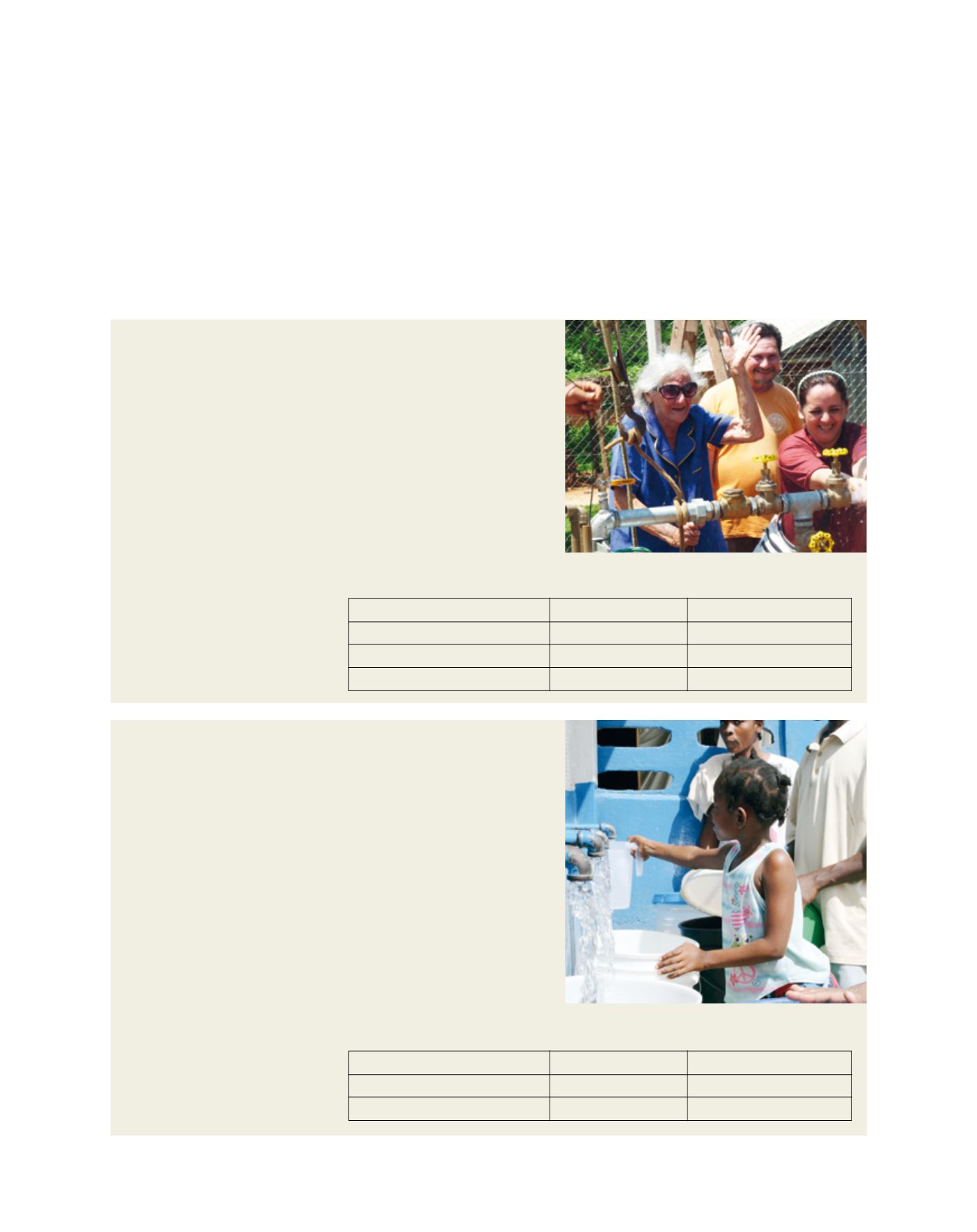
Funding (total US$148 m)
US$ (millions)
Per cent of total
Fund donation
100
67
IDB loan
32
21
Local contribution
16
12
Paraguay is one country where the Fund’s comprehensive
approach is having more impact
Image: IDB
Haiti
The level of access to drinking water and
sanitation services in Haiti is among the
lowest in Latin America and the Caribbean.
In general terms, the situation of Haiti’s
water and sanitation sector is alarming:
only 8.5 per cent of households are
connected to a water distribution system
and sanitation services are practically
non-existent, with only 30 per cent of the
population having access to them.
Interventions
Four operations are aimed at providing
drinking water and sanitation services:
• intervention in six intermediate cities:
Saint-Marc, Port-De Paix, Les Cayes,
Jacmel, Ouanaminthe and Cap-Haïtien
• strengthening of service provision capacity
of the Autonomous Metropolitan Drinking
Water Station of Port-au-Prince Central
• improving the quality of life and sanitary
conditions of the rural communities in
the department of Artibonite
• contributing to the Cholera Inter-Sector
Response Strategy adopted by the
Government with a view to reducing
morbidity and mortality.
These will be executed by the Direction
Nationale de l’Eau Potable et de
l’Assainissement.
Milestones
The strategy for Haiti has been conceived
from a comprehensive point of view. Apart
from working in rural areas, intermediate
cities and Port-au-Prince, great efforts
are being made towards reforming the
sector. This reform was described in Haiti’s
Framework Law on Drinking Water and
Sanitation, passed in 2009. It involves
sector restructuring at national level, which
is being conducted with the support of the
fund. In addition to bank-managed funds,
AECID has an additional US$100 million.
Haiti is one of the best examples of a
complementary and harmonized approach
to resources, where the interventions of
both IDB and AECID come together as one.
Funding (total US$119 m)
US$ (millions)
Per cent of total
Fund donation
70
58
IDB donation
49
42
Water and sanitation service provision capacity is being
strengthened in Port-au-Prince
Image: IDB