


 198 / 336

[
] 198
W
ater
C
ooperation
, S
ustainability
and
P
overty
E
radication
cal economy. In principle, water is a renewable resource, but there
are physical and ecological boundaries that limit its use. How we
make those choices depends on the institutional ‘setting’ for deci-
sion-making. For example:
• Who has power, and who has control over transboundary
water resources?
• Who is involved in decisions?
• Are these decisions transparent?
• Is there adequate information?
• Is there sufficient accountability?
Examples from different parts of the world illustrate that sustainable
water use has everything to do with the politics around distribution,
within and between countries. It is essential to involve all sectors
of society with a stake in shared water resources, and to develop
institutional capacity and a culture of cooperation well in advance
of costly, time-consuming crises which could threaten lives, regional
stability and ecosystem health. It can be done.
Take the Netherlands. Water has long constituted an integral part of
our spatial planning. Having the right amount of water for water users
at the right time, in the right place, and at socially acceptable costs is
one of the key targets. But being a delta country, transboundary coop-
eration was crucial too. In the twentieth century water quality became
a serious issue. Due to industrialization across Europe, the Netherlands
became the soakage pit of Europe. During the period 1973-75, at the
point where the Rhine flows into the Netherlands, the river carried an
average of 47 tons of mercury, 400 tons of arsenic, 130 tons of cadmium,
1,600 tons of lead, 1,500 tons of copper, 1,200 tons of zinc, 2,600 tons
of chromium, and 12 million tons of chlorides every year.
17
Clearly,
something had to be done. Decades of international cooperation and
the development of international rules with riparian countries upstream
for the protection of these shared resources followed.
18
Although it
took many years, the Rhine, Meuse and Schelde river basin countries
concluded treaties about the integrated management of these rivers.
We invested heavily in knowledge, learning by doing, and innovation.
The public and private sectors have joined forces with the knowledge
institutes to foster innovations. Now biodiversity in our rivers is thriv-
ing again, and these waters are safe for agricultural and
recreational use.
The Netherlands is committed to contributing to a
world where disputes over water are settled in consul-
tation with those concerned. Our long-lasting support
to river basin organizations and programmes directed at
transboundary management of river basins such as the
Nile, the Mekong and the Senegal rivers, are an example
of this commitment. By their transboundary nature, these
multi-country water resources represent regional public
goods that provide national water and food security, and
the protection of important international ecosystems.
The Netherlands development cooperation programme
further supports water programmes in Kenya, Ghana,
Benin, Mali, Ethiopia and South Sudan, in addition to
integrated delta management programmes in Egypt,
Indonesia, Bangladesh, Mozambique, and Viet Nam.
In March 2013 the Netherlands hosted the celebration
of World Water Day, as part of the United Nations as
the International Year of Water Cooperation. A strong
appeal was made to the world community to ensure
water security and a sustainable future for all. It was
recommended that water security should be established
as a sustainable development goal to which the world
will commit itself from 2015.
“Thousands have lived without love, not one without
water”, the poet W. H. Auden once famously said. Water
scarcity and poor water quality may in future devas-
tate the most sacred thing given to us: human life and
human dignity. Based on our history of integrated water
management, and our experience with risk assessments,
spatial planning, adaptation strategies (including water
safety, fresh water supply and developing resilient urban
areas) as well as international water governance, the
Netherlands stands ready to work in partnership with
other countries for a water secure world. Tomorrow’s
world demands nothing less.
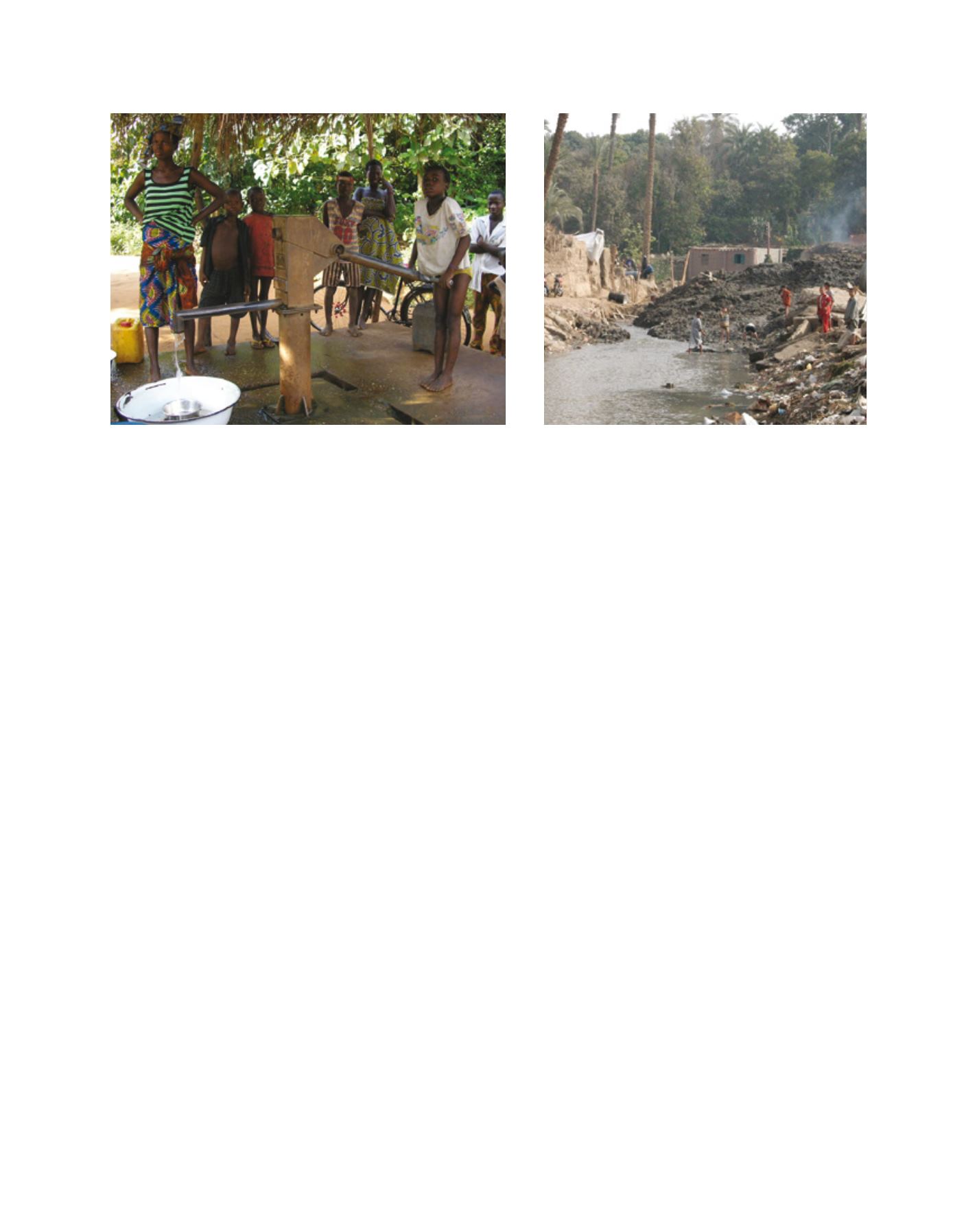
A local community in Eastern Province, Zambia benefitting from water cooperation
projects supported by the Netherlands
Water governance is essential when countering increasing pressure on
water resources. Children play alongside a polluted river in Egypt
Image: Rita Tesselaar
Image: Antonie de Kemp