


 219 / 336

[
] 219
W
ater
C
ooperation
, S
ustainability
and
P
overty
E
radication
The scaling-up of these innovations has been attempted
in countries like India, Vietnam, Thailand and China.
In India, the new model has been scaled up through a
Department for International Development-supported
Andhra Pradesh Rural Livelihood Project in the state
of Andhra Pradesh. This approach puts the people
living in the watershed at the centre of development
and involves not only soil and water conservation, but
also the efficient and sustainable use of resources to
improve the livelihoods of people including women
and the landless. In this programme, the scaling-up
approach has been extended to 50 watersheds (10
nucleus and 40 satellite) in three districts of Andhra
Pradesh. With support from the Sir Dorabji Tata Trust it
has been extended to nine districts of Madhya Pradesh
and seven districts in Rajasthan, India. Further, the
World Bank-assisted Sujala watersheds and Adarsha
watershed, Kothapally, have served as benchmark or
nucleus watersheds and demonstrated the benefits of
integrated watershed management. The technology
has been adopted in the watersheds of neighbouring
villages and other areas by farmers with little techni-
cal support from the consortium. This approach was
also implemented in China, Thailand and Vietnam with
support from the Asian Development Bank. The Bureau
of Agricultural Research in the Philippines is adopting a
similar approach for scaling-out the benefits of produc-
tivity enhancement in watersheds.
The recent comprehensive assessment of watershed
programmes in India
9
led by ICRISAT and its partners
has clearly shown the potential of these programmes
in the country, and the
new Common guidelines for
watershed management
10
have adopted this approach
for addressing natural resource management along
with improving livelihoods. Based on Sujala watershed
experiences, ICRISAT and the GoK have taken a knowl-
to the community. Soil health assessment, stress-tolerant high yielding
cultivars, water analysis and so on were used as an entry point for build-
ing a rapport with the community. Improved rainwater management
and harvesting resulted in increased efficiency in greenwater use as well
as augmenting water resources (ground and surface water) through
low-cost water harvesting structures.
Knowledge-sharing system
In the watershed, knowledge-based entry point activities have
enhanced the farmers’ capacity and improved their participation
in programme activities. Collective action in soil sampling, varietal
selection and water management has ensured the sustainability of
the system in the region. For example, the diagnostic farmers’ partic-
ipatory soil health assessment in the watershed revealed widespread
deficiencies of zinc, boron and sulphur in farmers’ fields which were
holding back the potential of rain-fed agriculture in the region.
8
Through the participatory approach nearly 100,000 soil samples
were collected across 30 districts of Karnataka in India under the
Bhoochetana initiative, and taluk-wise and crop-wise recommenda-
tions were developed based on the soil analysis for micro and macro
nutrients. This approach resulted in increased crop yields of 20-66
per cent over farmers’ management, and ensured an increased agri-
cultural growth rate for the state. Similarly, under a Government
of Karnataka (GoK) Sujala-ICRISAT initiative, farmers selected
improved varieties of ragi (finger millet) and groundnut along with
improved hybrids of maize, sunflower and soybean through partici-
patory varietal evaluation, and produced increased yields over their
varieties. The economic benefits of improved management practices
in crops varied from Rs6,300 ha
-1
in the case of finger millet to
Rs21,000 ha
-1
in the case of sunflowers.
Scaling-up process
The innovative integrated watershed management model has
demonstrated that with proper management of natural resources the
system’s productivity can be enhanced and poverty can be reduced
without causing further degradation of the natural resource base.
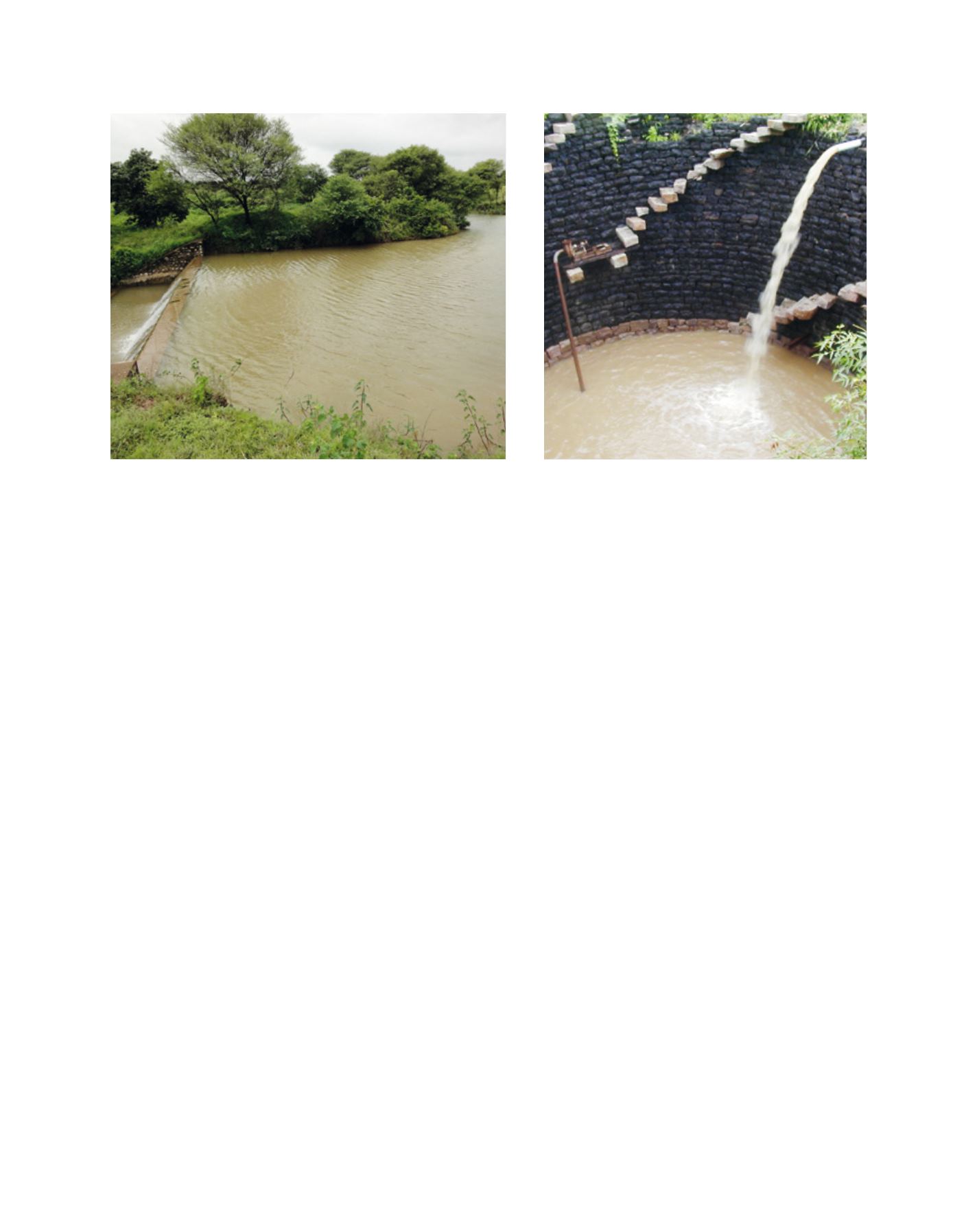
Efficient management of water resources is needed to ensure livelihood support
Image: ICRISAT
A drain diversion into a well
Image: ICRISAT