


 307 / 336

[
] 307
I
nternational
C
ooperation
on
W
ater
S
ciences
and
R
esearch
ment techniques resulted in the establishment, in 1964,
of the International Organization for Standardization
Technical Committee on Hydrometry – which has
since published over 70 international standards on
water measurement.
Viewed together, these technical, organizational
and political opportunities to further increase inter-
national cooperation on water data represent the
possibility of a step-change in freshwater information
sharing around the globe. If coupled with initiatives
to improve the underlying hydrological monitoring,
the availability of quantitative observation data to
support water science, management and policy devel-
opment can be greatly enhanced. The United Nations
International Year of Water Cooperation provides a
backdrop against which organizations, individual
nations and the international community must renew
and further support initiatives aimed at turning local
water data into global water information.
information also exist in the commercial sector. A recent report by
the World Business Council for Sustainable Development identified
the development and accessing of shared scientific data as key to
the implementation of catchment-scale water stewardship. Adopting
such an approach could provide significant commercial benefits to
businesses, including mitigation of risks to long-term water security
and opportunities for cost savings and revenue growth.
In tandem with policy development, another vital route towards
improving international cooperation lies in the sharing of knowledge
between hydrologists to build global monitoring capacity, develop
common understanding around data and provide mutual techni-
cal support. A wide range of initiatives are currently underway to
address the technical barriers to data exchange and harmonize data
practices and it is vital that these are supported both now and into
the future. For example, water data experts from around the world,
working under the umbrella of WMO and the Open Geospatial
Consortium, have come together to seek technical solutions to the
challenge of describing and exchanging surface and groundwater
data. Similarly, the need for harmonization of global water measure-
Case study: UNESCO FRIEND-Water European Water Archive
The UNESCO Flow Regimes from International Experimental and Network
Data (FRIEND-Water) programme
3
is a long-standing international
collaborative study in regional hydrology. One of the most successful
initiatives developed by UNESCO’s International Hydrological Programme
(IHP), FRIEND-Water has expanded from seven European countries in
1985 to encompass 162 countries in 2010. It supports a diverse body
of hydrological research around the globe, bringing up a new generation
of scientists working together and sharing data, scientific knowledge and
techniques across political borders.
A central feature of FRIEND-Water activities is scientific cooperation
in relation to sharing hydrological data for research purposes.
Through its eight regional groups, the programme has established
regional databases which have grown over the years and are regularly
updated in order to meet new research challenges. These hydrological
databases are a cornerstone for FRIEND-Water research activities.
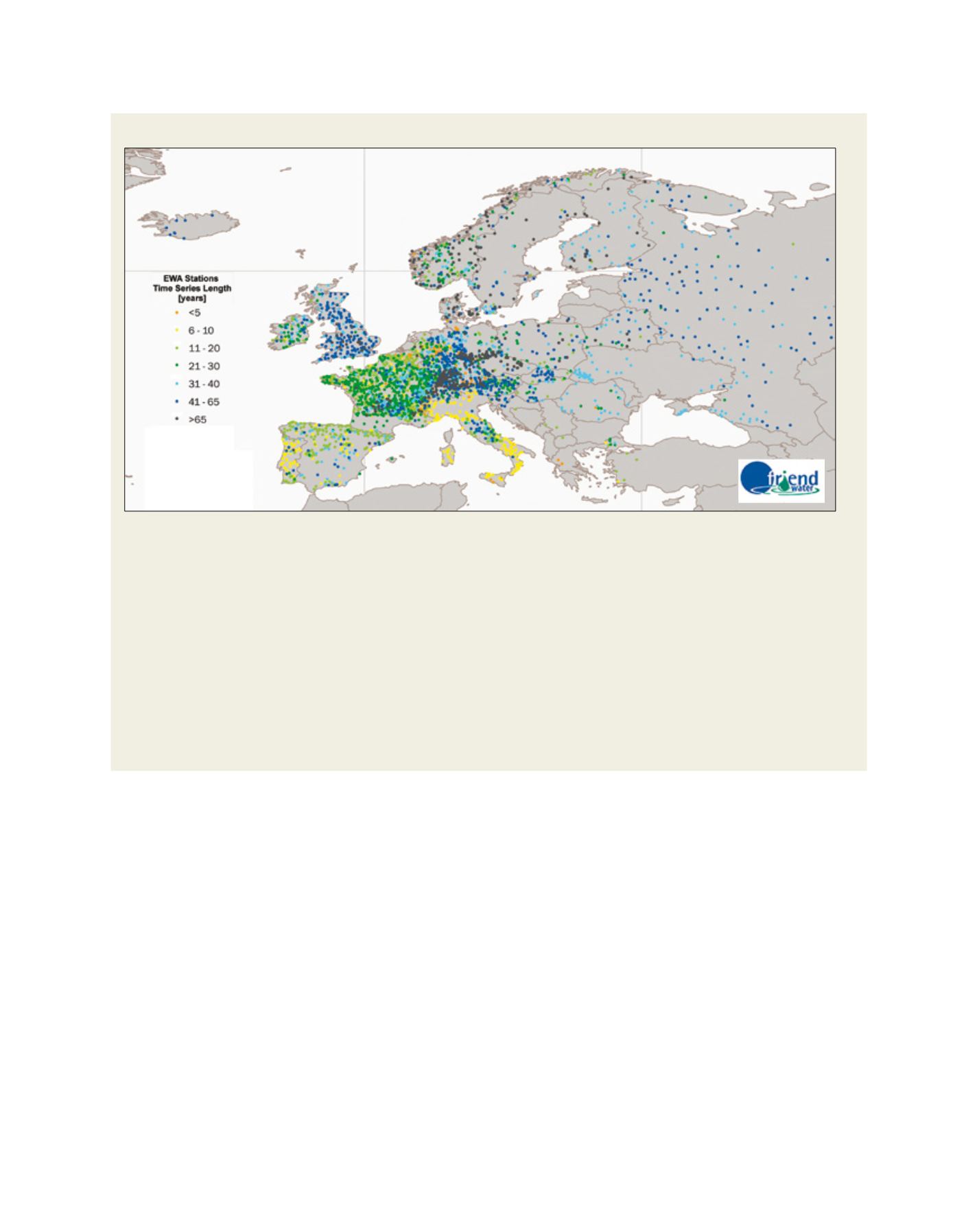
The European Water Archive (EWA) represents the central database for the
EURO-FRIEND-Water group and contains river flow records from over 4,000
monitoring stations across 30 countries. It has grown to become one of the
most comprehensive hydrological archives in Europe. Originally hosted by the
Centre for Ecology and Hydrology in the UK, five regional data centres were
established across Europe to assist in the acquisition of data for the FRIEND-
Water project. In 2004, maintenance of the EWA passed to the Global Runoff
Data Centre at the Federal Institute of Hydrology in Germany.
Data archived in the EWA have been supplied on a voluntary basis
and free of charge by hydrometric agencies across Europe. The EWA is
freely available for use by FRIEND-Water group members for research
purposes and now supports international research in fields such as low
flow and drought, large-scale hydrological variations, techniques for
extreme rainfall and flood run-off estimation, and catchment hydrological
and biogeochemical processes.
River flow monitoring stations for which data are included in the UNESCO IHP FRIEND-Water European Water Archive
Image: Global Runoff Data Centre