


 108 / 192

[
] 108
organizing seminars, hosting workshops for enhancing capacity for
professional peace building and by conducting research and education
(USM’s Research and Education for Peace Unit).
Sustainability infusion in curriculum, research and networking
In addition to promoting ongoing sustainability initiatives, Penang’s
Regional Centre of Expertise (RCE-Penang@usm) has been focusing
on a variety of new projects, such as:
7
White coffin campaign
This student-led, on-going initiative builds awareness regarding the
use of polystyrene-based food containers (‘white coffins’), the long-
term use of which is environmentally unsustainable and may cause
cancer. This programme has successfully discontinued the use of
polystyrene and reduced the use of plastics on campus, and has been
emulated in six other local universities.
Sustainable Penang initiative
USM works closely with other community organisations such as the
Socio-Economic and Environmental Research Institute on issues such
as urban development, heritage conservation and sustainable living.
‘Wormi-Compost’ project
Using technology enhanced by USM researchers, this successful
community-based project utilizes waste from rice paddies, cow dung
and other biodegradable village waste to produce quality compost
which is then either sold or used as manure for organic farming,
resulting in increased income generation.
ProSPER.Netprojects
RCE-Penang leads two major international projects in collaboration
with the ‘Promotion of Sustainability in Postgraduate Education and
Research Network’ of UNU-IAS.
(i) Development of generic modules and training materials for
sustainability
: given that the focus and emphasis of sustainabil-
ity may differ from place to place, the purpose of this project is
to research and develop generic training modules for
ProSPER.Netmembers. USM is collaborating with 18 other universities to develop
a generic module entitled
Education for Sustainable Development:
Issues and Practices for Global Application
s. The module is currently
being refined through pilot tests to ensure its wider applicability.
(ii) Alternative university appraisal project
: USM has
initiated an alternative ‘rating’ system for universities,
which is being tested in Malaysia and four neighbouring
countries. This scheme places equal importance on quan-
titative key performance indicators and key intangible
performance indicators. USM is also involved in a similar
but larger project, ‘alternate university appraisal’, which
is part of the
ProSPER.Netprogramme. This assess-
ment is based mainly on a self-awareness questionnaire,
which seeks information on ESD activities in the areas
of governance, education, research and consultancy,
outreach and transformation.
USM as an accelerated programme for excellence
Since 2008, USM has embarked on a number of new
initiatives and activities, including:
Blue Ocean Strategy
USM believes science, technology and innovation
are instrumental in promoting sustainability. Such
approaches have been part of advancing human civili-
zation throughout history. Therefore, USM has adopted
the Blue Ocean Strategy to “realign itself in the trans-
formation process to move into unchartered space and
untapped markets” by focusing on radical resource
efficiency, renewable energy, whole system design,
industrial ecology, nanotechnology, bio-innovation,
poverty alleviation and peaceful coexistence.
8
University capacity-building
In 2009, USM developed a sustainability roadmap
9
to
build capacity at individual, institutional and systemic
levels to produce graduates who are equipped to address
the sustainability challenges facing their communities and
the world at large. The roadmap focuses primarily on the
UN-publicized sectors of water, energy, health, agricul-
ture and biodiversity (WEHAB). Three very closely-related
cross-sector issues are also given careful consideration:
climate change and disaster risk management, population
and poverty, and production and consumption issues.
10
USM’s new Masters in Development Practice (MDP),
to be introduced in 2011, will feature this integrated
approach to sustainability capacity-building. The roadmap
also suggests developing hands-on piloting and proto-
typing experiences for students and staff alike to ‘walk
the talk’ of living sustainably. These experiences could
include energy and water conservation, campus ecosystem
management and community outreach to villages, indus-
try, NGOs and policymakers. For example, USM’s Centre
for Global Sustainability Studies recently submitted a
policy brief on sustainability to the Malaysian government.
Centre for Global Sustainability Studies (CGSS)
Even with good intentions, a situation can arise where
sustainability promotion is seen as in everybody’s interest,
but as nobody’s responsibility. USM’s CGSS was estab-
lished in 2009 to circumvent this hurdle. The centre works
with all other sections of the university and its stakehold-
ers to promote sustainable development, paying particular
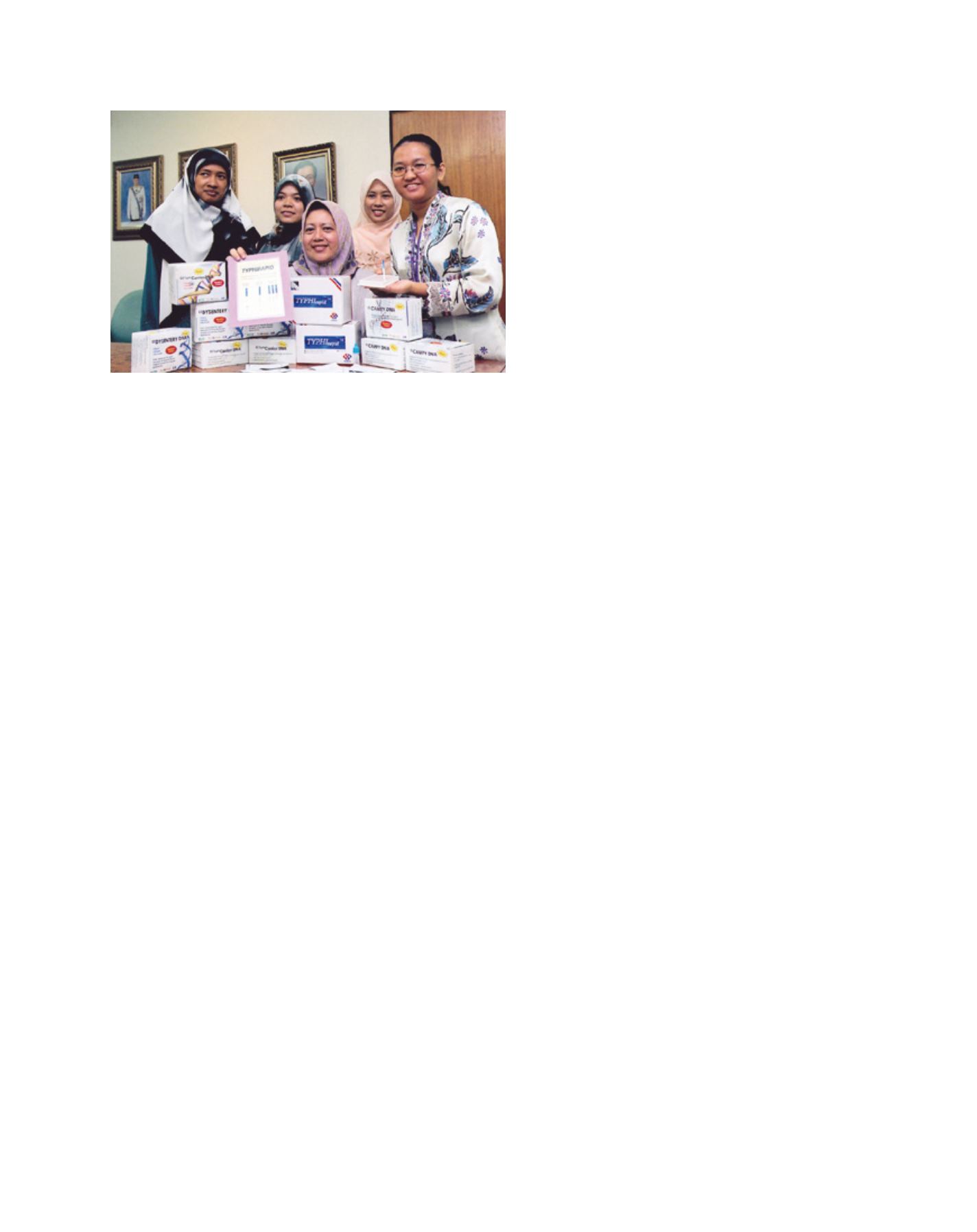
A very successful medical innovation that has grassroots applications
Image: USM