


 28 / 288

[
] 29
A
griculture
the East India Plateau are among the poorest in India.
Traditional farming practices are based around the
annual monsoon, with rice crops planted to coincide
with those rains. The rice is harvested from farms less
than 1 hectare in size on low-lying land.
Most families are faced with not growing enough
food, and it is common practice for men to emigrate in
search of seasonal work to supplement meagre incomes.
Women are left to undertake the roles done by men, but
they lack support and resources, especially labour and
access to technical know-how.
One place where technical know-how exists is the
rural development organization, Professional Assistance
for Development Action (PRADAN), which had trialled
water-harvesting technology to capture run-off and tap
shallow underground water sources. Such technology
can be very effective in areas with high seasonal rainfall,
such as those that experience the monsoon season.
The difficulty for farmers of the East India Plateau
is that enough rain falls for two rice crops, but almost
all that rain falls in one concentrated period. Water-
harvesting technologies present an opportunity to
extend the benefits of that rainfall across a much longer
period of the year.
ACIAR developed a project linking scientists from
the University of Western Sydney and the Australian
National University with the Indian Council for
Agricultural Research’s Research Complex for Eastern
Region and PRADAN.
The aim of the project was to test the PRADAN water-
harvesting technology – a network of storage pits in the
uplands with channels to funnel water to those pits,
allowing increased infiltration of monsoonal rain that
could be accessed later using seepage tanks in low-lying
areas near villages. PRADAN also worked with villag-
ers to ensure local participation, using participatory
methods to ask farmers, particularly women, to identify
research questions and carry out field trials.
In the village of Pogro a village core committee
(VCC), comprising self-help group representatives,
was established to improve project implementation and
build social capacity, shifting ownership, responsibility
and control to the villagers. The model helped women
in the village lead changes, such as managing weeds
through planting techniques, to support the water-
harvesting network. The VCC oversaw (with project
support) the initial implementation of the watershed
development plan, along with the introduction of
improved rice varieties that mature faster, allowing a
second crop, such as mustard or wheat, to be planted
in rice paddies.
The results have included dietary improvements and
additional income. This has allowed some Pogro villag-
ers to own houses and livestock for the first time and
to spend money on educational materials and books for
their children. Perhaps the most important change is
the strengthening of family units, as the ability to gener-
ate income in the village is helping prevent the seasonal
exodus of men in search of work.
nered with the Philippine Institute for Development Studies and
Visayas State University, to identify ways to better link the climate
science with the community.
A typical case study in the Philippines involved corn farmers in
the Visayas region. Team members compiled a brief description of
dominant cropping patterns and corn production practices in the
study area, then reviewed and presented a valuation framework for
estimating the economic benefits of SCF information under various
assumptions of risks and uncertainty. Their task was then to quan-
tify the potential economic value of SCFs to corn farmers in Leyte.
These data, along with the findings of another study of corn farmers
in Isabela, helped them to draw up policy implications on the useful-
ness of SCFs to corn farmers throughout the Philippines.
Surveys showed that farmers had a high degree of concern about
climate risk and were well aware of El Niño, but they only made
moderate use of the information in decision-making. As part of the
project, the team refined an Excel-based game that allows participants
to work out the best decisions for their situations, based on forecasts
that are more than guesswork, but fall short of perfect information.
Water harvesting
In India, research has helped communities to harvest water and use
this harvest to produce better returns. Farmers working land on
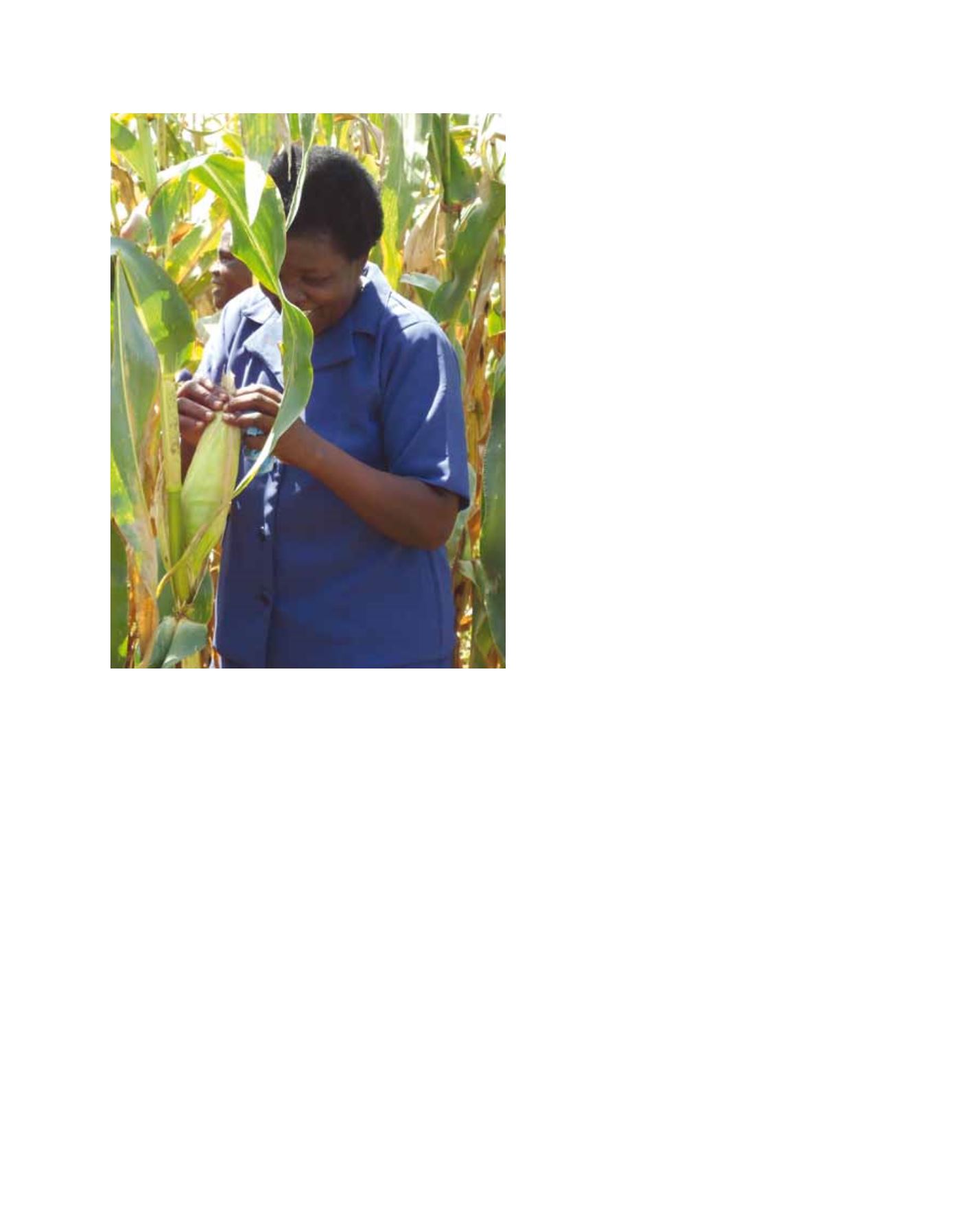
Women from the Liganwa farmers’ group in Siaya, Western Kenya, celebrating their
maize harvest
Image: Tesfaye Legesse