



 98 / 288

[
] 99
W
ater
precipitation and an increase in winter precipitation in most areas
are to be expected. While winter variability increases significantly,
there are no clear trends for spring and autumn. In the future,
more extreme events such as torrential precipitation events and
widespread drying are to be expected, the latter mainly in Southern
and Eastern parts of the DRB.
Extreme weather events
The simulations show for the DRB a future increase in intensity and
frequency of dry spells, hot days and heat waves as well as increases
in heavy rainfall, but the latter is uncertain in spatial and temporal
allocation. Due to the warming trend fewer frost days are probable
in winter. Whilst for the Upper Basin a general increased risk of
storm-related heavy precipitation with high wind speeds is assumed,
for the Middle Basin the amount of extreme precipitation days are
expected to increase in winter and decrease in summer.
Water-related impacts
The Danube study considers several climate change impacts on
water-related issues and possible adaptation measures. This includes
impacts on water availability, supply and demand, groundwater,
snow cover and runoff as well as impacts on different water uses,
which encompasses agriculture, irrigation, forestry, land use, soils,
biodiversity and ecosystems, limnology and water-related energy
production, navigation, health and tourism.
Basically, the impacts on water-related sectors are triggered
by temperature and precipitation changes. The main impacts in
connection with water management are the availability of water,
extreme hydrological events, the quality of water and impacts which
affect the water user sectors. Temperature and precipitation changes
may cause reduction in water availability, groundwa-
ter recharge and decreases in snow and glacier ice
storage and soil water content. Furthermore, changes
in seasonal runoff regimes, with a likely decrease in
summer and increase in winter, are triggered by changes
in rainfall distribution and evapotranspiration, as well
as reduced snow storage. Increasing water tempera-
ture may also cause greater pressures on water quality.
No clear picture can be provided on changes in flood
magnitudes and frequencies, but more intense, longer
and more frequent droughts, low flow and water scar-
city situations are expected.
All these impacts can cause changes in ecosys-
tems and biodiversity with shifts of the aquatic and
terrestrial flora and fauna. Regarding water users,
climate-related increases in water demand of house-
holds, industry and agriculture are expected, causing
higher water stress in water-dependent sectors such
as agriculture (irrigation), forestry, navigation and
water-related energy production. But positive effects
on different sectors were also observed, like the reduc-
tion of ice days on rivers or longer vegetation periods.
Despite the uncertainties in climate change impacts,
which are specifically addressed in the Danube study,
possible adaptation measures are introduced for each
impact area. In order to avoid regrettable adaptation
activities, these measures are focused on win-win and
no-regret options, because measures of these catego-
ries minimize climate risks but also have other social,
environmental or economic benefits.
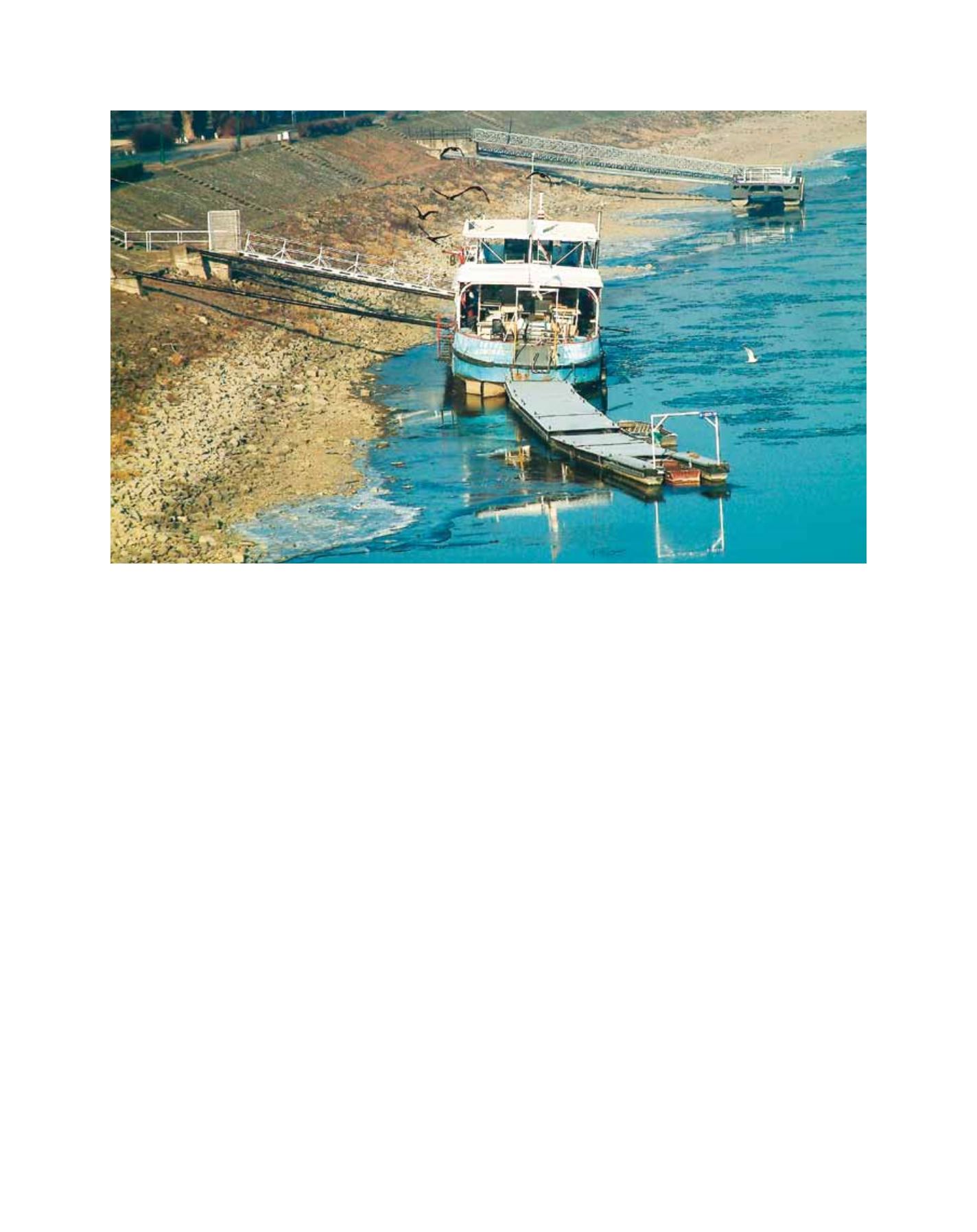
More intensive and frequent dry spells are expected to cause negative impacts on different water-related sectors, like inland navigation
Image: ADU-NeKI, Hungary