



 81 / 218

[
] 81
change in improving air quality in their communities. Similar
activities are taking place across the border in the United States.
Epidemic malaria in Africa
It is now widely recognized that malaria is a major constraint
to both socio-economic development
5
and the MDGs
6
in Africa,
where there are an estimated 90 per cent of all malaria deaths,
and immeasurable sickness occurs.
7
Approximately 500 million
Africans live in regions endemic to malaria. Endemic malaria is
highly correlated with climate in terms of its spatial distribution
and its seasonality. A further 125 million Africans live in regions
prone to epidemic malaria, which is again highly correlated
with climate, but in this case, with climate anomalies.
8
Significant resources are now being made available to control
malaria in African countries through the Global Fund for AIDS,
TB and Malaria. It is considered that climate information could
be used to help focus these resources more effectively. While
significant gaps have been identified between climate services
and end-users in Africa,
9
a number of African countries seek to
use climate information as part of integrated epidemic early
warning and response systems. The most advanced example can
be found in Botswana where the National Malaria Control
Program uses tailored seasonal climate forecasts
10
and weather
scale information
11
received through the National Meteorological
Services as part of an effective Malaria Early Warning System.
Botswana’s example is being promoted by WHO to encourage
other African countries to follow suit.
12
However, if such initiatives are to perform at the scale
required, significant interdisciplinary collaboration is essen-
tial. Training must be provided, and mechanisms developed
across disciplines, to address socio-economic vulnerability to
severe disease outcomes.
This demand asserts the importance of evidence in effective
policy making while placing climate in a broader context as
one amongst several imperatives. If evidence is to have a
greater impact on policy and practice, four key requirements
are necessary:
• Agreement on the nature of acceptable evidence
• A strategic approach to evidence creation, together with
the development of a cumulative knowledge base
• Effective dissemination and access to knowledge
• Initiatives to increase the uptake of evidence in both policy
and practice.
Improving routine health surveillance is clearly one essential
component of this strategic approach, but more effective part-
nerships need to be developed to integrate the climate factor
effectively. The following three diverse examples illustrate this.
Heat stress in Europe
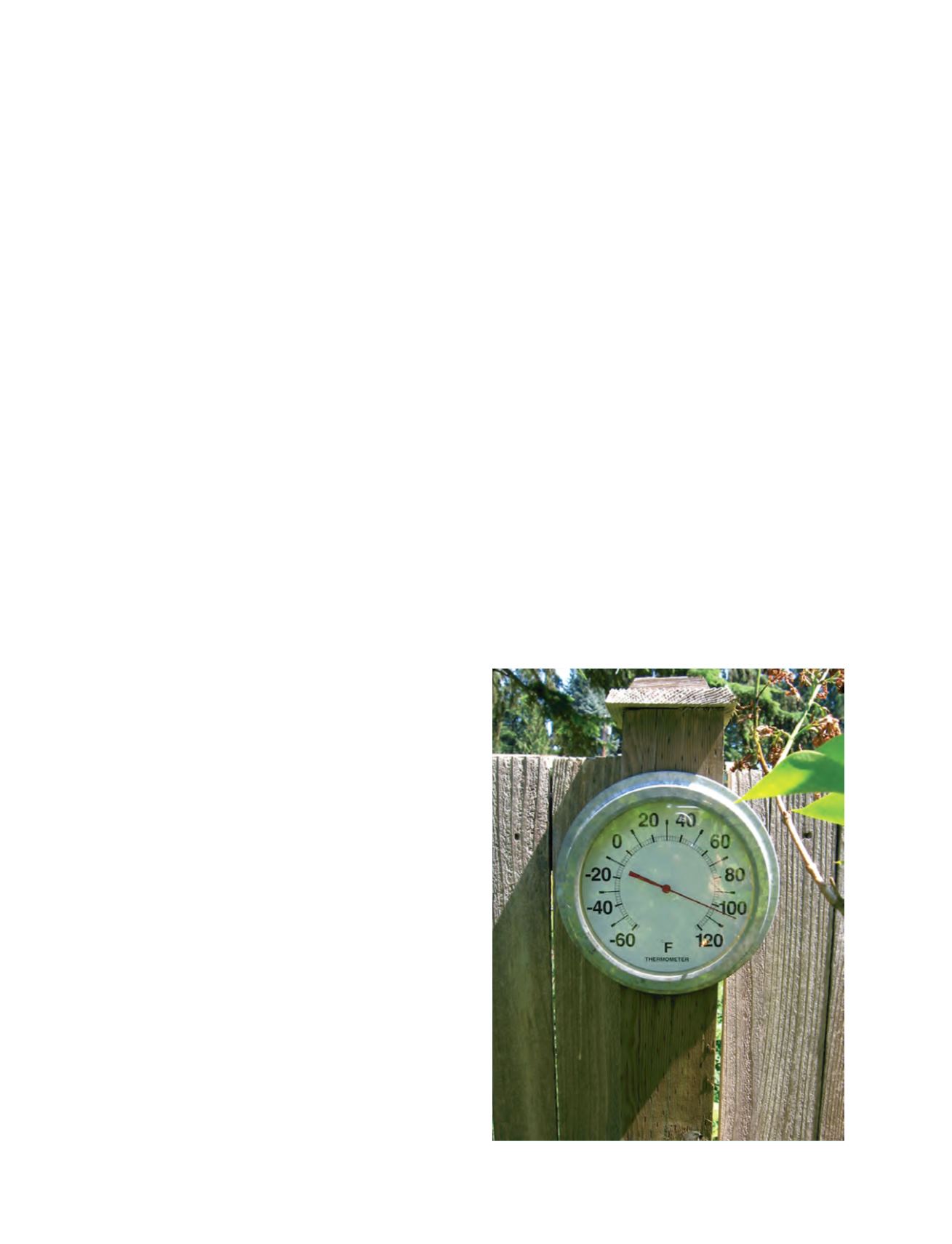
The European heat wave during the summer of 2003 is asso-
ciated with an estimated 40,000 excess deaths, with 15,000 of
these deaths occurring in France alone. Since then, the
European Office of WHO, with funding from the European
Union (Euro-Heat), has joined research institutions, health-
care providers and many of the National Meteorological
Services in studies to establish the factors and mechanisms
responsible for these deaths. This information is then used to
set up early warning systems to increase public awareness and
to reduce vulnerability and associated risk.
3
The socio-economic factors implicated with heightened risk
and vulnerability are complex but include age, existing medical
conditions, poor levels of physical fitness, urban residence and
poor ventilation. The climatic factors involved focus largely
on the stability and persistence of elevated temperatures, rela-
tive humidity and cloud cover, where these create a high local
heat stress index.
Meteo-France, a Euro-Heat partner, recently declared July
2006 as the warmest on record. Yet preliminary figures suggest
that heat-related deaths in France number only a few hundred,
and for Europe a few thousand. While this is extremely good
news, and suggests that early warning systems are working
well, the importance of socio-economic factors vis-à-vis
climatic factors is yet to be clearly understood.
Respiratory disease in North America
There are numerous studies linking atmospheric air quality,
airborne particulate matter (airborne PM: particulate matter less
than 10 micrometres in size), aggravated cardiac and respiratory
diseases (such as asthma, bronchitis and emphysema) and various
forms of heart disease. A strong correlation exists between high
levels of airborne PM and increases in emergency room visits,
hospital admissions and fatalities. Children, the elderly and
people with respiratory disorders are particularly susceptible.
The Canadian Meteorological Service produces a daily air
quality forecast. Air quality is expressed using an Air Quality
Index (AQI).
4
Air Quality Advisories are issued when the air
pollution levels exceed national standards. They are issued in
partnership with provincial and municipal environment and
health authorities and contain advice on action that can be
taken to protect health and the environment. A cornerstone of
this process is the development of relevant and timely health
messages that allow Canadians to safeguard their own health,
as well as the health of those in their care, and to motivate
Photo: Christopher Phelps