



 83 / 218

[
] 83
Public and preventive health strategies that consider envi-
ronmental health interventions are often cost-effective and yield
benefits that contribute to the overall well-being of communi-
ties. Respiratory health improves when air quality improves as
has been shown by many intervention studies. Examples
include industrial plant shutdowns and lowering of fuel sulphur
content. The Olympic games are usually a great incentive for
improving air quality. For instance, during the summer 1996
games in Atlanta implementation of an alternative transport
strategy resulted in lower traffic emissions. Hospital admissions
of children with acute asthmatic symptoms fell by 41.6 per cent
during the period of the games.
7
More recently, Beijing has
conducted some of China’s most ambitious environmental
actions, including controls on emissions, adopting alternative
fuel use, and relocating heavily polluting plants outside of
Beijing. The importance of regional air quality has also been
recognized and possible measures are being considered.
Excessive UV radiation is harmful to humans, as well as flora
and fauna. Reporting of a UV index, a service that is provided
by many National Meteorological and Hydrological Services
(NMHS), may initiate preventive measures against conditions
that can cause skin cancer, certain types of cataracts and
immune system suppression.
8
Tourism can suffer significant economic impacts from
increased air pollution and reduced visibility. Environment
Canada surveyed tourists in the Greater Vancouver area regard-
ing poor visibility and found that for a single extreme visibility
event, a loss of USD7.45 million in tourist revenue was
predicted.
9
Evidently, these losses can seriously threaten
regional economies that rely heavily on tourism.
Biomass burning is a major contributor of gaseous and
particulate air pollutants in many parts of the world. As a
consequence it has a severe effect on the health of the popula-
tion, civil aviation operations, maritime shipping, agricultural
production, and the tourist industry. Southeast Asia witnessed
one of the worst smoke and haze episodes in autumn 1997,
with estimated economic losses at USD 9.3 billion.
10
Air quality services
Amongst other services, NMHSs, working alone or together
with environmental agencies, issue AQIs giving details of daily
air quality, as well as air quality forecasts (AQF) in a simple and
instructive manner. These are designed to enable the general
public and authorities to take appropriate measures both in
immediate and future actions, thus counter-acting the negative
effects as far as possible.
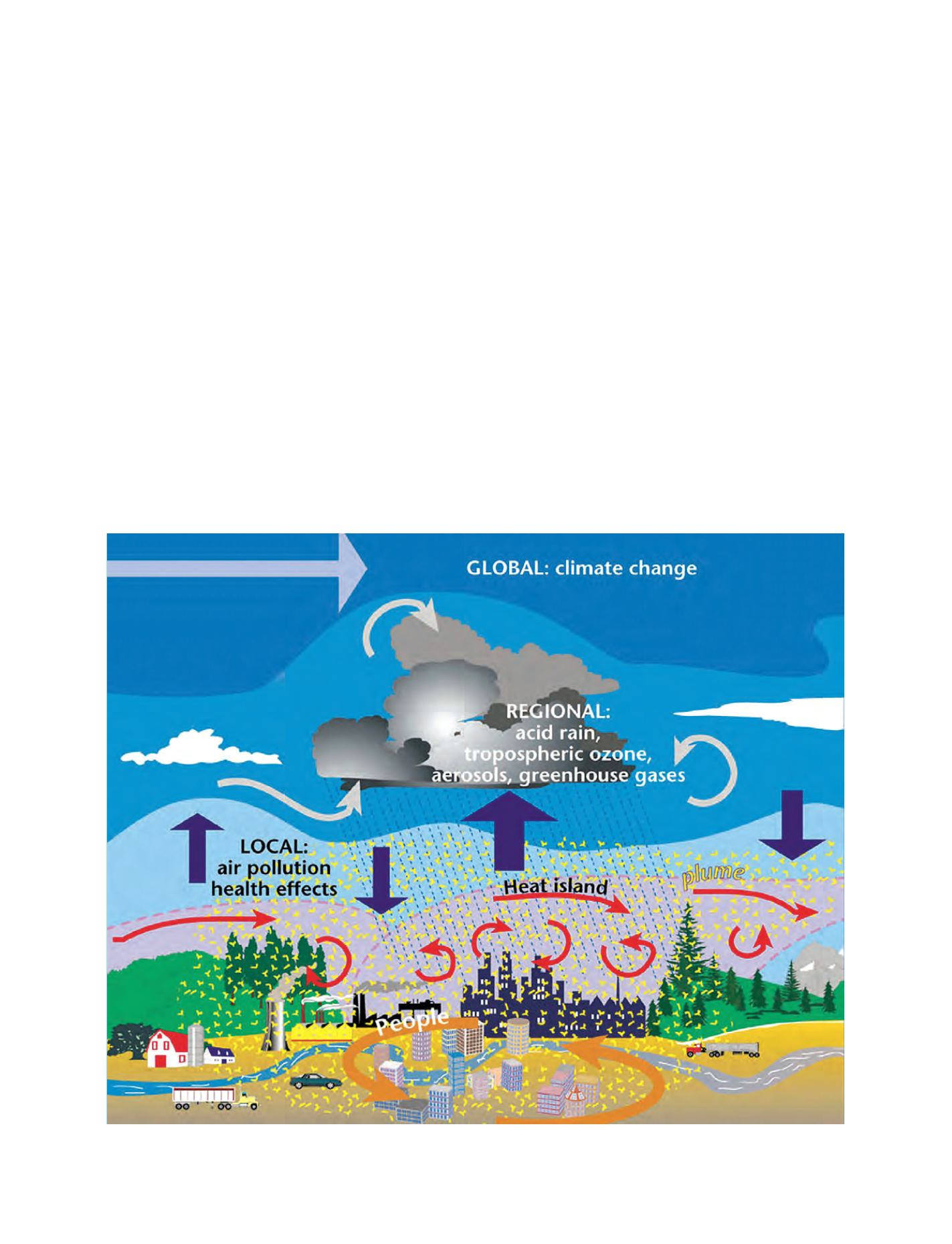
WMO addresses air pollution problems on all scales
Source: GURME (GAW Urban Research Meteorology and Environment project)