



 87 / 218

[
] 87
I
T IS KNOWN
that meteorological conditions, and climate in
general affect human health. The effects can be direct, such
as through increased heat stress and loss of life in floods
and storms, or indirect through alterations in the range of
diseases as well as food availability and quality.
Thus, it is becoming increasingly important, taking into
account global warming, that health and meteorological
authorities form a close partnership and cooperate in order to
mitigate the impact of meteorological conditions on human
health.
Such cooperation began in Portugal in 1999 between the
Portuguese Institute of Meteorology and the Portuguese Health
Institute, with the aim of creating an operational watch
warning system on heat waves with effect on mortality.
The occurrence of heat waves is recognized as a danger to
public health,
1
since it is a phenomenon causally associated
with avoidable excess mortality. Still fresh in our minds is the
European heat wave of 2003, which is estimated to have caused
approximately 50,000 excess deaths.
2
Whilst the impact of
heat waves on human mortality rate is widely established, there
are also causal links to disease, and excess strain to health care
services.
3
During the heat wave of 1980, average daily temperatures in
Memphis, USA, rose above the mean on 25 June and remained
elevated for 26 consecutive days. During the July period 83
heat-related deaths were recorded, most of which involved
elderly, poor, black inner-city residents.
4
A heat wave occurred in July 1988 in Allegheny County,
USA, with daily maximum temperatures near or above 90
degrees Fahrenheit for 15 consecutive days.
5
During that
period there were a total of 694 related deaths in the county,
with the most affected being persons over 65 years old.
In July and August of 1995, during a heat wave in England
and Wales, 619 extra deaths were estimated relative to the
expected number of deaths based on the 31-day moving
average for that period. Excess deaths were apparent in all age
groups, most noticeably in women and for respiratory and cere-
brovascular disease.
6
The watch warning system on
heat waves with effect on mortality
Eleonora Paixão, Paulo Nogueira and José Marinho Falcão, Instituto Nacional de Saúde
Dr. Ricardo Jorge, Observatório Nacional de Saúde, Portugal
Fátima Espírito Santo, João Ferreira and Teresa Abrantes, Instituto de Meteorologia, Portugal
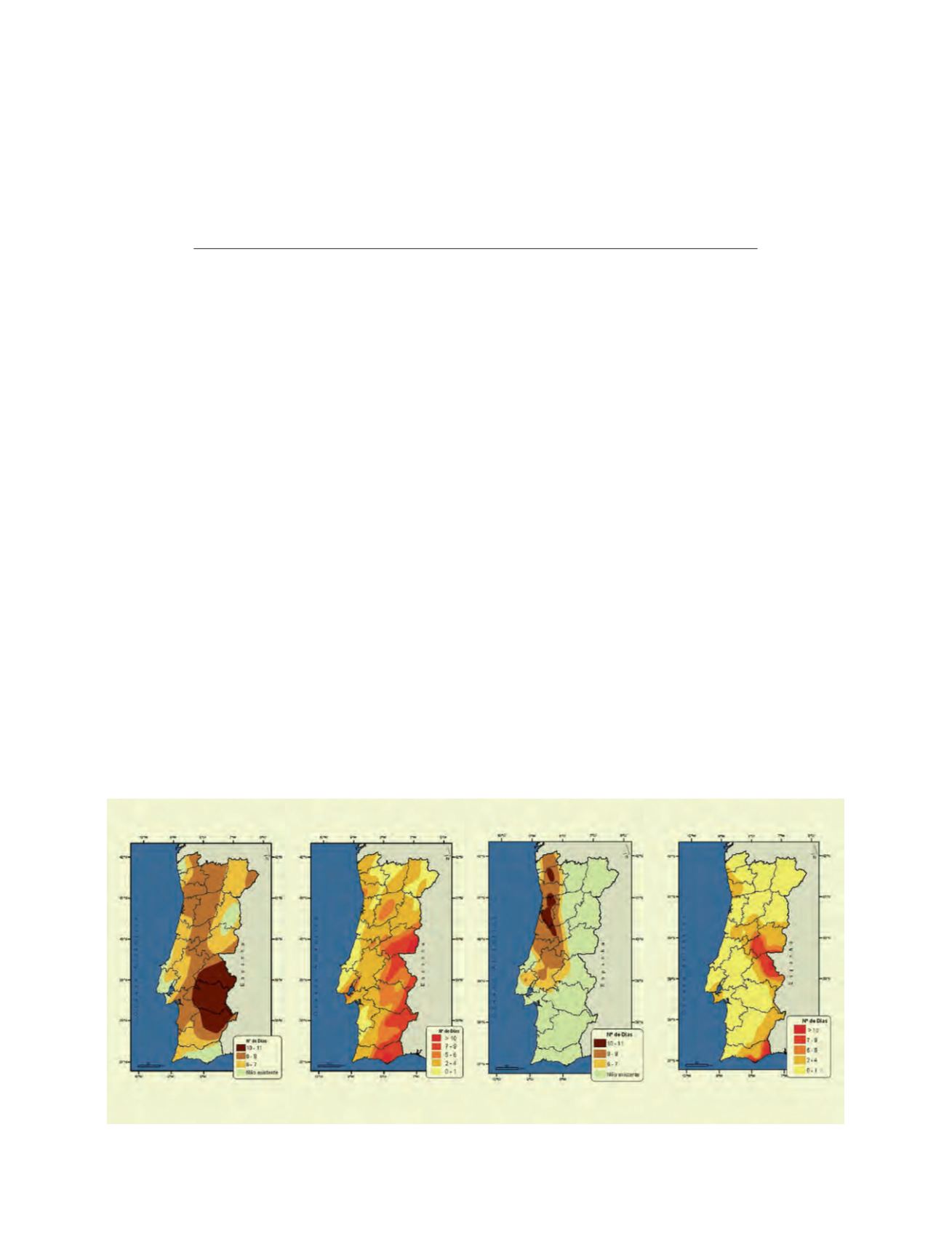
Source: IM Portugal
Heat Wave Duration Index (left), number of consecutive tropical nights (Tn
≥
20°C) (second left),
7-18 July 2006 – (third left), and 1-14 August 2006 – (right)