



 90 / 218

[
] 90
P
ROJECTIONS FOR GLOBAL
population growth indicate that
cities will continue to grow rapidly at the expense of
rural areas, much as they have since the mid-1980s.
Urban growth will continue in both developed and develop-
ing regions. At the same time, there is strong empirical
evidence that our climate is changing – in large part as a conse-
quence of anthropogenic emissions of radiatively important
trace gases (RITG). Computer model projections indicate that
these changes are likely to continue for the foreseeable future,
pending significant reductions in anthropogenic emissions.
Changes in climate will be accompanied by changes in weather,
and there are indications that some climate-induced weather
changes may already be happening.
In the face of these predicted changes in population, climate
and weather, short-range weather forecasts and predictions will
be even more important in the future than they are today.
However, urban forecasts and warnings still depend on obser-
vations and data from a synoptic observation system that was
designed decades ago, and which cannot provide the precise,
high-resolution weather predictions needed in the cities of
today and tomorrow. The implications for public safety of this
impending ‘perfect storm’ can be met by the implementation
of advanced regional atmospheric observation systems that
facilitate markedly improved warnings, forecasts and predic-
tions of hazardous weather. The onus for this rests on National
Meteorological Services, non-governmental organizations and
private industry.
The population challenge
The United Nations Population Division (UNPD)
1
prepared
estimates and projections of urban and rural populations for
major areas, regions and countries of the world for the period
1950-2030. By the end of that period, the world’s number of
urban dwellers is expected to equal the number of rural
dwellers in the current year, 2007. In 1950, only 30 per cent
of the world’s population lived in urban areas, but this had
increased to 47 per cent by 2000. According to the UNDP
report, the world’s urban population reached 2.9 billion in 2000
and is expected to rise to 5 billion by 2030, when the urban
proportion will reach 60 per cent. Virtually all the world’s
population growth between 2000 and 2030 is expected to
occur in urban areas, and almost all of this expected urban
population increase will occur in less developed regions, whose
population is likely to rise from approximately 2 billion in 2000
to just under 4 billion in 2030.
In more developed regions, the urban population is expected
to increase slowly, from 0.9 billion in 2000 to 1 billion in 2030.
In these regions urbanization is already very advanced – 75 per
cent of the population lived in urban areas in 2000. The concen-
tration of population in the cities of the more developed
countries is expected to increase further so that 83 per cent of
the inhabitants will be urban dwellers by 2030.
By 2030, the urban population percentage in less developed
regions is expected to rise substantially to 56 per cent. The less
developed regions will reach a level of urbanization in 2030
that is similar to that of the more developed regions in 1950.
Table 1 summarizes various indicators of urbanization for the
more- and less-developed regions of the world. Compared to
1950, the percentage of the world’s total urban population is
projected to have doubled by 2030, and it will have more than
tripled in the less developed regions.
Improved weather-related services
in cities in the face of climate,
weather and population changes
Dr Walter F. Dabberdt, Vaisala, USA
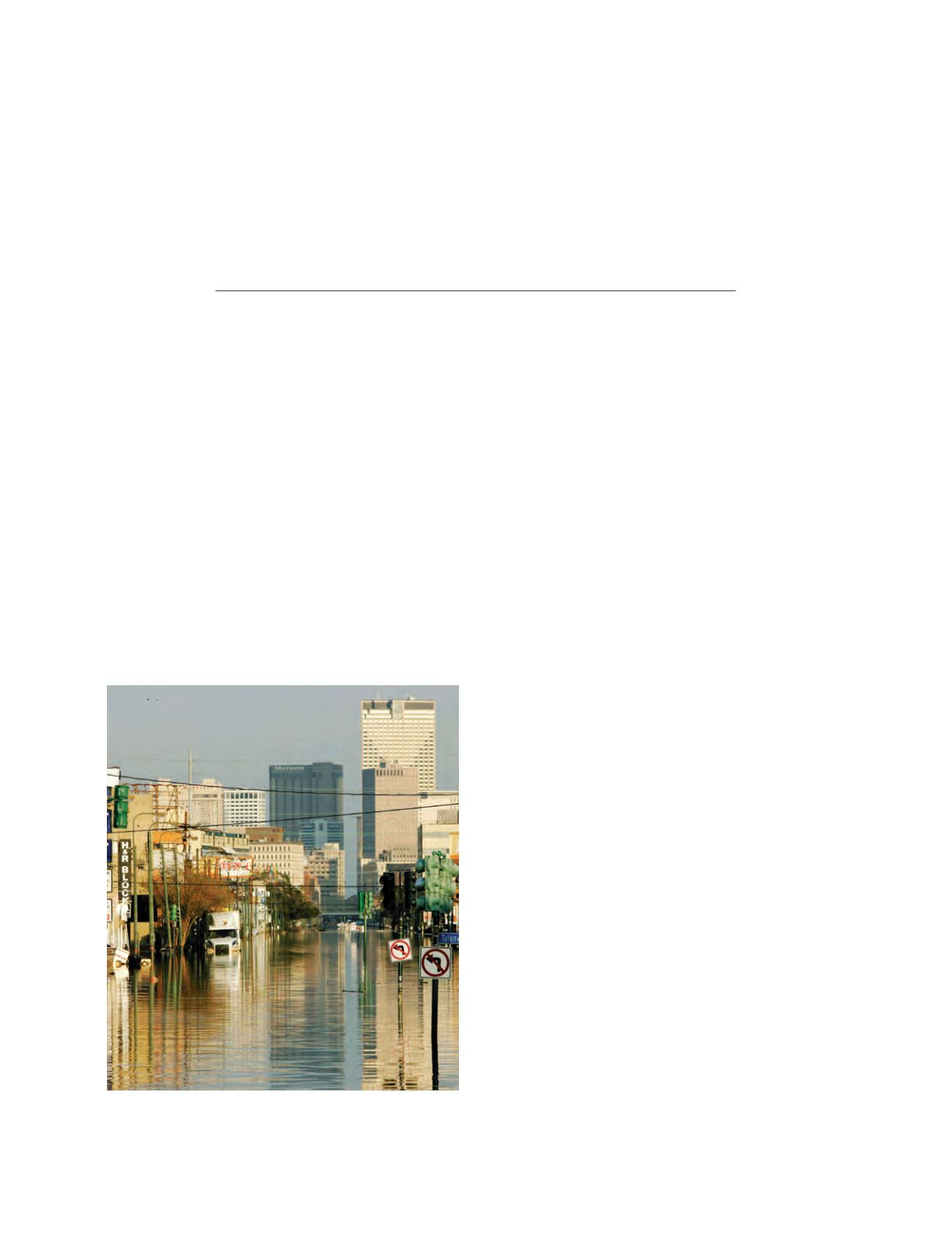
Flooding in cities like New Orleans (2005) has wreaked havoc, death
and destruction. More urban flooding catastrophes can be expected as
populations rise and climate warms in the coming years and decades
Photo: Vaisala