


 85 / 210

[
] 83
A
dvancing
S
ocial
I
ntegration
and
I
ntergenerational
S
olidarity
ble for collective welfare, has a duty to guarantee the rights
necessary for people to build careers and overcome vulner-
ability (such as education, health, employment, housing
and sociocultural rights). These rights must be guaranteed
by the possibility of access to resources, services and facili-
ties necessary for families to develop their productive and
reproductive cycles.
This framework is conceived as a suburban comprehen-
sive strategy and inter-agency approach with families that are
socially vulnerable. It has three core components:
• developing a proximity strategy with families to
develop family skills
• strengthening local support networks
• implementing changes in the governance of public
policies to respond rapidly and comprehensively, by
making various services accessible to those in vulnerable
situations such as extreme poverty and destitution.
These three components are inseparable and indispensable in
responding with the integrity required to give coherence to
a framework that seeks to overcome fragmentation and the
dichotomies that conceal contradictions.
“The axis of social benefits is central, because if changes in
the material conditions of life are not built then other aspects
of everyday life can hardly be changed: the links, the relational
structure, capacity building and learning. In turn, if there is
no process of psycho-socio-educational support to cooperate
and commit to access or restoration of violated rights, it is
unlikely the transition to processes of inclusion and social
well-being will be sustained over time.”
In connection with the foregoing, we should note the
relevance of the territory in this view and approach: “The
services and goods available, and the local networks that
provide social protection are varied depending on the char-
acteristics of each area of technical services and equipment
present. The proximity of existing community networks
also helps to identify the particular and institutional inter-
ventions and to approach families not contacted by the
healthcare and social protection network.”
Being precise in the above implication seems central.
Generally there are no major repairs or discussions about the
need for support and proximity to areas of poverty and desti-
tution. There needs to be agreement on the importance of
this aspect, provided that it does not compromise the skills,
responsibilities, and processes of autonomy or generate
unnecessary dependencies.
However, the development of social policies aimed at the
most excluded population has focused on cash transfers
and still tends to be accompanied by insufficient mate-
rial resources. The relevance of the material aspects in
transforming the living conditions of the poor and desti-
tute social sectors runs the risk of being hidden behind
‘psychologizing’ and/or ‘responsibilizing’ (sometimes
even blaming) explanations of the situation for families.
Therefore, to emphasize its relevance seems central to
avoiding undesired political, theoretical and methodologi-
cal approaches and effects.
This position involves multiple challenges and trans-
formation processes at different levels and with different
responsibilities according to the various stakeholders.
Statewide, it involves rethinking the orientation of the
production of public goods, which has so far been directed
towards individuals as subjects of intervention and consid-
ered from a homogenizing suburban perspective. Thus,
it represents a challenge and an invitation to reorienta-
tion, looking at the various family arrangements in their
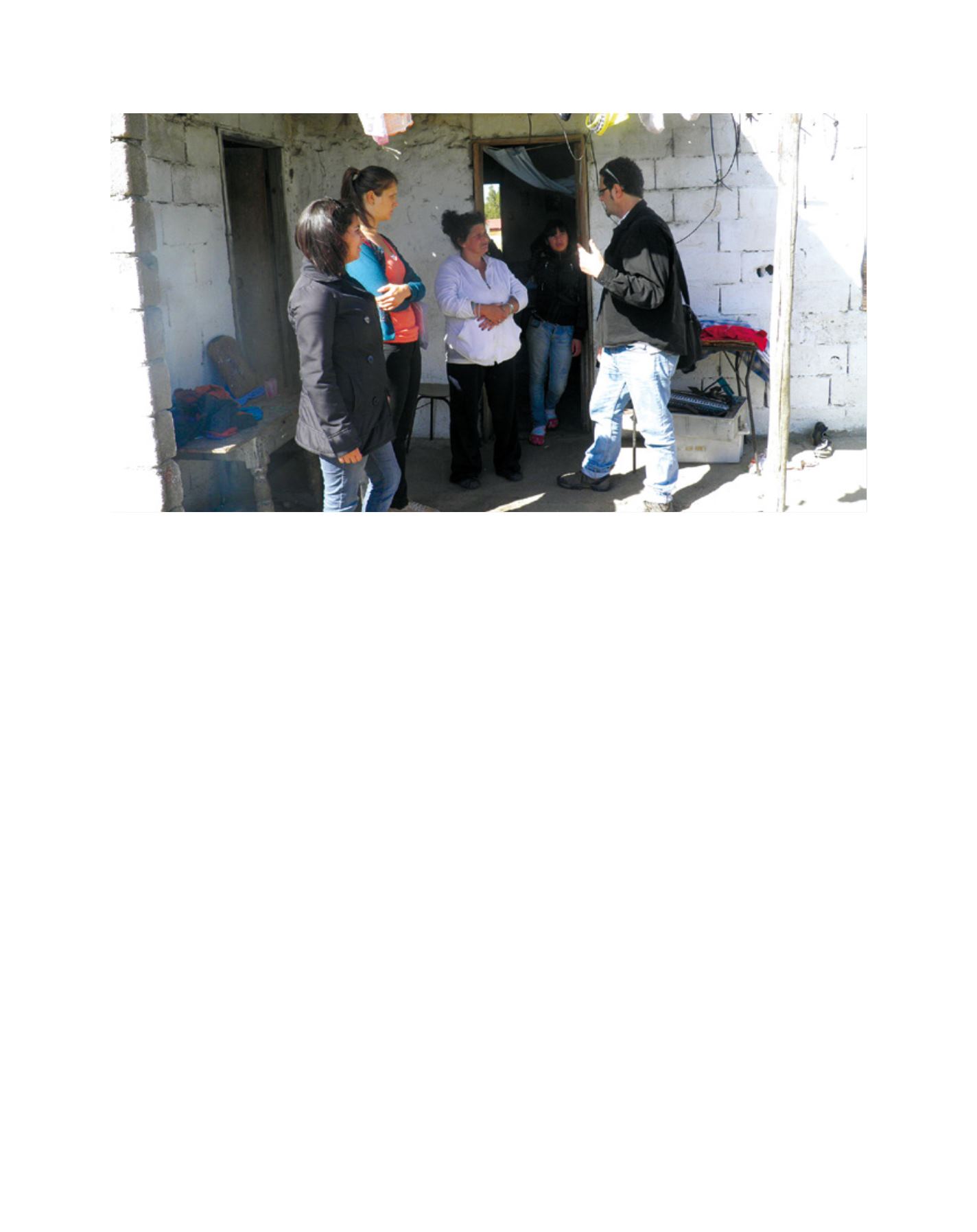
Cercanías aims to strengthen families so they can care for dependent members, and to help households access social benefits, rights and other community resources
Image: Cercanías Coordination Program