


 84 / 210

[
] 82
A
dvancing
S
ocial
I
ntegration
and
I
ntergenerational
S
olidarity
care. It also aims to develop a second level of specialized
care in outreach work with families that have the most crit-
ical needs and those suffering socio-familial vulnerability.
This will ensure fast and efficient access to existing basic
social services and promote the intrafamily and relational
changes necessary for families to independently sustain the
improvements achieved.
It is understood that without changes in the material
conditions of life there will be few changes in other aspects
of everyday life, such as family ties, relational structure,
capacity building and learning. Conversely, if there is no
socio-educational process to accompany and sustain the mate-
rial production of these changes and promote understanding
and subjective appropriation, only the immediate survival
needs of families will be addressed, without generating trans-
formations that can be sustained over time.
Cercanías bases its actions on institutional linkages with
other programmes, institutions and existing services in the
territories (utilities, in agreement with the state or provided
by civil society). In particular, it communicates with other
programmes aimed at the population in most critical situa-
tions, such as Uruguay Crece Contigo and Jóvenes en Red.
To guide its actions, Cercanías first seeks to conceptualize
the term family, understanding this as: “A group of indi-
viduals united by affective relationships and/or relationship,
forming a matrix linking around the breadwinner and social,
cultural and/or biological reproduction. Shares a temporal-
spatial dimension of everyday life, with unique identity,
history and future prospects.”
This definition not only represents an important concep-
tual agreement, but also has methodological derivations that
place the family in a larger social totality and in a relation-
ship network that exceeds the support group. It is also well
understood that families and contradictions express them-
selves as manifestations of that totality, in the context of
a system that produces and reproduces unequal relations
based on domination, oppression and expropriation of
socially produced goods.
Within this system and the relations promoted by it, the
rights of a large number of families are violated for various
reasons, creating a situation of inequality in access to the
opportunity structure, material and symbolic goods. Many
of these families fail to conform to the logic and require-
ments imposed by that structure, and most do not even
have the minimum potential in terms of resources, services
or rights exercised.
In order to understand and recognize the diversity of family
arrangements, the demands of production and reproduction
imposed by daily life and the vulnerability to which many
families are exposed, it is necessary to distance conceptual-
izations that do not take into account cultural, historical and
social aspects, and to see those conceptualizations as ‘prob-
lematic’, ‘dysfunctional’ and so on.
“There is in our country a lot of families that are being
violated in their rights, their social and labour living
processes and by educational exclusion and residential
segregation. They have acquired particular characteristics
depending on their unique paths and the resources avail-
able to them. In turn, family functions in general have
changed and existing institutions must achieve appropri-
ate responses to the needs of this population sector.” This
finding requires that the state, as the public actor responsi-
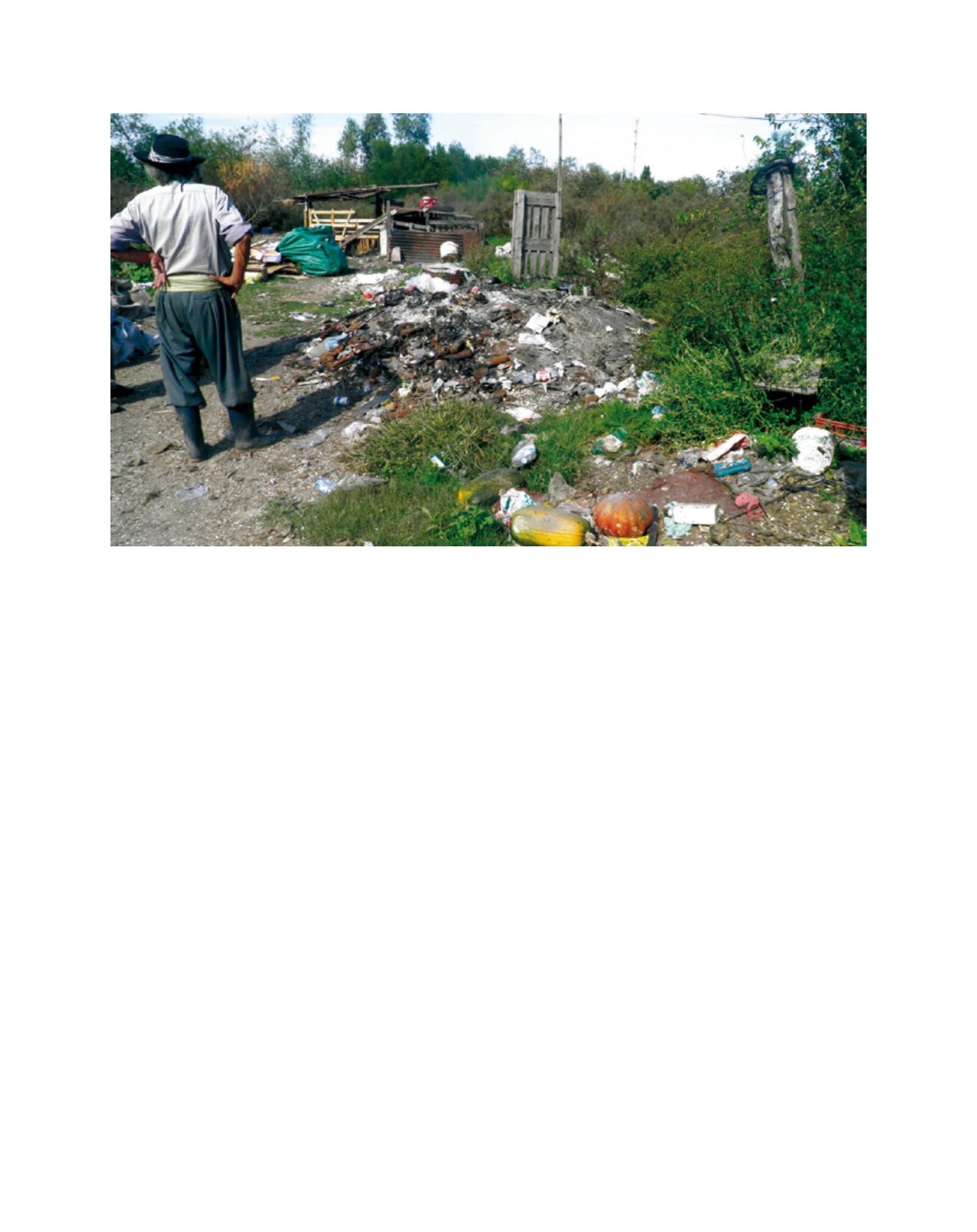
Uruguay has seen a sharp increase in poverty and social fragmentation since the 1990s
Image: Cercanías Coordination Program