


 88 / 210

[
] 86
A
dvancing
S
ocial
I
ntegration
and
I
ntergenerational
S
olidarity
One of the main elements in this intervention in ethnic
families is the quest for social integration and intergenera-
tional solidarity. This is the only guarantee of the cultural,
linguistic and racial survival of these peoples. It is a strength
in the face of cultural absorption and a mechanism to build
new opportunities for social inclusion, inter-ethnic dialogue
and relations between the communities and state agencies.
In order to satisfy these needs ICBF, in coordination with
its regional offices, is implementing the project ‘Support for
Strengthening the Families of Ethnic Groups’, engaged in areas
of welfare, culture and the social strengthening of indigenous,
black, afro-descendant, palenquera, raizal and rom communities.
One of the most important actions of the project is to engage
the traditional authorities in areas of action that strengthen
intergenerational relations through dialogue and wisdom.
This will enable the elders to share and provide guidance to
the children and young of their communities based on their
experiences and visions of the cosmos.
In Departments such as Arauca, Putumayo, Nariño, Guajira,
Cesar and Meta, among others, there have been successful
experiences in intergenerational issues. One example is Mocoa,
capital of Putumayo, in the Yunguillo Reservation of the Inga
communities, where work has been done on the ‘Strengthening
and transmission of ancestral wisdom for the permanence of
cultural identity’. Another is the Inga Council of Valledupa,
Cesar, which focuses its proposal on the strengthening and
preservation of cultural roots and material culture through the
establishment of a cultural protection plan. Both communities
are using workshops to improve educational and ethno-cultural
processes and the transmission of craft knowledge to children
and the young, enhancing their identity as Inga people.
Each ethnic group has its own particular way of organizing
itself along father-son or mother-daughter lines, which in turn
defines how power is exercised. Inmost cases, however, there are
two figures whose authority stands out: the shamans, who are the
traditional doctors – old men who wield spiritual authority –
and the Indigenous Governing Council and its members, who are
the political and administrative authorities. So, in many of these
peoples, there is a struggle against the loss of spirituality and the
relationship with the gods and nature, a battle that is fought by
rescuing their own forms of medicine and the ancestral rites of
their authorities. In the Department of Arauca, the Association
of Traditional Councils and Authorities engages in ‘Promotion,
strengthening and learning of traditional practices in medicine
and the intercultural approach between the Sikuani people’s
reservations’. Boys, girls and adolescents engage in ‘nursery’
groups for systematization, traditional medicines and traditional
plants. This has brought about improvements in some commu-
nity health problems and the dependence on some substances
that are harmful to their ethnic development.
These activities in dialogue between generations seek to hand
down knowledge of the wisdom of the elders, such as the sense
and meaning of traditional crafts and, in cultural areas such as
music and dance, the recovery of native rhythms. Further, in the
area of food sovereignty, one of the most important actions has
been to recover and preserve traditional foods and encourage
the young to discover, cultivate and consume their own foods.
In this regard the Department of Nariño is pursuing a proposal
to strengthen and recover indigenous wisdom through the oral
traditions of the elders, seeking to transmit the culture, principles
and values to the new generations of their communities of the
Eperara Siapidaara. Spaces for encounter between the elders and
the young are arranged in order to strengthen cultural identity
and recover historic memory tough the oral traditions of these
pillars of wisdom of their communities. These experiences bear
witness to ICBF’s work among ethnic families in which there are
reflections on the relationships of power between genders and
generations. The result is recognition of the capacities of women,
men, children, adolescents and the elderly and their roles in the
family group, as defined by their vision of the cosmos and the
way they are related to the world around them.
In respect of the use of free time, the project involves boys,
girls and the young in intergenerational integration activities.
Workshops are held to sensitize them to knowledge of their
ancestral trades and the importance of the oral tradition.
The work done with ethnic families includes reflection on
the relationships of power and gender and between generations
within families. The capacities of women, men, children, adoles-
cents and the elderly are all recognized, with their roles in the
family group defined by the vision they have of the world and
the way in which they relate to their immediate surroundings.
The interaction between family and community has
acquired special relevance in the ethnic peoples. In some
sensitive issues, such as child-rearing, there is a very subtle
dividing line between family and community, because the
community takes the lead in actions for care and protection.
This demands strong articulation between the two elements
in daily life and work, with an emphasis on the family as the
agent of local and community development, while at the same
time being the quintessential protective environment.
Colombia is a multi-ethnic country that does not forget its
roots; a country with major challenges in the protection and
development of its ethnic communities. With initiatives such as
those mentioned here we are moving forward along the road to
guarantee social inclusion and prosperity for thousands of fami-
lies who struggle to preserve their culture. They are finding that
intergenerational dialogue is a secure and sustainable means to
hand down ancestral traditions to future generations.
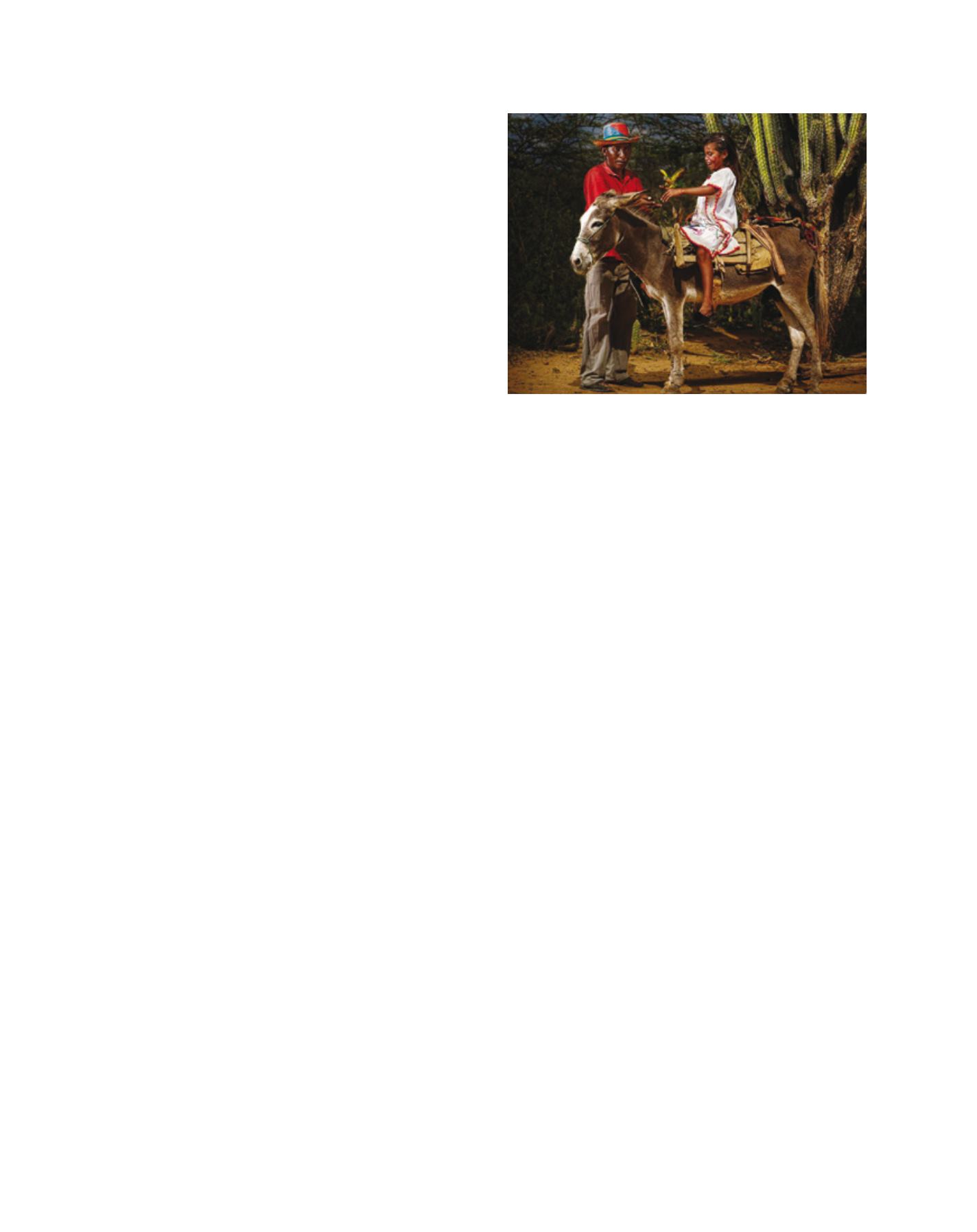
Family roles are defined by the vision people have of the world and the way
they relate to their immediate surroundings
Image: Families and Communities Direction from the ICBF