


 93 / 210

[
] 91
A
dvancing
S
ocial
I
ntegration
and
I
ntergenerational
S
olidarity
terms of the responses of families to both changing economic
conditions and household, family structures.
The Turkish Republic Ministry of Family and Social Policy has
initiated many nationwide studies, both on family and on social
issues related to family. These studies have aimed to:
• collect data
• turn the data into information
• publish information for the use of experts, policymakers and
non-governmental organizations (NGOs)
• use the outcomes to constitute social policy.
The Ministry of Family and Social Policy has a duty to conduct
scientific studies on national and international levels. This falls
among its many other duties aimed at identifying social problems
in Turkey as well as formulating their solutions, maintaining the
integrity of families and increasing social welfare in the country.
There is no doubt that these studies make it possible to outline
and understand the transitions that have led to the change in
family structure and to make up new family policies to resolve
the tension stemming from the change and crises.
The first step towards developing a Family Education
Programme was the Study on Family Education Needs Analysis
in 2009. The outcomes of this study were used to construct the
Study on Developing a Curriculum for the Family Education
Programme. Within the context of the Study on Developing a
Curriculum for the Family Education Programme, 23 chapters
in five distinct fields (Family Communication, Health, Finance,
Law and Media) have been developed.
In 2010, family educationmaterials, aimed for the use of partici-
pants, facilitators and trainers in family education were published.
After developing the curriculum and materials, Training the
Trainers of the Family Education Programme began, with training
programmes for 2,000 trainers throughout the country.
The crucial importance of the prenatal period and all the
periods of parenthood for the health, stability and well-being
of all children and adolescents has been confirmed by recent
scientific studies in the fields of medicine, genetics, biology,
sociology and psychology. As a result, parents hold a critical
role and responsibility for the future of their children and
thus for the future of their country. In this respect, one of the
most crucial and potential outcomes of the Family Education
Programme is providing family members with programmes to
help them get ready for parenthood.
Furthermore, the Family Education Programme aims for happy,
healthy and resilient families in general. In order to pursue this,
it aims to help families to benefit more efficiently from services
in education, law, economy, media and health; to functionalize
internal processes such as communication, education, house-
keeping and parenthood within the family; to encourage efficient
management of family resources; and to contribute to preventative
measures against possible risks faced by families.
The Family Education Programme’s 23 chapters and five
sections have been prepared taking into account the basic needs
of all families. The section on Family Communication comprises
of four chapters: ‘First quarter of life (development between 0-18
years)’, ‘Marriage and family life’, ‘Family life skills’ and ‘School
and family’. It aims to approach family life as a whole with an
understanding based on cooperative balance, to provide infor-
mation about problems that can occur in the family life cycle,
to equip individual family members with the appropriate skills
and awareness to help resolve these problems, and to cultivate
preventative and socially constructive practices within the family.
The Law section aims to provide the legal knowledge neces-
sary for the daily life of a family in simple and straightforward
language, which encourages family members to improve their
awareness of their rights and responsibilities. This section
includes five chapters: ‘Legal literacy’, ‘Personal rights’, ‘Family
law’, ‘Business life and law’ and ‘Rights of vulnerable people’.
The five chapters of the Finance section are: ‘Family budget’,
‘Financial literacy’, ‘Energy saving’, ‘Family and shopping’ and
‘Micro-entrepreneurship’. This section aims to equip families
with an awareness about financial mechanisms, to enable them
to use their current financial resources productively and effec-
tively, help them to obtain information about small ventures,
assist them in tracking expenses and spending in accordance
with the family’s needs, and to foster a family lifestyle that relies
on a sustainable environment through frugality.
Through its three chapters: ‘Media literacy’, ‘Understanding
media’ and ‘Conscious use of media’, the Media section aims to
strengthen and equip the intellectual, emotional, aesthetic and
ethical understandings of family members against the side effects
of media. It seeks to help families to use media in the best way
possible and minimize its potential harm through empowering
them with necessary knowledge and skills.
Finally, the Health section aims to protect and improve
family health and quality of life through medical science. It
also aims for a stronger society through improving family
health, fighting diseases, decreasing health costs and increas-
ing productivity. There are six chapters in the section: ‘Health
literacy’, ‘Healthy living and prevention of diseases’, ‘Child
and adolescent health’, ‘Reproductive health and healthy
motherhood’, ‘Geriatrics’ and ‘First aid’.
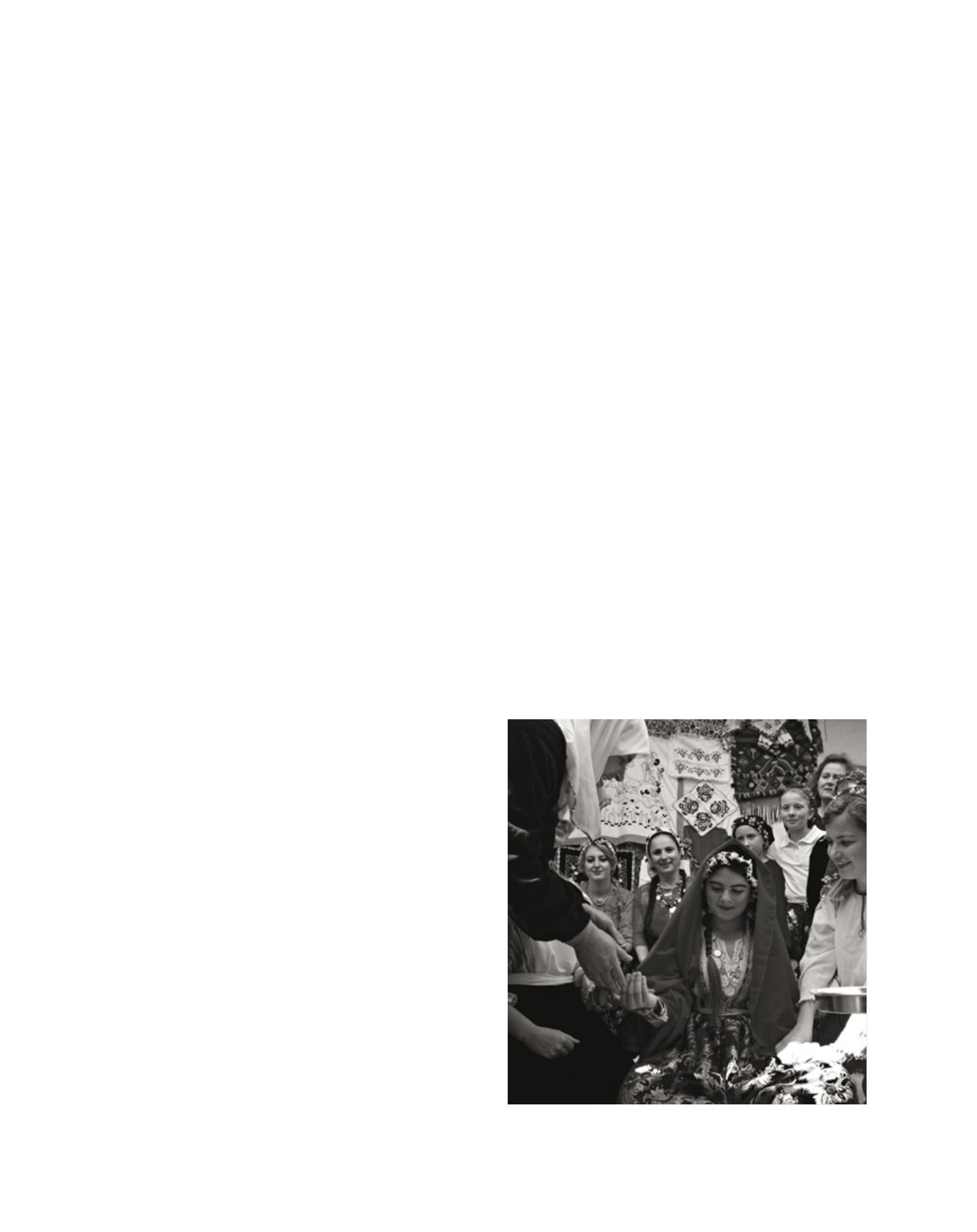
Family Education Programme training specifically focuses on people who are
married or preparing for marriage
Image:Barı
ş
Cengiz