


 92 / 210

[
] 90
Family Education Programme: advancing social
integration and intergenerational solidarity in Turkey
Emre Ertekin and Serdar Özhan, Ministry of Family and Social Policy, Republic of Turkey
A
dvancing
S
ocial
I
ntegration
and
I
ntergenerational
S
olidarity
L
ocated at the crossroads of three continents connect-
ing east and west; north and south, Turkey includes
six different climate cultures: Mediterranean, Black
Sea, Balkans, Caucasian, Middle East and Europe. Some
97 per cent of Turkey’s territory is in Asia and 3 per cent
is in Europe. Turkey has a history of three major empires
at the very heart of the land, which was called Anatolia
throughout the last millennium. These are the Eastern
Roma, Seljuk and Ottoman empires, which have enabled
the country’s settlers with a culture of welfare.
The Turkish Republic has a distinctive culture, being both a
convergent and divergent point of Western and Eastern civiliza-
tions with more than 19 million households and a population
of 75 million. The average household size is 3.7, which is
comparatively higher than the average for European countries
and lower than that of Middle Eastern countries. These house-
holds cover the full range of the social and cultural complexity of
terra Anatolia – the entire social spectrum from professional to
unskilled occupations; from affluence to poverty; from Muslims
to Christians and Jews (with different sects from Sunnis to Shias;
Roman Catholic Church to Greek Orthodox Church); from
passionate believers to nominal and irreligious ones; from Turks
to Roma, Kurds and Arabs. This diverse structure of households
also covers house owners and renters; the long-married and
newlyweds; wide composite three- or four-generation house-
holds and households of people living alone; families with
numerous relatives living close at hand and families whose kin
are thin on the ground and widely scattered beyond the borders,
mainly including Germany, France, Austria, Bulgaria, Eastern
European countries, Syria, Iraq, Iran and Azerbaijan.
With all these distinctive characteristics the family in Turkey,
like families the world over, is accepted as a pillar institution. It
functions as a primary actor in the whole socialization process
whereby the individual is integrated into culture and society at
large. Family still means a lot in Turkey as it forms a significant
universe of meaning in the lives of individuals, giving direction
to life by both causing and dismissing tensions. As the family’s
multifunctional and contrasting features are still essential to the
formation of an individual’s existence and identity, the expecta-
tions from the family are comparatively high in Turkey.
As the state in Turkey aims to build up welfare, the question of
how to allocate welfare production and responsibilities between
market, family and government has become a more erratic issue
since the 1990s. These three institutions are mutually interde-
pendent: the market produces material welfare including income
and employment facilities; the family produces emotional welfare
including security and care services for family members; and the
state decides on the distribution of responsibility betweenmarket
and family. Because Turkey has a transitory economic structure,
fluctuating market conditions have blurred the future, raised the
risk and caused many crises. Global and local risks causing crises
and failures in the markets have intensified the importance of
family in terms of its capacity to absorb and compensate in the
event of the failure of individual members. Hence, in transitory
countries, governments pay much attention and spend more on
family policy, to empower the family’s problem-solving and care-
providing capacities.
As mentioned above, household sizes in Turkey are bigger
than those in developed countries. Although the nuclear family
seems widespread in Turkey, the average household size and
close blood agnation between families builds up an environ-
ment for the socialization of individuals in which family is the
prime actor, designer and stage director in constituting networks,
commitments and convictions. Moreover, studies on urban and
rural areas show that there is vast variation within Turkey in
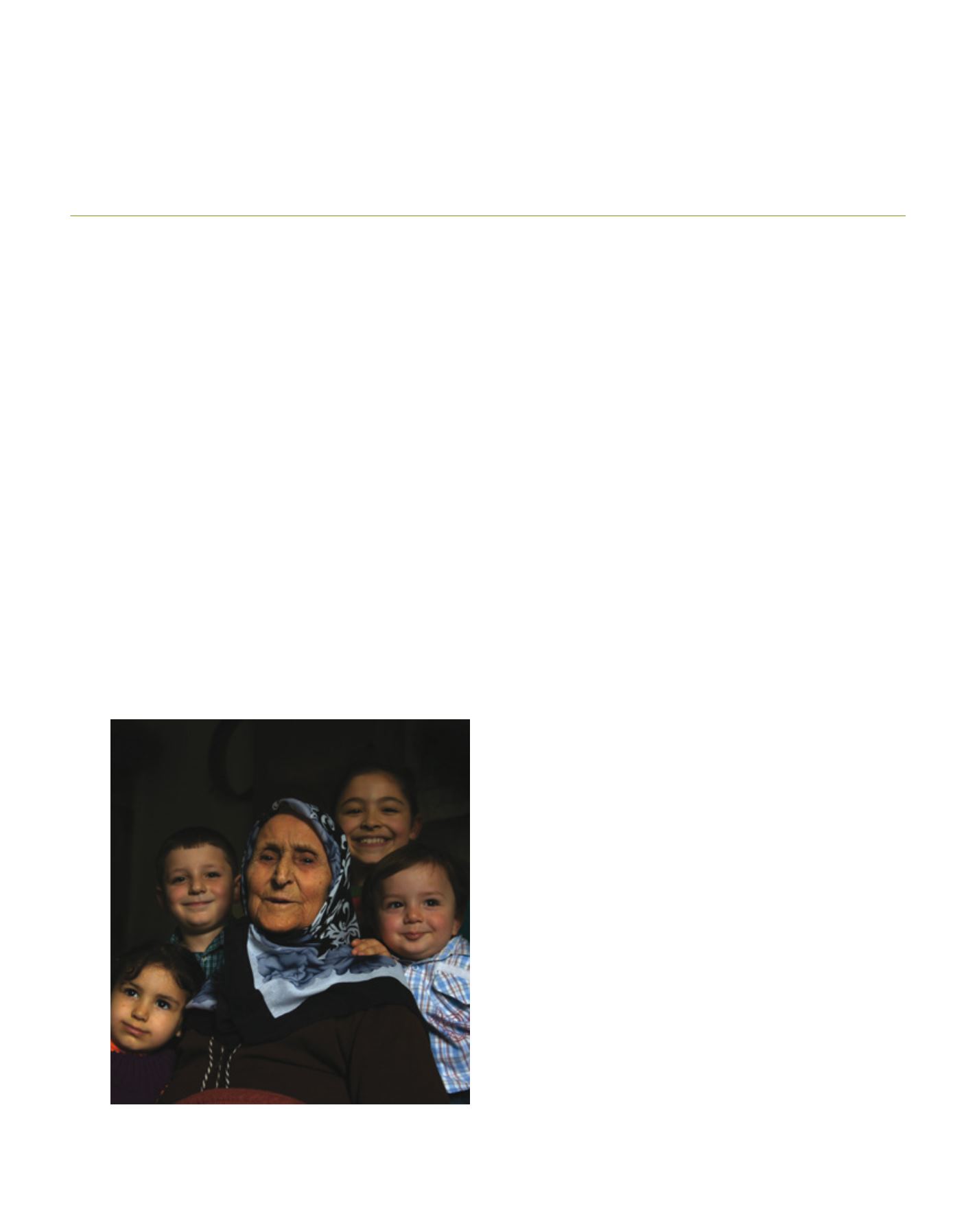
The family is seen as a pillar of society in Turkey, forming a universe of
meaning in the lives of individual members
Image: Veysel Kaya