


 98 / 210

migration policies are designed to meet EU labour market short-
ages only, and tend to consider the individual migrant only
as a worker, in a utilitarian view. Changing their status from
temporary to long-term worker is surely not a straightforward
process. As a consequence, many workers who wish to stay in
the EU when their temporary contract expires are paradoxically
forced into being undocumented by the difficulties of changing
status. Moreover, while an increasing number of policies and
legislations are put forward in favour of temporary, circular and
seasonal workers and those who work in the health sector to fill
the labour market shortage, no specific policies are put in place
to prevent risks and protect families.
Finally, while migration is increasingly demonstrating to be
a family business, policymakers still shape migration policies
around the individual alone. Whether this is through choice
or a lack of understanding of today’s society, there is an urgent
need to invert this tendency. For these reasons COFACE is
working to raise awareness of the difficulties that transnational
families specifically go through and advocating towards the EU
institutions for migration policies that consider migrants’ fami-
lies not as a burden but as part of the process. The number of
transnational families is growing and will not stop, even if we
keep ignoring their existence. The future of these families, and
of the people who belong to them, is in the hands of today’s
leaders and we cannot risk the future of these people because
we choose to turn a blind eye. We need to look at today’s world
and society, remembering that the world economy is not made
of numbers but of people.
Public attitude to migrants
Unsuccessful integration may be the result of ‘unwelcoming’ attitudes
to immigrants, which may in turn be reinforced by the social problems
linked to their poor integration. This situation may make it politically
unacceptable to receive more immigrants. Eurobarometer survey
results indicate that, on average, only 40 per cent of EU citizens feel
that immigrants contribute a lot to their country, while a majority of
citizens (52 per cent) do not agree with this statement. However,
there are significant differences across countries. While 79 per cent
of Swedes and two-thirds of Portuguese have a positive opinion of
immigrants’ contribution to society, only 12 per cent of Slovaks hold this
view. In general, citizens in the old member states are more positive
about migrants’ contribution than those in the new member states.
Immigrants with jobs are more closely bonded to their host
society. Equally, employed migrants contribute to a positive public
image of immigrants (i.e. as hard-working, rather than as a drain
on public resources). However, in a recent Eurobarometer survey
on discrimination in the EU, most EU citizens acknowledged that
foreigners would stand less chance of getting a job or traineeship,
even with the same level of qualifications as other candidates. On
average in the EU, 58 per cent of people thought that foreigners
would be less likely to be successful compared with native born
workers of the country. Countries with the highest shares of
respondents expecting foreigners would be less likely were Belgium,
Finland, France, the Netherlands and Sweden, all with rates over
70 per cent. As shown earlier, these are among the member states
with the largest gaps in employment rates between migrants and the
EU-born. Discrimination not only hinders labour market performance
of immigrants, but by decreasing returns to human capital lowers their
incentive to invest in host-country-specific human capital, which in
turn results in lower labour market performance.
– Employment in Europe Report 2008, European Commission
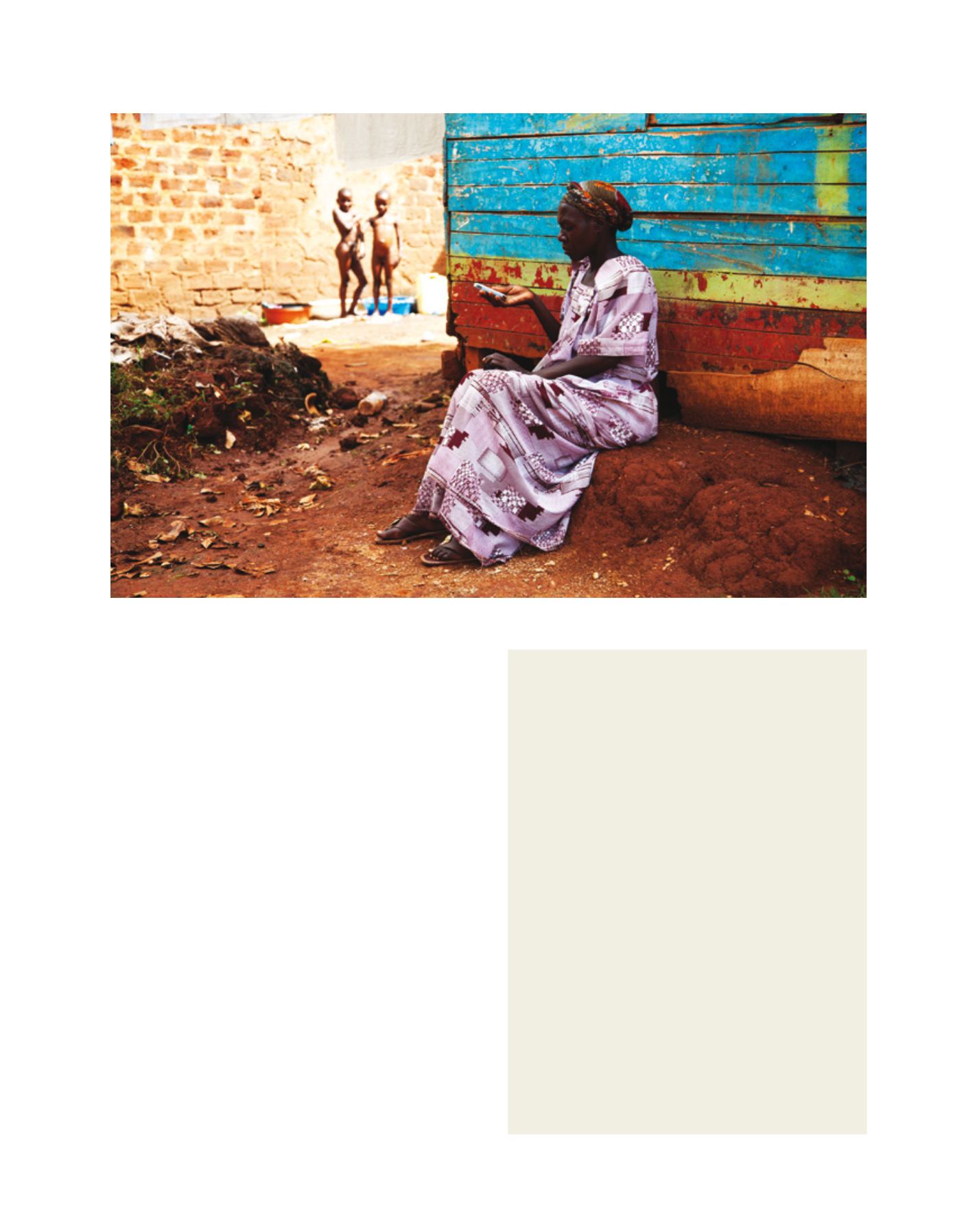
Mobile phones and the Internet are important communication tools, but they depend on a good communication infrastructure and knowledge of how to use such devices
Image: Stylianos Papardelas /www.stylianospapardelas.com
[
] 96
C
onfronting
F
amily
P
overty