


 100 / 210

[
] 98
C
onfronting
F
amily
P
overty
Valuing the work of families
Human relations are unique and family relationships matter. This
foundational premise was developed over several years and the
approach has recently been confirmed.
Fertility regulation using the Billings Ovulation Method of
natural family planning (not the rhythm method), which is a well-
researched, scientific and reliable method:
• recognizes that a decision regarding pregnancy is a joint decision
involving both husband and wife
• raises the status of women, as they begin to speak out about
their fertility and infertility cycle
• helps men to understand their wives and become more
interested in them
• provides an instrument of dialogue between husband and wife
through a chart on which women mark their fertility patterns.
SERFAC worked with couples on aspects like budget, income-
expenditure and saving, and taught them to maintain small bank
accounts. These were additional tools for dialogue between husband
and wife on economic areas and the well-being of the entire family.
It became clear that mere economic alleviation and providing short-
lived schemes offered only temporary respite. Poverty alleviation must be
addressed, keeping in mind long-term and lasting goals. This approach
calls for a belief in human capacity, which has its genesis in the family.
cal growth of children due to poor food, nutrition, hygiene
and housing. Poverty limits the resources needed to eat well
and live a life befitting human dignity. Being malnourished or
poorly nourished, members of such families are unable to build
resistance to epidemics and contagious diseases which create ill
health and pandemics, in turn leading to forms of social isola-
tion and further increasing victimization and social drifting.
Family poverty often leads to children being involved in
household work and outside employment so as to augment the
family’s income; looking after siblings; looking after cattle; and
doing heavy chores because the mother has to go out to work
in fields, the construction industry or other such semi-skilled
or unskilled areas. This ‘need’ often causes poor academic
performance, and participation in school life is inhibited as the
children juggle home chores and studies. Most often they are
forced to study by the light of a kerosene lamp, in a neighbour’s
house or under a street light. Such children often lag behind in
their school work, give up and/or drop out.
Poverty affects the family’s entire environment. There is
more to poverty than having a low income. Poverty affects and
inhibits the social, cognitive, emotional and physical develop-
ment of children, and in adults it does not allow for adequate
parenting. Hence the inability of parents to raise children
and respond to developmental needs and tasks. Lack of basic
amenities blunts their capacity for any form of engagement.
This shortcoming is transmitted to successive generations
and continues as a vicious cycle if it is not interrupted with
appropriate interventional measures which will need to be
combined with psychological and emotive counselling.
These are the essential constituents of poverty. Most
countries have not identified, sufficiently comprehended or
contextualized effective policies to combat, confront and
eradicate poverty. There seems to be little political will and
courage to really confront poverty. Yet, in all countries it is
families who subsidize the cost of democracy, as the adults
enthusiastically cast their vote hoping that it will lead to better
days in their lives and for their children.
To be poor is to be ‘classified’ as unimportant and to be
made to feel unimportant.
The Service and Research Institute on Family and Children
(SERFAC) believes that:
• a family-centric framework for poverty eradication must
place people and their human security at the heart of the
development process
• the process must focus on the family as a social unit and
engage in a strategically unified and multidimensional
approach covering the whole gamut of relationships.
Based on insights into ground realities gained from observa-
tions made during various field experiences in India and other
Asian countries, SERFAC was established with the conviction
that the poor can change their lives for the better if they are
given adequate emotional and physical support for working
towards this goal.
Several experimental initiatives took place over a decade,
trying to identify possible and probable reasons for poverty in
the family. Among the major findings was that lack of stability
in the marriage and family due to abuse, and different forms of
violence in the home between husband and wife and parents
and children, resulted in the breakdown of family relation-
ships at several levels and in different ways. Both causes and
consequences were intertwined and intricately enmeshed.
Any solution had to address the complexities of the problem
and simultaneously address its consequences, giving priority
to the source of the problem(s).
A unified and integrated approach helped to identify an
entry point as well as its branch areas/ramifications, which
pointed to the need for fertility regulation. Such an approach
also clarified the role of parenthood. It took into account the
need for gender balance and recognition of the wife as woman
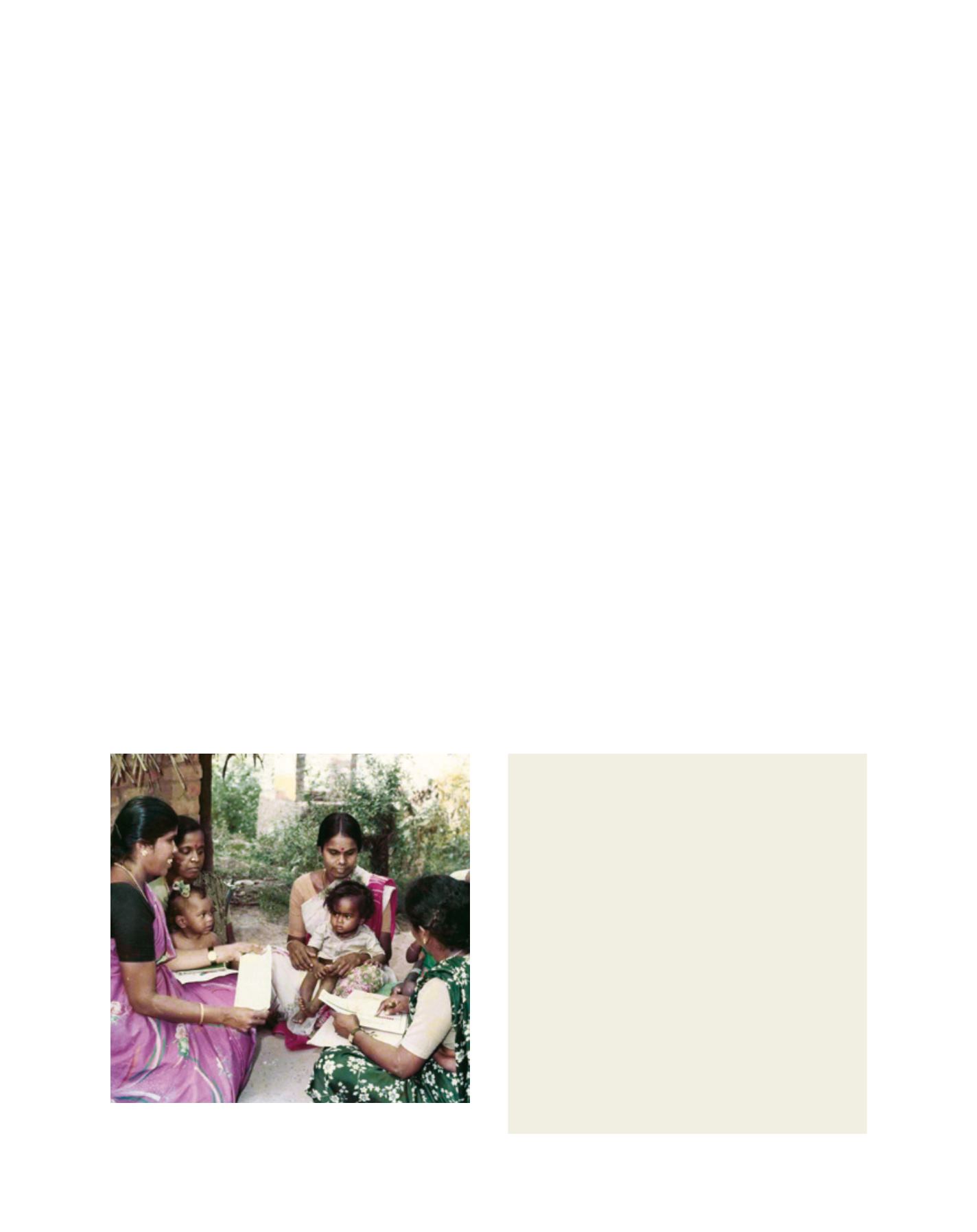
Image: SERFAC
The Billings Ovulation Method has helped to raise the status of women and
enabled family planning through joint decisions