


 104 / 210

[
] 102
C
onfronting
F
amily
P
overty
sector, either those who are self-employed or those in other
informal enterprises.
While there is some heterogeneity in the group of women
who are self-employed, women in this group tend to be of
low socioeconomic status with few options to access child-
care services outside their family network. For women who
do not have family support to meet their childcare needs, the
opportunity cost of continuing to work may be high enough
to induce them to stop working for pay, which adversely
affects household income. Therefore, by creating differenti-
ated opportunities for women to be integrated into the labour
market, the supply of and/or unequal access to childcare
options reinforce social and economic inequalities.
Moreover, unequal access to childcare and early educa-
tion can also perpetuate socioeconomic inequality in future
generations. From this perspective, childcare not only
facilitates insertion into the labour market or enhances
reconciliation of family and work responsibilities for low-
income women, it also affects the future performance of
their children. Extensive evidence shows that early stimu-
lation and education have positive and lasting social and
economic impacts and are associated with better educa-
tional attainment, lower levels of teenage pregnancy and
lower involvement in risky activities.
Outside the family, the supply of childcare services in the
region comes from a poorly articulated combination of public,
private and community initiatives. Usually public initiatives are
managed fromministries or institutes relating to the family and
social development, or in some cases the Ministry of Education.
Instead of providing the services directly, the state also encour-
ages the development of childcare services through grants to
non-state institutions, including private for-profit providers
and non-profit religious and community organizations.
There is a high degree of heterogeneity in net attendance
rates to early education or childcare services in Latin America.
According to ECLAC, the net attendance rate for children
between birth and three years old ranges from 5 per cent
(Guatemala, Honduras, Dominican Republic and Paraguay) to
20 per cent (Cuba and México). For children aged three to six
it is considerably higher, but only in Cuba and Mexico does it
approach universal coverage; in Brazil, Uruguay, Argentina,
Peru, Colombia and Panama net attendance rate for children
aged three to six is between 60 and 75 per cent.
In recent years several countries in the region have
expanded infrastructure and increased availability of early
childhood education and care services. In Mexico, preschool
education and childcare is provided by the Mexican Social
Security Institute (directed at employees in the formal
economy) and, starting in 2007, a system of services promul-
gated by the Secretariat of Social Development (SEDESOL),
aimed specifically at low-income working mothers who do
not have access to social security benefits. The SEDESOL
programme seeks to facilitate the incorporation of these
women to the labour market and at the same time create
jobs. The model subsidizes both the supply and demand
of childcare services. Money is transferred to individu-
als, in most cases women or social organizations, to adapt
their spaces into childcare centres and subsidies are paid
to families for every child who uses these services, cover-
ing 35 per cent of the cost of the childcare. To enrol their
children and receive the state subsidy, parents must meet
certain requirements, including that the mother be working,
looking for work or studying, household income require-
ments, and that the household should not have access to
childcare provided by the Mexican Social Security Institute.
To qualify for the subsidy, the service provider does not need
0
20
40
60
80
100
Two-parent extended
Without children
Single-parent extended
Two-parent nuclear
Single-person
Single-parent nuclear
Blended
Per cent
1990
2
59
9
15
7
4
4
Quintile I
Quintile V
2010
5
51
13
5
14
8
4
1990
13
45
9
14
10
3
6
2010
22
33
11
17
7
4
6
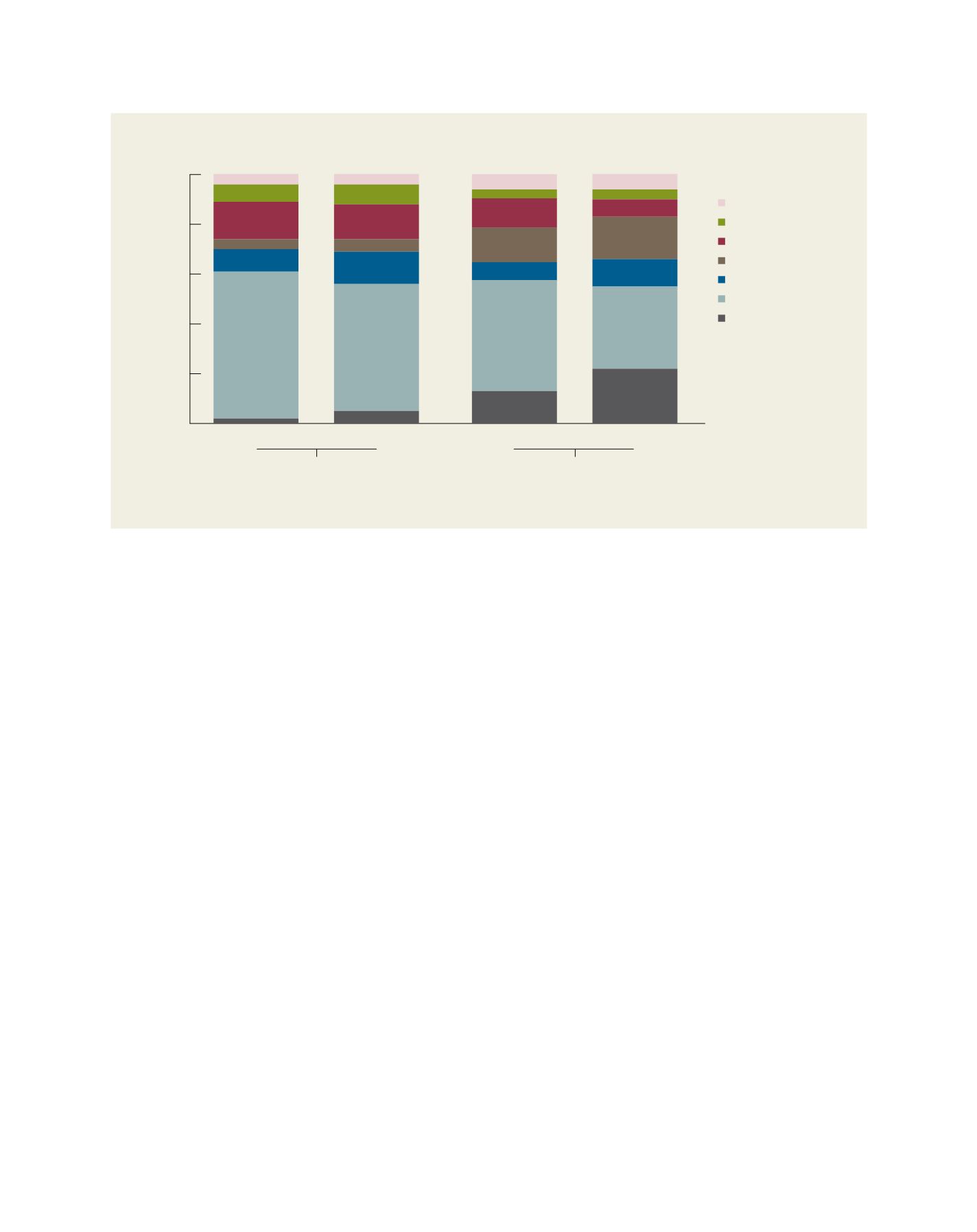
Latin America (18 countries): composition of first and fifth income quintile according to family type, 1990 and 2010
Source: ECLAC, on the basis of tabulations of household surveys in the region