


 108 / 210

[
] 106
C
onfronting
F
amily
P
overty
teachers to enhance their professional skills for optimum
performance while providing an increased awareness of the
important role of teachers in children’s development. The
school also runs short seminars for child-minders. Since
many parents work outside the home, child-minders and
home-helps play a vital role in the upbringing of young
children. The school therefore runs a seminar programme
to help child-minders acquire skills for effective early
childhood development. The school currently attracts and
influences 500 families every year.
Since 2006, in the Democratic Republic of the Congo,
the Association for the Family (AFA) continues to work
to defend and promote the family. The main activities take
place around two schools supported by the association: the
Lycã Minzoto for girls and the College Bilombe for boys. To
date, these two schools have had 990 students, representing
nearly 200 families chosen on the basis of parents’ personal
involvement in their children’s school education. AFA is
very involved in the training of parents. Accordingly, it
organized study days on the family, a programme on family
orientation in which 50 couples have already participated,
and a club providing training for the school’s mothers and
their friends. Nearly 200 women participate every month
to discuss topics such as the care of small family matters,
family budget management and the involvement of chil-
dren in school life.
In Côte d’Ivoire, since 1989 the Family and Education
Association has trained about 1,560 couples in the cities
of Abidjan, Yamoussoukro and Yopougon. Since 2000 the
‘Ivorian Family Day’ has been held on the first Sunday of
December each year, attended by 450-500 people. The asso-
ciation has also established two schools: the Etimoe girls’
school and the Makoré boys’ school. Today, these two schools
total 378 students from around 200 families. Most of the fami-
lies have participated in the association’s family enrichment
courses and attend various training programmes to develop
their abilities as parents and educators.
Kianda Foundation was set up over 53 years ago to reduce
levels of poverty through empowering women, who are
the bedrock of the family. In Kenya, 45.9 per cent of the
population lives below the poverty line. Consequently there
is a huge population that has little or no access to basic
human needs such as education, health, housing and water.
At the time of the foundation’s inception very few women
had access to education because society was highly patriar-
chal. The foundation initiated the Kianda College project
in 1961 and currently supports several projects within the
thematic areas of education, economic empowerment and
health. The projects include the Kianda School, Kibondeni
College, Kimlea Girls Technical Training Centre, Tewa
Training Centre, Gatina and Maramba Nursery Schools,
Kimlea Clinic, Children’s Health Program (CHEP), Trainer
The story of George Gitahi
Twenty-four-year-old George Gitahi is from Outering estate in Eastlands,
Nairobi. He is the sixth of nine children in a family that is not well off. His
father works at many odd jobs while his mother sells mitumba (second
hand clothes) at their doorstep. With many mouths to feed, paying school
fees was not the family’s highest priority.
Despite these challenges, and the negative peer pressure that saw
two of his primary school friends were shot down soon after they began
stealing, George managed to complete his high school education.
But even those who are fortunate enough to acquire some tertiary
training often have to overcome the challenges of poor professional
preparation because of the irrelevant courses they took, or lack of
capital to start a business.
George came across these challenges after high school. His tough
schooling experience impacted negatively on his final results and
going to university was ruled out. He tried his hands at many things.
“I once sold key holders, worked for a courier firm, did volunteer jobs
among others, until I got the opportunity of joining the Informal Sector
Business Institute,” he says.
Like many other students, George learned about ISBI through his
friends. He enrolled for classes at ISBI’s Eastlands Centre, which
opened up horizons for him: “It is like my vision was clouded, but now I
can see clearly,” he says.
At ISBI, George enjoyed learning how to use the computer, receiving
entrepreneurial ideas and attending the life skills sessions. He
specialized in electronics, which gave him the most memorable
experience both in classes and his ongoing internship.
George feels that he has improved ethically thanks to the business
ethics class, and he is grateful for the practical advice he received to
help him solve day-to-day problems: “I used to be very shy. I couldn’t
face people and when I did, I was very casual with them, both the old
and the young. Thanks to the programme, I have overcome that.”
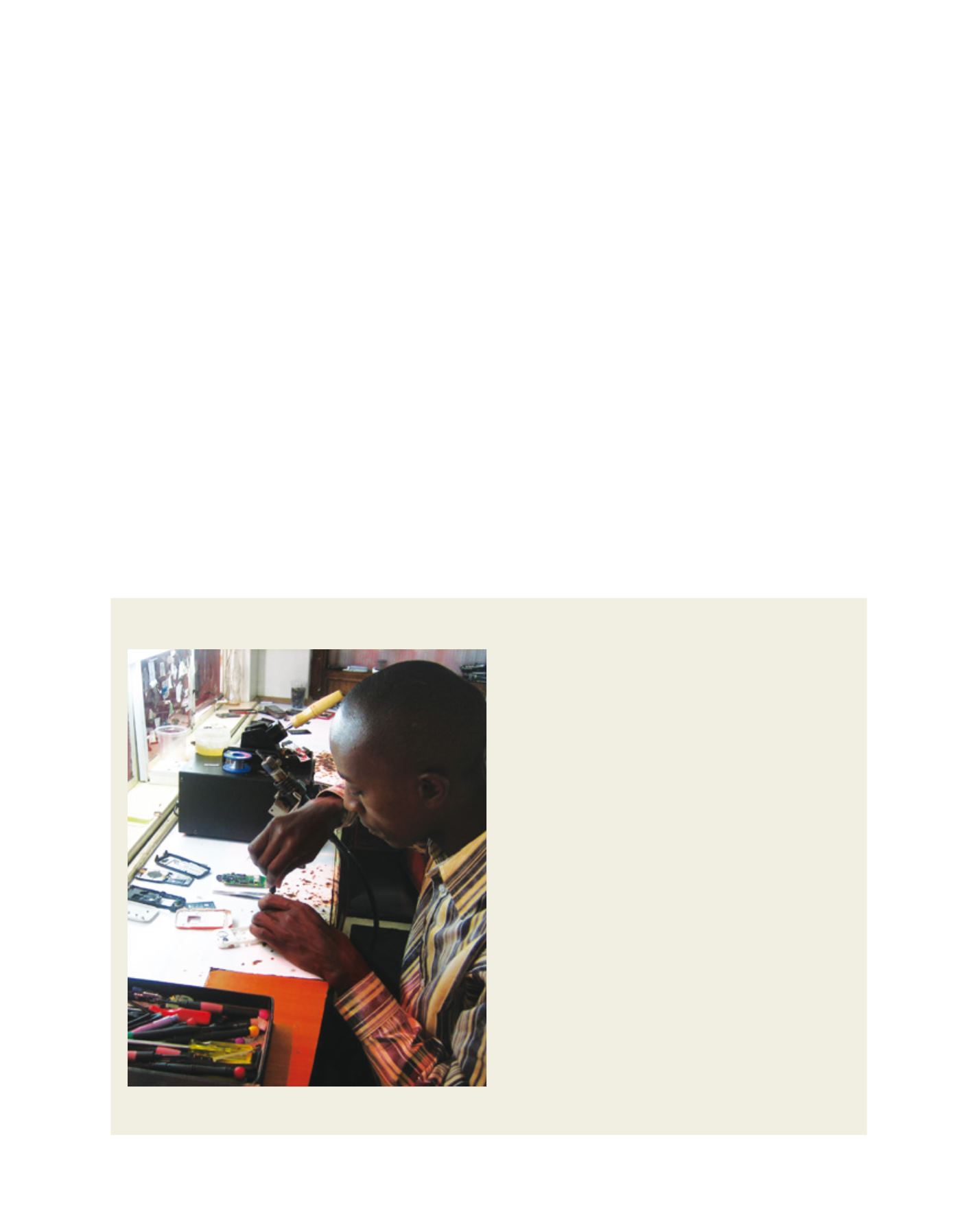
George now has his own electronics supplies and repairs shop where
he has one permanent employee and takes on casual workers when
needed. He plans to bring his family out of poverty and to help his other
siblings achieve their dreams.
Studying at ISBI has enabled George Gitahi to set up his own electronics
supplies and repairs shop
Image: VOFA