


 112 / 210

[
] 110
C
onfronting
F
amily
P
overty
the household level that were solely under the communities’
management. Today, these community groups have been
recognized as water service providers to their communities
and have successfully enhanced incomes at family level.
The 1980s and 1990s saw the department revolutionize the
women’s movement, working hand-in-hand with the govern-
ment of the day to give women a voice and opportunities
to participate in and benefit from development initiatives.
While this may have been seen as a token gesture, the period
did see the rise of women leaders in the country. Hundreds
of women’s groups were registered, bringing together
millions of individual members and providing an oppor-
tunity for capacity building for women’s leadership, and
mobilization of a huge resource base for direct support to
poor families. This resource base has seen the rise of strong
financial foundations for women-specific programmes.
Housing programmes have emerged and land-buying invest-
ments and other initiatives have helped put financial power
into the hands of women, along with the ability to negotiate
in an environment that was largely male-dominated.
This movement culminated in the birth of the present
day women’s enterprise and youth enterprise funds, which
receive a sizeable amount from the exchequer to support
populations that have previously been marginalized. Under
both the CCSP and the Central Kenya Dry Area Project,
strong leadership for women emerged that led to the forma-
tion of revolving fund women’s groups, some of which now
run savings and credit cooperatives. Building the capacity
of women in Kenya remains a key strategy for confronting
poverty at the family level, and this has been a key area of
focus for the department’s efforts. Having evolved through
programmes that supported women as caregivers at the
household level to intervening through women-specific
projects that popularized the slogan ‘to educate a woman you
support a whole family’, the department has left footprints in
the history of the country as the driver for women’s projects
focused on uplifting the status of the family.
Outside existing family networks and other social capital
systems among the different nationalities and peoples of
Africa, formal interventions in the area of social welfare and
social protection have often been approached with token-
ism. With the breakdown in traditional systems, families and
populations already in the poverty bracket are increasingly
falling into chronic poverty and vulnerability. Governments
across the majority of least developed countries are now
embracing other poverty intervention measures within
the broader social security spectrum. Cash transfers to the
vulnerable have become one of the most common strate-
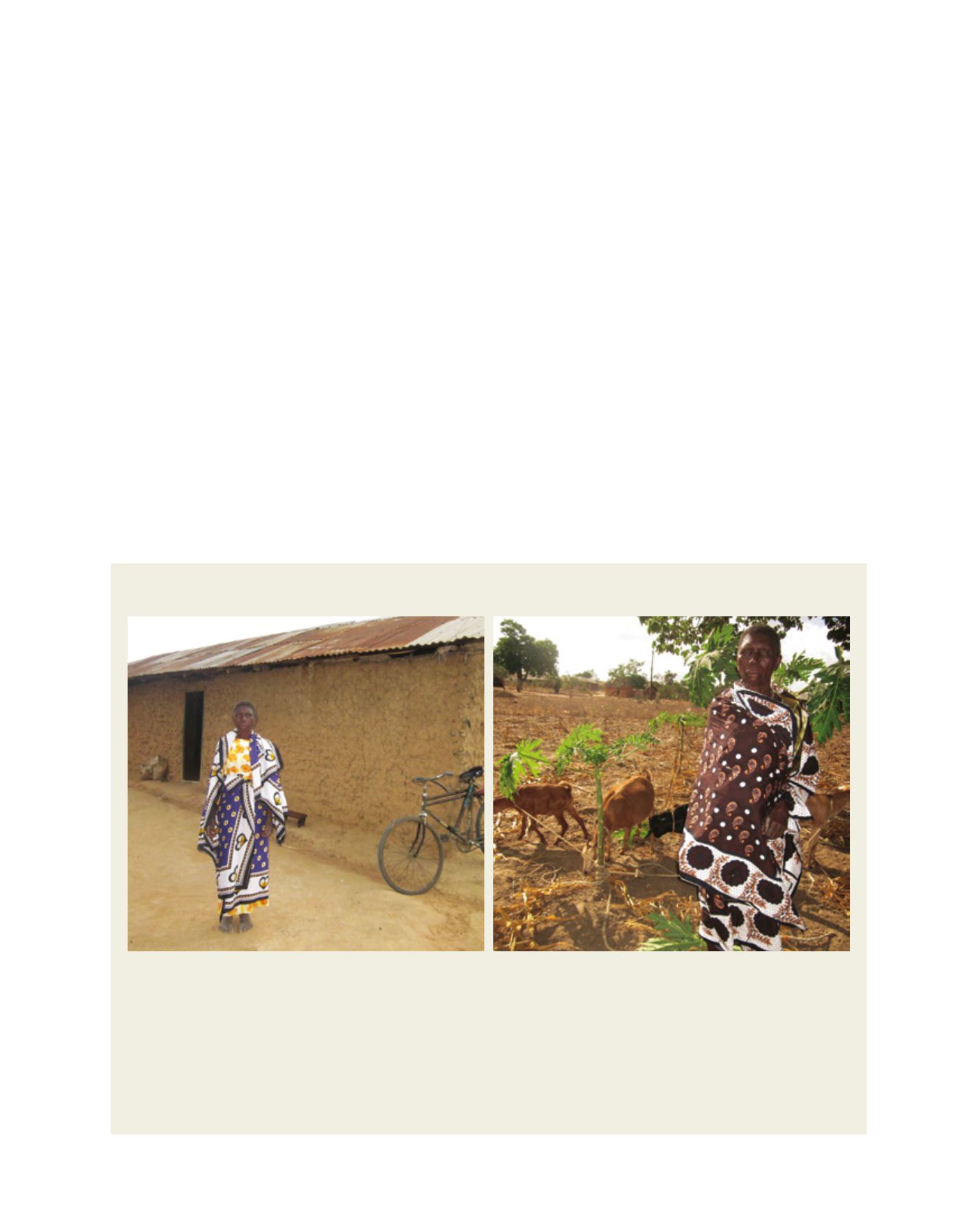
Julia Charo Kalama
Older people in Ganze Sub County, Kilifi County were enrolled in 2009
to the Cash Transfer Programme. Julia Kalama, from Kari village in
Bandari, is one of the beneficiaries.
At the time of enrolment, 72-year old-Julia faced many challenges. Not
only had her life deteriorated because of poor health, but her homestead
was equally in a bad state: her hut was almost collapsing, posing danger
to her. In addition, Julia could not afford decent clothing.
After the first payment Julia bought three goats for income generation.
She spent some of the money on hospital check-ups to ensure that she
remained healthy. She used the rest to purchase a few decent clothes.
She also spent money on improving her hut.
Julia now lives in a decent house (the walls are made of mud
and sticks while the roof is made of iron sheets). She also engages
in business by selling her goats at the market. She supports her
grandchild by paying school fees with the money she gets. Now she
sells at least five goats a year and maintains 10 in her herd for easy
upkeep. It is evident that Julia’s living standards have improved through
this programme.
Julia has been able to improve her house and buy a herd of goats to generate income
Images: Stefanie O. Bitengo