


 118 / 210

[
] 116
C
onfronting
F
amily
P
overty
today is incomplete without understanding the role played
by the colonial government in relation to the early growth
of M
ā
ori economic development and the impact of its loss
through confiscation and war. It is critical to recognize that
the influence of colonization is not just a historical one. Its
impact has been far-reaching and it continues to shape and
inform attitudes towards M
ā
ori. The effects of ongoing racism
and discrimination have been demonstrated and the negative
effects of colonialism have produced the unequal distribution
of social, political, environmental and economic resources in
New Zealand.
The Children’s Commissioner’s report recognizes that the
M
ā
ori child develops within wh
ā
nau and community settings
and that it is important to situate the child in these larger
contexts. The report also states that it remains useful to
consider the experience of poverty from the perspective of
the M
ā
ori child, to ensure that all policy formations are atten-
tive to the impact that any policy may have on children. Policy
that intends to produce positive outcomes for M
ā
ori must be
mindful of wh
ā
nau dynamics and the strengths and vulner-
abilities that may be found there.
The way that M
ā
ori children experience poverty is multi-
faceted and the outcomes of growing up in conditions of
deprivation are varied. However, for too many children
their health, education and life-path outcomes are likely to
be poorer than for other children. Early engagement with
the criminal justice system, for example, maps onto poverty
statistics. Many M
ā
ori children, growing up in considerable
material hardship, are able to draw on significant support
from wh
ā
nau, hap
ū
, iwi and others that mitigate the effects
of poverty and they are well supported to go on to lead posi-
tive, contributing lives. For others, however, child poverty
translates into poor educational performance, high offending
rates, severe and ongoing health problems, low income and
high state dependency rates. Moreover, the intergenerational
transfer of social inequalities needs to be recognized. Poor
children largely grow up to be poor adults and so poverty
has significant intergenerational aspects. M
ā
ori children are
disproportionally more likely to be exposed to the impacts and
effects of poverty than the average New Zealand child. They
are more likely to grow up in households in receipt of state
benefits or with low incomes than the average New Zealand
child; they are less likely to achieve well in the compulsory
education sector and are less likely to go on to university
study than other children in New Zealand. It is clear that
poverty severely limits the opportunities and aspirations of
children. For M
ā
ori children the effects of poverty lead to
their marginalization from mainstream New Zealand society,
but may also limit their opportunities to fully participate in
their wh
ā
nau, hap
ū
and iwi.
In a land of abundance good health should be the birth-
right of every child in New Zealand. Children growing up in
poverty, particularly in the early years of childhood, increase
the risk of ongoing health problems throughout their lives. A
M
ā
ori child growing up in poverty in New Zealand has two to
three times poorer health than non-M
ā
ori, non-Pacific Island
children. Access to warm, stable, healthy homes is an impor-
tant determinant of good health. The impact of poor housing
has been well documented in New Zealand and it is clear
that it causes significant social, health and economic costs
that damage life opportunities. A National Health Committee
report shows that children growing up in low-income fami-
M
ā
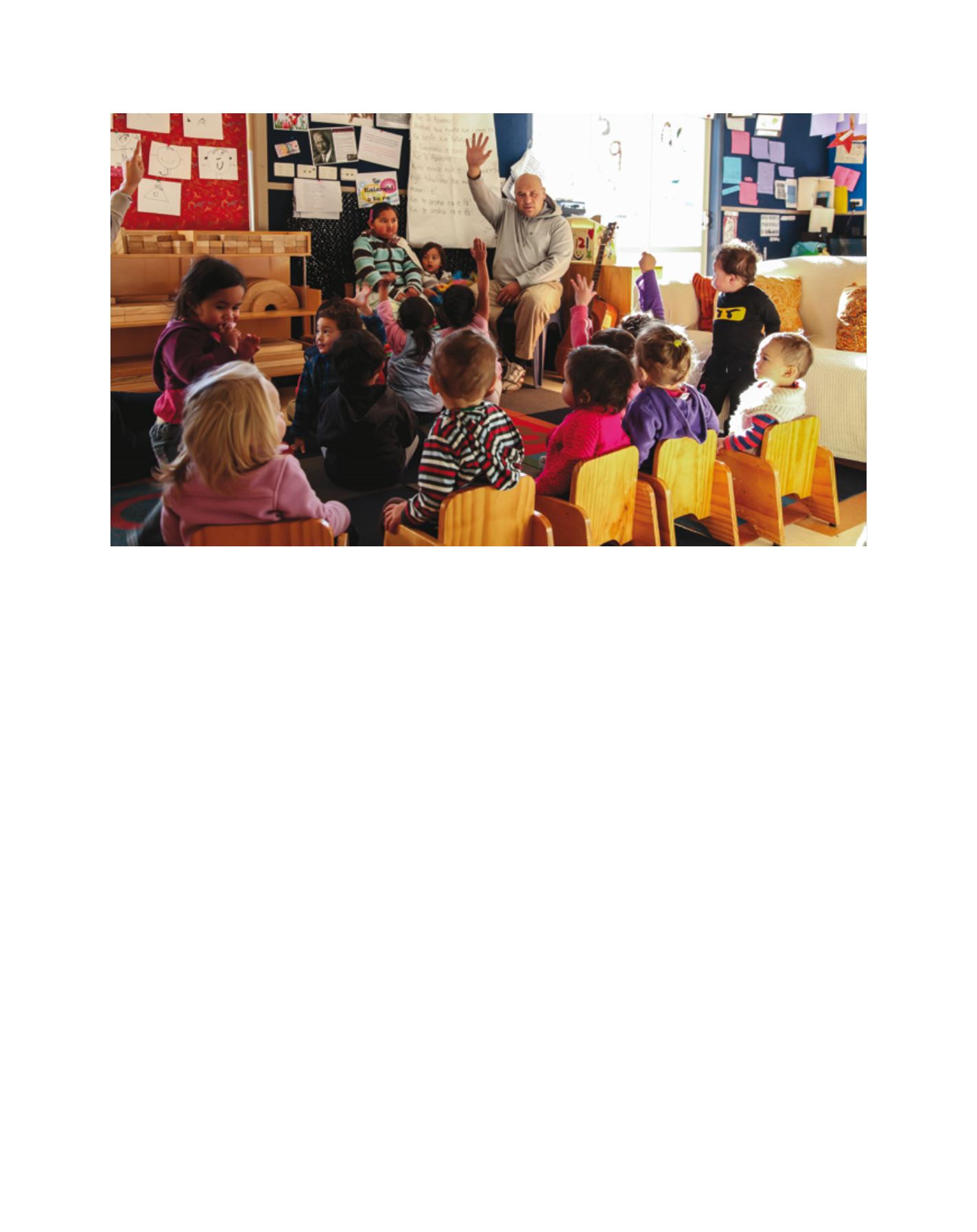
ori children develop within wh
ā
nau and community settings and it is important that any policy aimed at helping M
ā
ori recognizes this dynamic
Image: Josie McClutchie, Ng
ā
Pae o te M
ā
ramatanga