


 124 / 210

[
] 122
C
onfronting
F
amily
P
overty
10 per cent of them are orphans who have lost both parents.
Parental death is not the main factor for the placement of
children in the institutions; rather, it is so that the child can
access education – or to put it differently, poverty. On the
other hand, a growing number of scientific studies produce
evidence that children who stay in a family environment have
better survival and development outcomes than those who are
deprived of one. As cited from a 2012 article in the Lancet,
“a caring and protective family, immediate and extended, is
central to effective child protection.”
Strategies are needed, whenever appropriate, to prevent
children from bearing that burden of poverty. Initiatives
towards an integrated social protection system should aim
to provide assistance to families and communities that will
enable them to keep children in their families and enable
families to assume their responsibilities for the protection and
well-being of children. This requires increased resources and
financial incentives to prevent children from being sent to
institutions, through economic strengthening and livelihood
support for parents and families. Moreover, the strategy also
needs to anticipate that some children are living in or facing
exceptionally difficult conditions within their own families,
and therefore are entitled to special protection.
Secondly, poverty exposes children to risks of violence,
abuse, exploitation and neglect, and experiencing those
reduces their capacity to overcome and escape poverty in
the future. People would agree that children’s vulnerability
goes beyond monetary poverty. It includes the dynamic inter-
play between that and other risk factors in every stage of life.
However, this concern, although understood, is still largely
missing from poverty alleviation approaches. Not to put the
blame on others, we have to admit that child protection and
community well-being often works outside of this develop-
ment arena. Existing social protection strategies have yet to
include child protection concerns as issues to be addressed,
including the need to recognize other dimensions of poverty
which lead to family separation and/or the institutionaliza-
tion of children. At the same time, very few child protection
programmes are intentionally designed to address poverty.
Social protection systems need to comprehensively aim
to help the most vulnerable children and their families to
counter these non-monetary risks. Programmes should cover
a short-term safety net for basic needs in times of crisis; chil-
dren’s survival, which includes food, nutrition, shelter and
health care; children’s developmental needs, which include
education and psychosocial support; and children’s protec-
tion, which includes access to birth registration and a legal
identity in the form of a birth certificate, and protection from
as well as a reporting mechanism for abuse and violence.
Thirdly, an integrated approach is needed. However, an
integrated approach requires integrated targeting which
might leave specific groups of children in need of specific
interventions un-captured. From the same Lancet article, it
is recognized that there are children in the most dire straits
who live outside of family care or settings. These children may
be found living on the streets or in institutions, trafficked, or
exploited for their labour. Due to the nature of their envi-
ronment and existence, they are missing from the national
poverty data and therefore absent from any programme-
targeting. It is also important to note that even for children
living in ‘normal’ family situations, national poverty data tend
to be limited in informing programmes and policies about
more specific children’s vulnerabilities such as care situations,
experience of abuse and disability.
Social protection systems need to adopt new and improved
ways to better identify and target vulnerable children and
families. Development and usage of non-traditional house-
hold-based enumeration, such as the sentinel surveillance
traditionally used in HIV/AIDS interventions, should be
considered to be adapted further for the needs of enumerat-
ing out-of-family-care children.
Last but not least, invest where it counts. Alleviation of
poverty and inequality requires significant resources. The
previously mentioned PUSKAPA and Save the Children
paper highlights that Indonesia’s current budget allo-
cation and government spending for social assistance
programmes is much lower compared to other countries
with similar characteristics like the Philippines, Viet Nam,
Mexico, Brazil, Argentina and India. It shows that when
the Government allocated 2.05 per cent of the state budget
for social assistance programmes in 2011, the allocation
for fuel subsidy was almost 13 per cent – a subsidy regime
believed by many to be regressive. Moreover, raising
demand from the family side should go hand-in-hand with
the improvement of the supply side, namely infrastruc-
ture. Social assistance programmes’ budget needs should
not conflict with infrastructure programmes, and Indonesia
simply needs to invest more to be able to see bigger and
faster impact. All of these are also happening within a
context of decentralized service delivery. There cannot be
a better time to make sufficient investment to ensure that
adequate services are available locally.
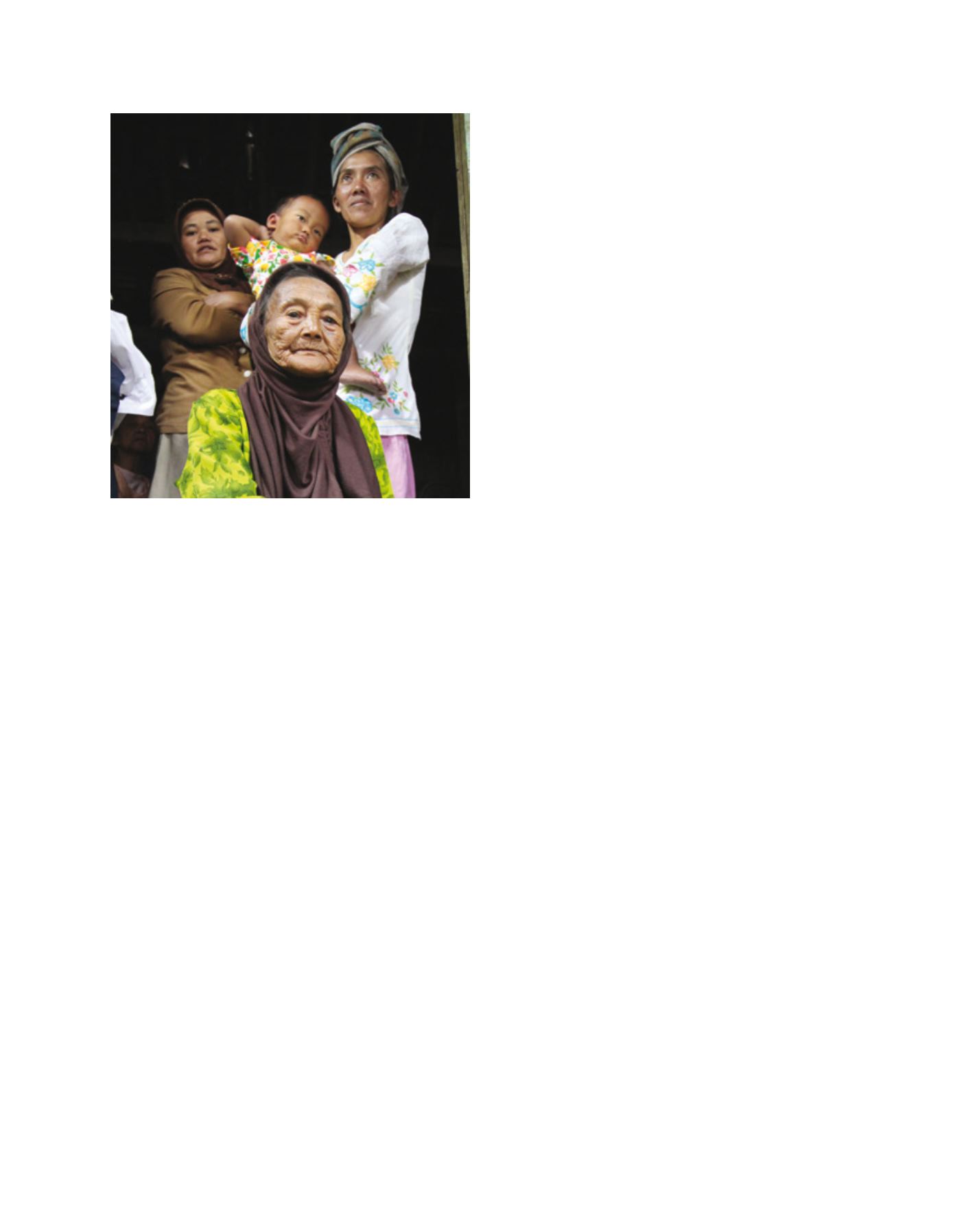
A family-based approach is essential in building people’s capabilities to
support well-being in every stage of life, from birth to old age
Image: Lindsay Stark