


 130 / 210

[
] 128
C
onfronting
F
amily
P
overty
of Israeli women, which are near the OECD average,
13
are
largely unaffected during motherhood. While 77 per cent
of Israeli women aged 25-44 without children are in the
labour force, the figure only drops to 72 per cent for women
with a child under the age of four at home.
14
Among women
with an academic degree, there is essentially no difference
between those with and without young children.
Perhaps Israel’s combination of a family-oriented society
and an integrative approach to women in the workforce is
best exemplified by its long history of supportive policies that
encourage employment by mothers. These include parental
leave arrangements (such as weeks of maternity leave, wage
replacement rate during leave and legislated job protection)
and particularly robust childcare policies (such as public
childcare, childcare subsidy and after school programmes).
15
Job and benefits protection during maternity leave and part-
time work options are also highly characteristic of the Israeli
labour market. Following a nationwide social protest move-
ment in 2011, Israel has begun to implement an existing
law providing for universal preschool starting from the age
of three, which will increase the share of children in public
preschools in 2013 by an estimated 10-15 per cent.
16
Specific
work-family policies and cultural attitudes have been credited
with nearly eliminating the ‘motherhood penalty’ for working
women in Israel, similar to Scandinavian countries and well
ahead of countries such as Germany, the Netherlands, Austria,
the United Kingdom and the United States.
17
Even within an environment supportive of both family and
working mothers, Israeli households face some significant
challenges. A 2012 study shows that the well-being of young,
working families has been negatively affected by decreased
income relative to other Israelis in recent years as well as
growing housing costs. These frustrations, alongside dissat-
isfaction in taxation, transportation and education policies,
culminated in the major 2011 social protest movement
and the subsequent efforts of the government-appointed
Trachtenberg Commission to recommend policy changes.
18
While there is serious concern regarding the well-being
of middle-class families, Israelis at the bottom end of the
income distribution are facing an even more severe situa-
tion. One in five Israeli families live below the poverty line,
which, together with the United States, is the highest rate
among the 22 developed OECD countries in the sample.
19
Because poverty in Israel is concentrated in larger families,
the young are particularly hurt. One in three Israeli children
lives below the poverty line, which is a rate unparalleled in
the developed world.
After an expansive period of welfare programmes in the
1990s helped taper growth in poverty rates, the last 10
years have been characterized by conservative fiscal poli-
cies which reduced such programmes.
20
Child allowances
and welfare-to-work programmes have been cut, while
eligibility for income support tightened and its payments
decreased. The problem is particularly pronounced among
Haredi and Arab households, 57 per cent and 50 per cent
of which live below the poverty line, respectively. Even
when these populations are excluded from the analysis,
Israel still has some of the highest rates of poverty in the
developed world.
21
In contrast to other countries, where poverty tends to
afflict the elderly and single-parent families, it is young,
large families which tend to be poor in Israel. The chal-
lenge for Israel is that moving entire large families out of
poverty requires more resources and innovative policies.
Further, there are unique structural barriers underlying
poverty in Israel. Central Bureau of Statistics data for 2009
showed that Haredi women in Israel average 6.5 children,
22
while recent generations of Haredi men – defying trends
across other developed societies – are progressively lower
educated and less likely to participate in the labour market.
Instead, Haredi boys receive only a partial education in
core subjects and even this ends completely after the eighth
grade. Religious and communal pressures lead most Haredi
men today to engage in part-time or full-time religious
studies throughout much of their life. In sharp contrast to
the growing rates of higher education in Israel, the share
of ultra-Orthodox men aged 35-54 with no more than a
primary school education has increased by more than 50
per cent in the past decade alone.
23
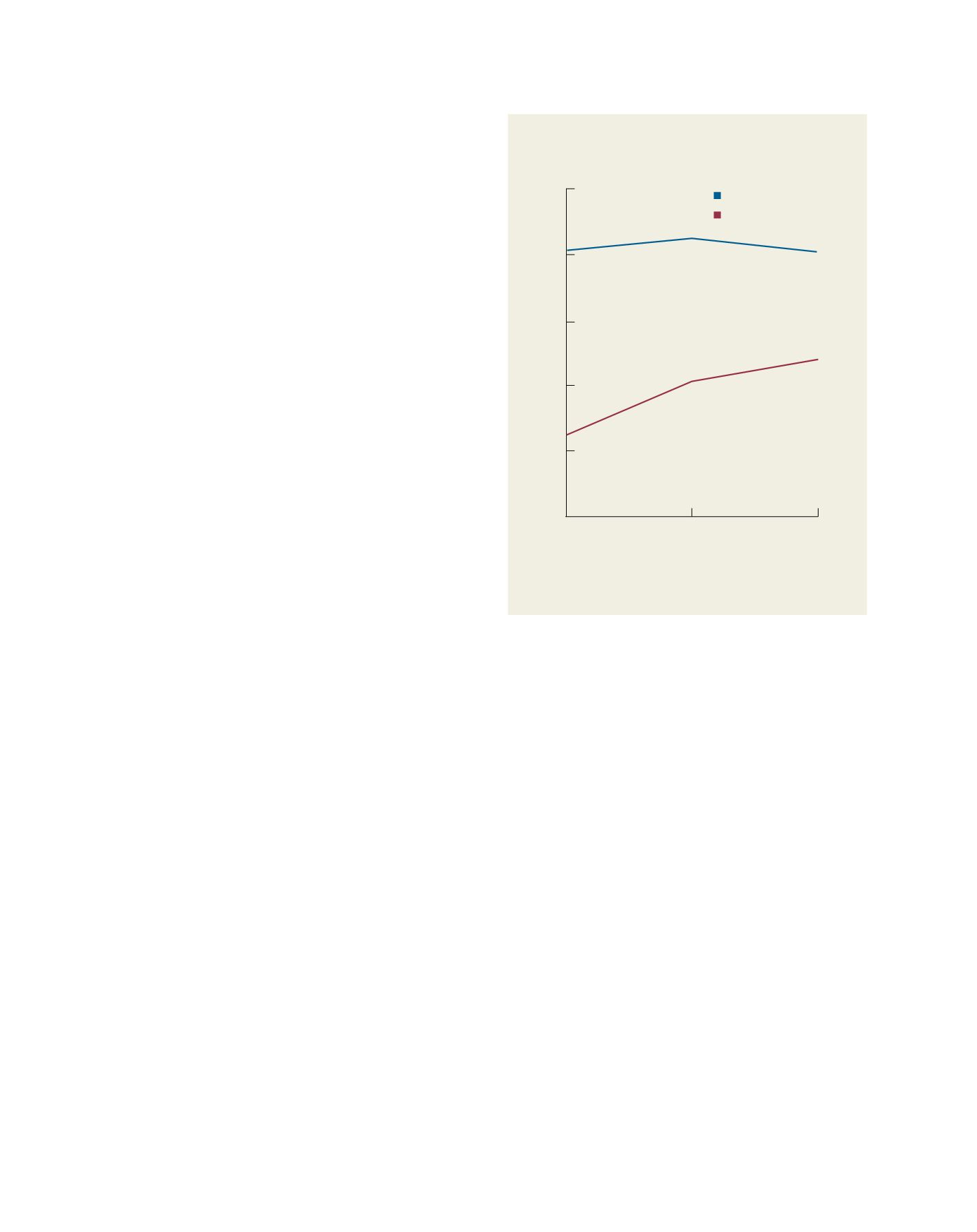
Less than half of ultra-
Orthodox men in the prime working age group of 25-44
are employed, compared to 80 per cent and higher among
all other Israeli men.
Poverty among Arab-Israeli families is caused by a very
different set of underlying factors. First, while growing stead-
ily, employment among Arab-Israeli women remains quite
low, at 30 per cent versus 81 per cent for non-Haredi Jewish
women. These numbers demonstrate the importance of educa-
Employment rates of working-age men by sector
and age, 2008
Source: Eitan Regev, Taub Center
Data: Central Bureau of Statistics, Population Census Data
0
20
40
60
80
81.4
26.8
84.9
41.1
81.0
48.3
100
25-34
*Haredi/m are ultra-Orthodox Jews
35-44
45-54
Haredim*
Non-Haredi* Israelis
Per cent