


 135 / 210

[
] 133
C
onfronting
F
amily
P
overty
in the region.
4
While production seems to be increasing, qual-
itative aspects remain a concern, as the share of undersized
fish and low-economic value fish in the total catch is increas-
ing. In most cases there is over-employment and the fishers’
share in the total revenue is negligible. Some major fisheries
are overexploited and their catch is declining. This is leading
to fisheries management measures, such as time and area
closure, causing temporary loss of income for fisher families.
Fishing is one of the riskiest occupations in the world
as thousands of people die every year while fishing at
sea. While developed fishing nations have surveillance
programmes to track mortality in fisheries, any such
programme is yet to be implemented in WBOB. Towards
this, the BOBP and the National Institute for Occupational
Safety and Health conducted a study during 2007-2010
to understand the mortality pattern and causes of acci-
dents at sea. The study found that mortality in the region
is about three times as high as in the developed nations.
Lack of use of personal safety and communication equip-
ment, weak coordination with surveillance agencies, faulty
vessel construction and frequent bad weather are the major
reasons for this high mortality.
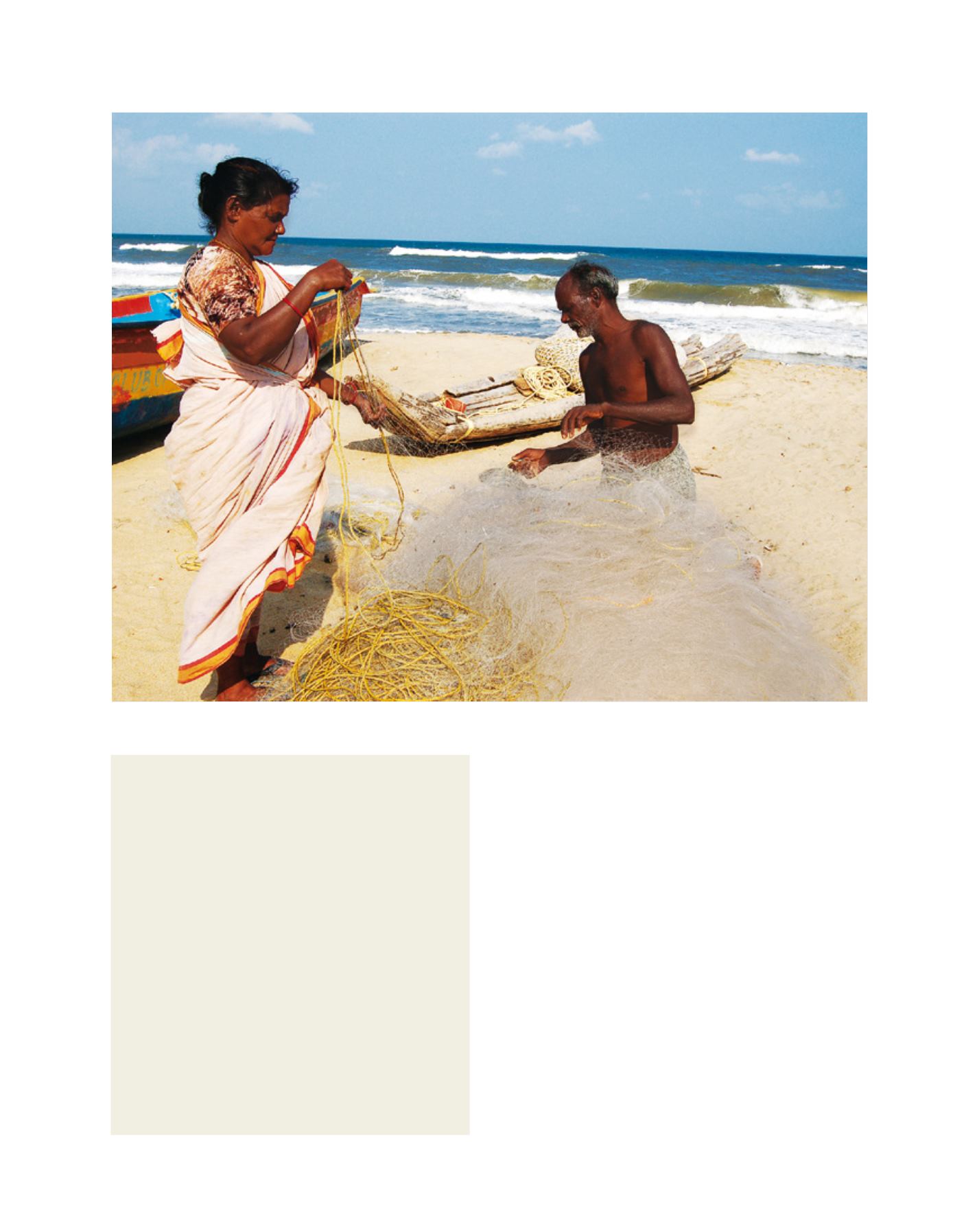
A traditional fisher and his wife preparing for the fishing trip, Mahabalipuram, India
Image: S. Jayaraj
Women fish vendors in Chennai
Fish retailing in Chennai, the capital of Tamil Nadu State in India,
is largely dominated by the fisherwomen. Compared to their
counterparts in Bangladesh or those of rural coastal areas in
Tamil Nadu, the Chennai women fish vendors enjoy better living
conditions. They are also mostly associated with the mechanized
fisheries sector and are economically well off.
However, these fisherwomen also face a host of issues. Their
problems start with the transportation of fish from Chennai fishing
harbour and wholesale markets to their retailing locations. Public
transporters and commuters often object to carrying fish due
to smell and seepage. The marketplaces do not have adequate
refreshment or toilet amenities for the women. The transportation
problem has been partially addressed by Government-provided
dedicated rail coaches for vendors, and women catering to the
same locality have formed groups to hire private transport.
Apart from logistics, another major issue is to properly preserve
and display products during retailing. Since fish is highly perishable,
it perishes quickly in Chennai’s tropical weather if not properly
insulated. The use of ice boxes, promoted by the BOBP in the early
1990s, is yet to be adopted by all fisherwomen. The Government is
also promoting the use of ice boxes by providing small subsidies to
offset the cost. The availability of quality ice is also a constraint at
times for these fish vendors.