


 141 / 210

[
] 139
C
onfronting
F
amily
P
overty
In December 2011 a new law on social assistance was adopted
in Romania, creating a unified and coordinated legal and insti-
tutional framework for the development and implementation
of public policies.
Romania has focused income support measures on support-
ing households with children and has introduced an allowance
for families which is linked to the school attendance of children
from the beneficiary families. Over the last year, Romania has
reformed the minimum income scheme by extending the cover-
age of social transfers so that a minimum income is guaranteed
to every citizen. The conditionality of benefits, such as means
testing and linkage with willingness to accept job offers, has been
strengthened. The guaranteed minimum income, family allow-
ance programmes, heating benefit and child-raising allowance
programme, along with some programmes in the social assis-
tance field, were modified beginning in January 2011.
Progress comes from accomplishing many small things, and
we therefore pledge our continuous support for the improve-
ment of the Romanian social assistance system. For the
next period we intend to continue our improvements, being
confident that all these efforts will play a key role in social
assistance development. The measures will include:
• focusing on programmes devoted to low income families
(social aid, family allowances, heating aid)
• harmonizing the eligibility criteria for programmes
devoted to low income families
• consolidating these programmes into one single
programme, whose indicative title should be ‘minimum
insertion income’, for 2013
• raising the co-accountability of those who receive the
minimum insertion income by conditioning the payment
of benefits on the school results of children and on the
active search for a job in the case of parents
• reducing the costs of child-raising allowance and the
period in which it is paid
• consolidating payments to disabled persons into one single
social security benefit and introducing income testing for
all beneficiaries who are part of wealthy families
• performing checks (inspections) in all social assistance
programmes that are exposed to a high risk of error or
fraud (social aid, family benefits, heating aid, benefits paid
to the disabled, child-raising allowances)
• increasing the effectiveness of social inspection activities by
introducing client profiling (a system whereby irregularities
can be reported) and an efficient sanctions policy
• developing an integrated management information system
that should be used for paying social assistance benefits,
for detecting suspected fraud or error cases by cross-
checking the information in public databases, and for
supporting a result-based management model
• interconnecting the databases that refer to social rights
beneficiaries with other relevant data sources
• simplifying administrative procedures by setting up
a single point of submission and establishing a single
application form to claim social assistance benefits.
In 2013, the Romanian Government re-entered a firm path
of combating family poverty. Its measures include increas-
ing the minimum wage by 15 per cent and planning a
continuous increase in 2014; increasing pensions with the
inflation rate by applying the pensions point for the first
time since 2010; introducing electrical energy heat social
aid; increasing the minimum guaranteed income by 13 per
cent; increasing the allowance for family sustainment by 30
per cent; and promoting and adopting a new bill for child
protection to further protect the rights of children with
parents working abroad.
By the end of 2014, Romania will have a new strategy for
combating poverty and promoting social inclusion for 2014-
2020, focused on family as the main social concept.
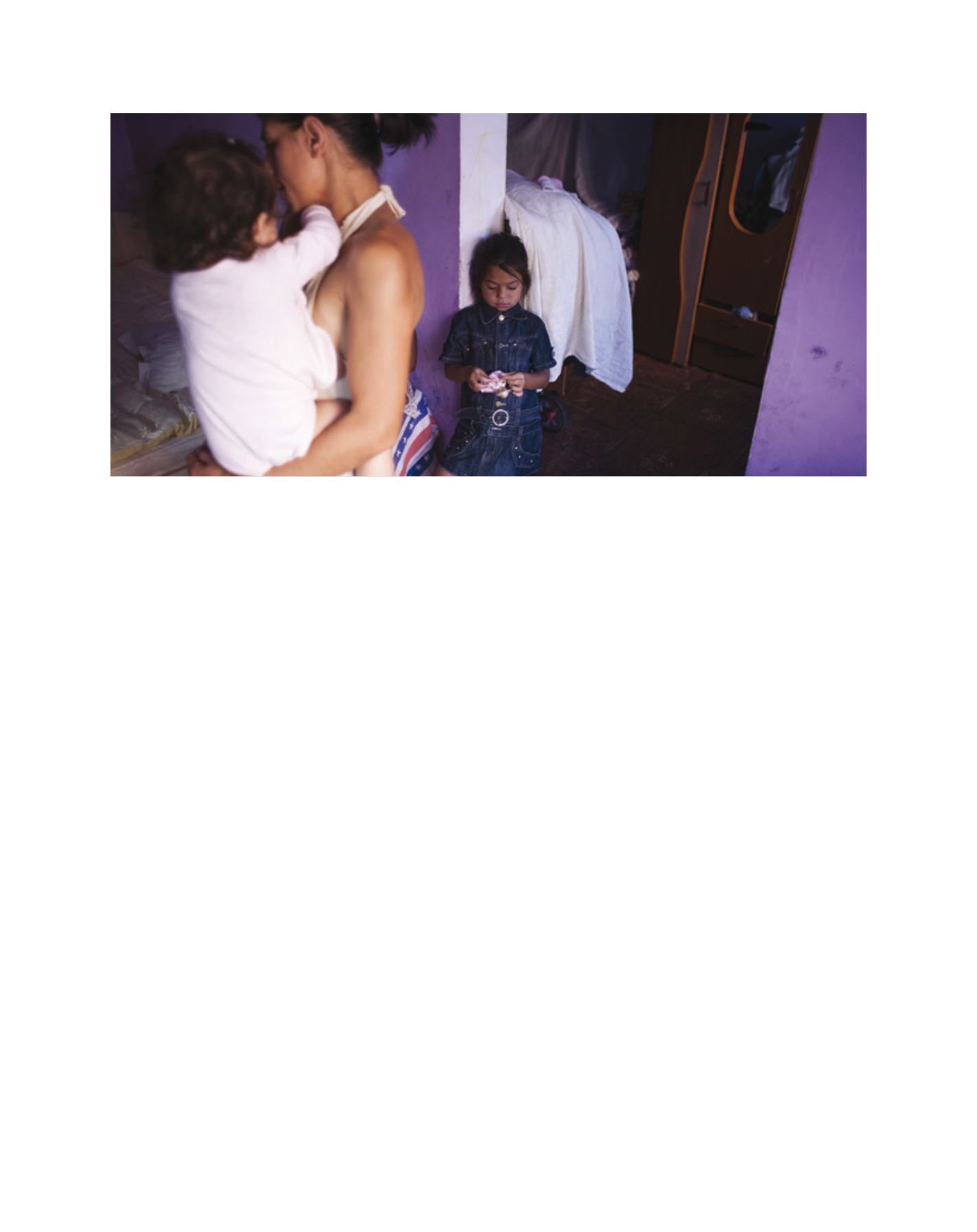
Romania’s new strategy for combating poverty and promoting social inclusion will focus on family as the main social concept
Image: www.mmuncii.ro