


 145 / 210

[
] 143
E
nsuring
W
ork
-F
amily
B
alance
restrictions, restrictions on particular groups? Questions
that concerned working families were largely unanswered
at a global level.
Important steps were taken by many to document the
experiences of working families in individual coun-
tries. Together with an international team of researchers
I (Jody)
1
joined these efforts, launching the Project on
Global Working Families to carry out the first initiative
to examine these realities on a global scale. Through this
project, we conducted in-depth interviews with over 2,000
families on six continents. We used household surveys
of more than 55,000 people to understand the frequency
of families’ challenges and opportunities among a larger,
representative population. We visited workplaces ranging
in size from 26 employees to over 100,000, from factory
floors to wholesalers and service centres.
We found that many issues facing families posed serious
risks. More than one in three of the working parents we
interviewed had been forced to leave a young child home
alone, while 27 per cent had left a child in the care of another
child. Nearly 40 per cent of parents had needed to leave a
child home alone while sick, or sent a sick child to day care
or school. Almost one in four had taken children to work
with them, frequently under unsafe conditions, for lack of
other care options. Many of these parents had already lost
jobs or promotions due to caring for a sick child. Poorer
families were more likely to experience these conflicts.
We also found that while circumstances differed in
important ways, the commonalities were enormous. Across
borders, hundreds of millions of parents struggled with
balancing their desire and need to work – both for its own
sake and to provide for their families – with their desire
and need to care for their children and ageing parents.
This realization was critical – it meant that policymak-
ers could recognize the value of learning about and from
the policy approaches taken by different countries to these
common problems. This informed our next initiative: to
collect information on the legal and policy approaches that
nations had used to make work and family complementary,
rather than competing, responsibilities.
Over several years, deeply informed by the work of differ-
ent United Nations bodies and partnerships across academia
and civil society, we launched the WORLD Policy Analysis
Center. Among our first initiatives was the systematic anal-
ysis of the workplace policies in place in all 193 United
Nations member states that would enable working families
to balance paid work and care-giving – from leave to care
for infants, to policies governing night work and overtime,
to sick leave protections and more. This involved a dedi-
cated, multilingual research team translating thousands of
pages of legislative text and other sources of information
on national policies into a comprehensive, comparative,
quantitative database.
Twenty years after the first International Year of the
Family, how are nations doing on support for working
families? We have learned that when the global commu-
nity gets behind an initiative, dramatic progress can be
made – maternal leave is a flagship story of success. The
global community has been committed to maternity leave
for almost a century; the International Labour Organization
adopted its first Maternity Protection Convention in 1919,
and this commitment has been renewed in numerous United
Nations conventions since then. This commitment has borne
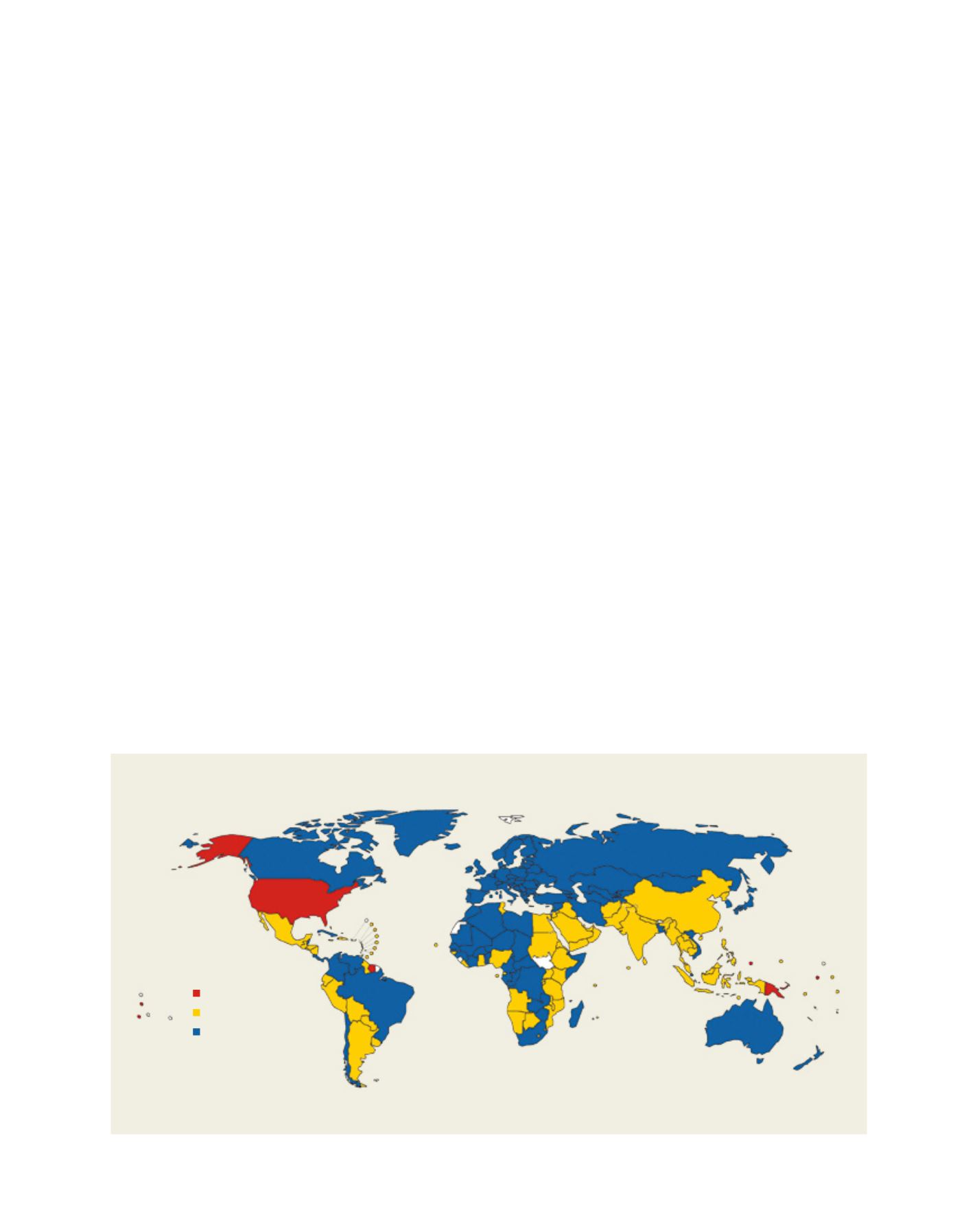
results: almost every United Nations member state has legis-
lated paid leave for new mothers, with just seven countries
failing to meet this near-universal standard.
We have also demonstrated the economic feasibility of
supporting work and family. Again, countries at every
income level have managed to make significant change.
Countries with the most competitive economies over-
Is paid leave available for mothers of infants?
Source: WORLD Policy Analysis Center, Adult Labour Database
Yes, 14 weeks or more
Yes, less than 14 weeks
No paid leave