


 147 / 210

[
] 145
Fathers and work-family policies
Professor Margaret O’Brien, Director, Thomas Coram Research Unit, Institute of Education, University of London
E
nsuring
W
ork
-F
amily
B
alance
F
athers’ active participation in family life will likely
be one of the most important social developments of
the twenty-first century. Social scientists argue that
today’s children wish for a relationship with their daddy
not only as an authority figure or ‘father of duty’, but
also as a human ‘loving father’. In many places across the
world fathers are expected to be accessible and nurturing
as well as economically supportive to their children. Caring
father images are now part of everyday culture through
advertising and depictions of sporting icons. In 1975 the
preeminent fatherhood scholar Michael Lamb lamented
that fathers were the “forgotten contributors to child devel-
opment.” Thirty-five years later in
The Role of the Father in
Child Development,
1
he declared: “How do fathers influence
children’s development?: let me count the ways.”
Over recent decades, the issue of fathers in families has devel-
oped an increasingly global focus in research, practice and
policy. In 2010 the first international conference on fatherhood
in Asia took place; in 2011 the first United Nations Report on
Men in Families and Family Policy in a Changing World was
published; and in 2013 advocacy for active fatherhood became
global with the emergence of the global fatherhood campaign,
MenCare, across 25 countries on five continents.
But who are fathers and what do they typically do in the
families and communities in which they live? Research has
heightened our knowledge about the diversity of fathers as
individuals, the variety of ways men engage in fathering (their
behaviours) and the nature of fatherhood itself as a set of social
and cultural norms. Even within the same kin group, fathers
may behave differently to their children depending on a child’s
gender or a father’s age and cohort position. Just as mothers’ rela-
tionships with their children vary, so too do fathers’ and, as the
research evidence accumulates, it shows that fathers are critical
to children’s well-being. Children benefit and are at risk from the
life histories both fathers and mothers bring to their parenting.
Engaged and caring men are important in the lives of
women and children, and being engaged in family life in turn
benefits men’s health and well-being. Results from longitu-
dinal research show that children who have involved fathers
have fewer behavioural problems, fewer conflicts with the law,
less subsequent financial vulnerability, better cognitive devel-
opment and school performance, and overall feel less stress
during adulthood. Conversely, evidence points to the adverse
impact on children of dysfunctional or violent fathers.
An important distinction is between biological/genetic fathers
and ‘social fathers’, who are not biologically connected to the chil-
dren they live with and support. Social fathers may be step-fathers
– one of the fastest growing categories of fathers in high-income
countries – or kin members such as uncles or grandfathers who
take on paternal responsibilities when biological fathers are absent
through lone motherhood, separation or migration.
The increase in divorce and re-partnering towards the end
of the last century has been a key demographic change shaping
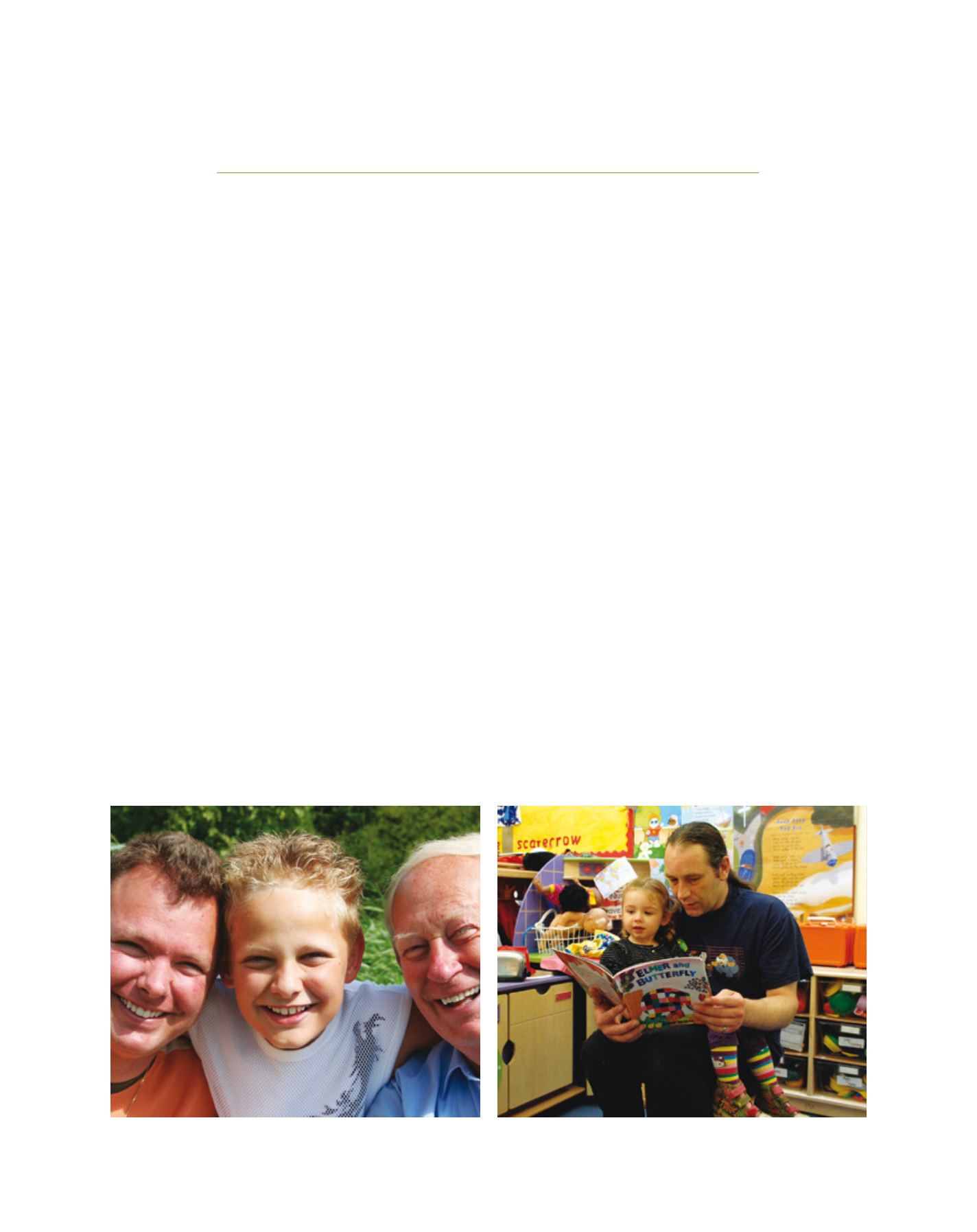
Image: The Fatherhood Institute
Image: The Institute of Education
Children are now more likely than in previous generations to experience more than one father figure throughout their life course