


 152 / 210

[
] 150
E
nsuring
W
ork
-F
amily
B
alance
the number of children attending school who have lost one or
both parents against those of the same age with both parents
alive. In sub-Saharan Africa, 91 orphans go to school for every
100 children of the same age with both parents alive. In South
Asia, this ratio is even worse, dropping to 72 orphans for every
100 children of the same age with both parents alive.
The facts for child marriage, which often involves the
marriage of adolescent girls to adult men, are equally alarm-
ing. Eleven per cent of girls worldwide are married before
the age of 15, jeopardizing their rights to health, education
and protection; more than one third are married by the age of
18. Child marriage often leads to pregnancy and parenthood
for adolescent female spouses. This impedes these adolescent
girls from fully realizing their rights as children and often
serves to perpetuate the intergenerational cycle of poverty and
inequity, as impoverished adolescent mothers give birth to
children who face significant disadvantages from birth.
An agenda for children and families
What can be done to break this cycle, and give each and every
child the opportunity to grow up in a caring, supportive and
protective family? There are no easy answers or quick fixes. But
there are actions that can contribute to supporting families, to
enable them to better realize the rights of their children.
First, governments must examine their support to families
and children, particularly the poorest and most marginal-
ized, and maximize their actions in support of them. Chief
among these efforts is to fulfil their commitments under the
Convention on the Rights of the Child, to recognize and
support the diversity of family structures, provide economic
support to impoverished families through social protection
and inclusive growth strategies, and to support positive
parenting at the same time as defending the rights of children
against all threats, including any that may originate within the
family and community.
Second, parents must become an integral part of all deci-
sion-making processes that affect children’s lives, including at
school, in the home and in political forums, from inception
to completion.
Third, families and communities must know the rights of
children, and be supported in their efforts to demand that
these rights be met. Equally important is that no family or
community member must ever be immune from prosecu-
tion for acts that violate children’s rights to protection from
violence, abuse and exploitation.
Fourth, the post-2015 agenda must underscore the
fundamental importance of families to stable, prosperous
and rights-respecting societies, and propose measures to
strengthen and support families in the rapidly changing world
of the twenty-first century.
Finally, a global conversation about the changing nature of
family and its implications for children, childhood and real-
izing the rights of all of the world’s 2.2 billion children needs
to be opened as we mark the International Year of the Family
and the twenty-fifth anniversary of the Convention on the
Rights of the Child. And that conversation must be sustained
far into the future.
Across the world, the size, demography and even the
concept of the family is changing. Family size is shrinking in
line with diminished fertility rates everywhere. At the same
time, family demographics are changing as many societies age
at a rapid rate, and the family demands of children are begin-
ning to be matched or even surpassed by those of the elderly
in some contexts. Our notions of family, long seen as biologi-
cal and blood tied, are also being challenged by new societal
structures, questions and interlinkages. As these change, so
must our understanding of family, accompanied by a debate,
a resolution and conclusion of the responsibilities of fami-
lies, however constructed and accepted, to the cornerstone
of family: children.
Families are pivotal to realizing children’s rights
Every child should have the opportunity to grow up in a caring,
supportive and protective family
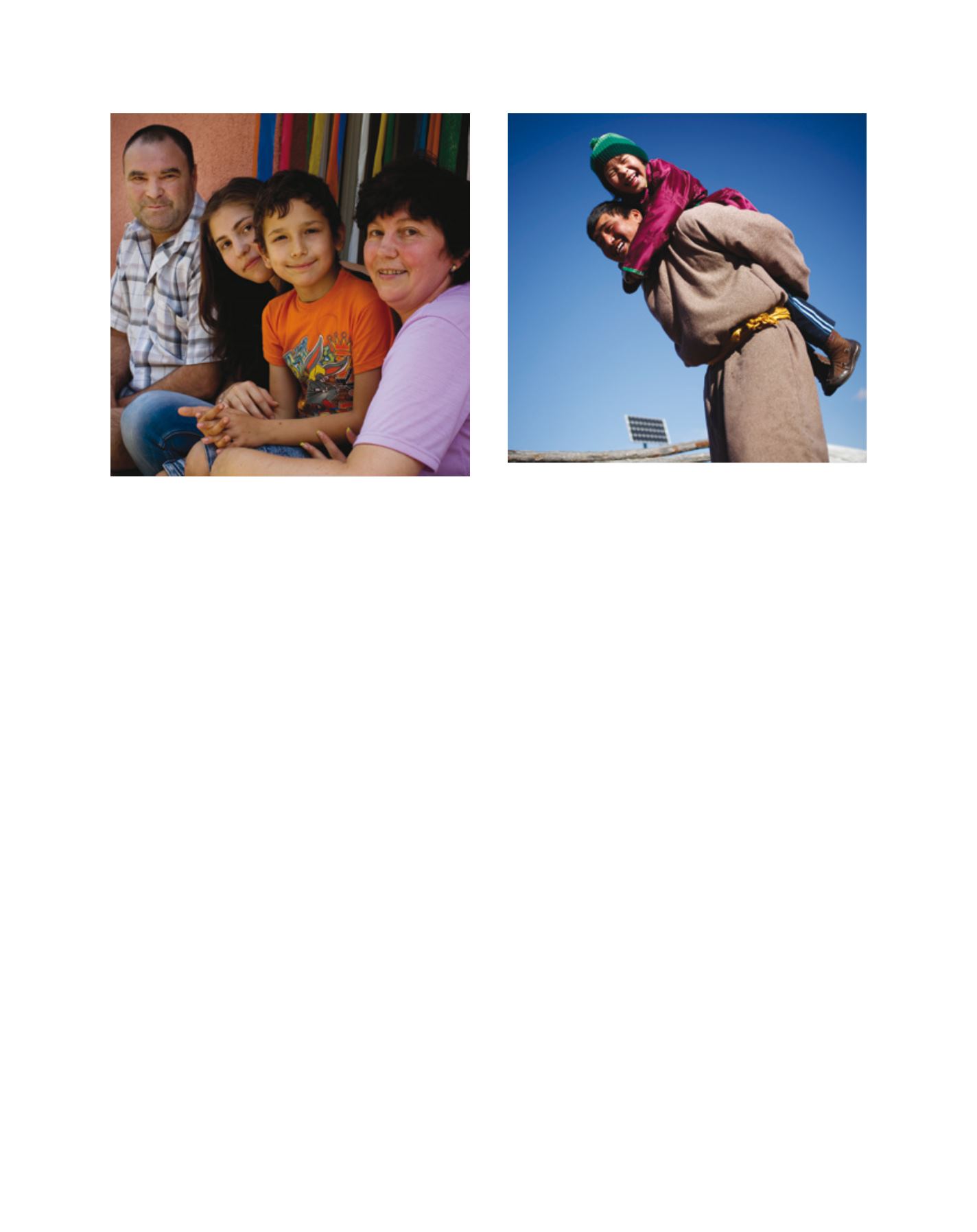
Image: © UNICEF/NYHQ2011-1173/Holt
Image: © UNICEF/NYHQ2012-1781/Sokol