


 151 / 210

[
] 149
E
nsuring
W
ork
-F
amily
B
alance
healthier, have higher earnings and participate more in society.
This is especially important for children in poverty. A good
foundation in the early years makes a difference through adult-
hood and even gives the next generation a better start.
UNICEF’s strong focus on community-based primary health
care, adopted since the early 1980s, came in response to growing
evidence that low-cost techniques such as growth monitor-
ing, immunization, oral rehydration and breastfeeding had the
potential to save millions of children’s lives if the focus of service
delivery was changed from institutions to families. Poor fami-
lies in particular often make enormous sacrifices to ensure their
children have access to and utilize quality health care, adequate
nutrition, safe water and decent sanitation, and can attend
school. Protective families form the first line of defence for chil-
dren against violence, abuse, exploitation and discrimination,
and the first safety net for them against shocks and crises.
Parents are of fundamental importance to child survival,
development and well-being. The facts speak for themselves,
particularly on mothers’ education. Globally, over half of the
reduction in under-five child mortality during the past four
decades can be attributed to the increase in women’s educa-
tion. Children of mothers with secondary education or higher
are twice as likely to survive beyond the age of five as children
of mothers who have no education. A child born to a mother
who can read is 50 per cent more likely to survive past five
years old. Each extra year of a mother’s schooling reduces the
probability of an infant dying by 5-10 per cent.
Educated women are less likely to marry early and more
likely to have smaller and healthier families. They are also
more likely to get a job and earn a higher wage. Educated
women are more likely to send their children to school, and
better able to protect their children from malnutrition, HIV
infection, trafficking and sexual exploitation.
The opposite, however, is also true. Many children are
deprived of a loving, caring family for numerous reasons
– the loss of parents, separation related to displacement,
domestic violence and abuse, migration and extreme poverty,
among others. Children’s vulnerability to poverty and ineq-
uity, exclusion and discrimination, and violence, abuse and
exploitation, increases markedly without the caring support
and guidance of families. When they are deprived of paren-
tal care or face violence or abuse within the home, children
struggle to reach their full potential and often experience
deprivations that have lifelong consequences.
Children who are often, though by no means always, lacking
family support are especially vulnerable to exclusion and
discrimination: orphaned children; street children; children
separated from home and family by exploitation, including the
worst forms of child labour; children in institutions, including
juvenile detention; and children who prematurely enter into
adult roles such as marriage and parenthood. Robust statis-
tics are often unavailable for many of these children, but they
do exist for the first (orphans) and last (child marriage and
adolescent parenthood). Focusing on these two issues gives
some insight into how loss of family protection affects chil-
dren and the extent of these deprivations themselves.
Worldwide, in 2012 around 150 million children under
the age of 18 had lost one or both parents due to any cause.
Families and communities rally round when children lose one
or both parents: there are innumerable stories and experiences
of family and community care and protection for orphaned
children. But the loss of one parent, or both, often also has a
devastating impact on the family.
This is particularly true for school enrolment in the poorer
regions of the world. One indicator of the impact of parental
loss is the orphan school attendance ratio, which compares
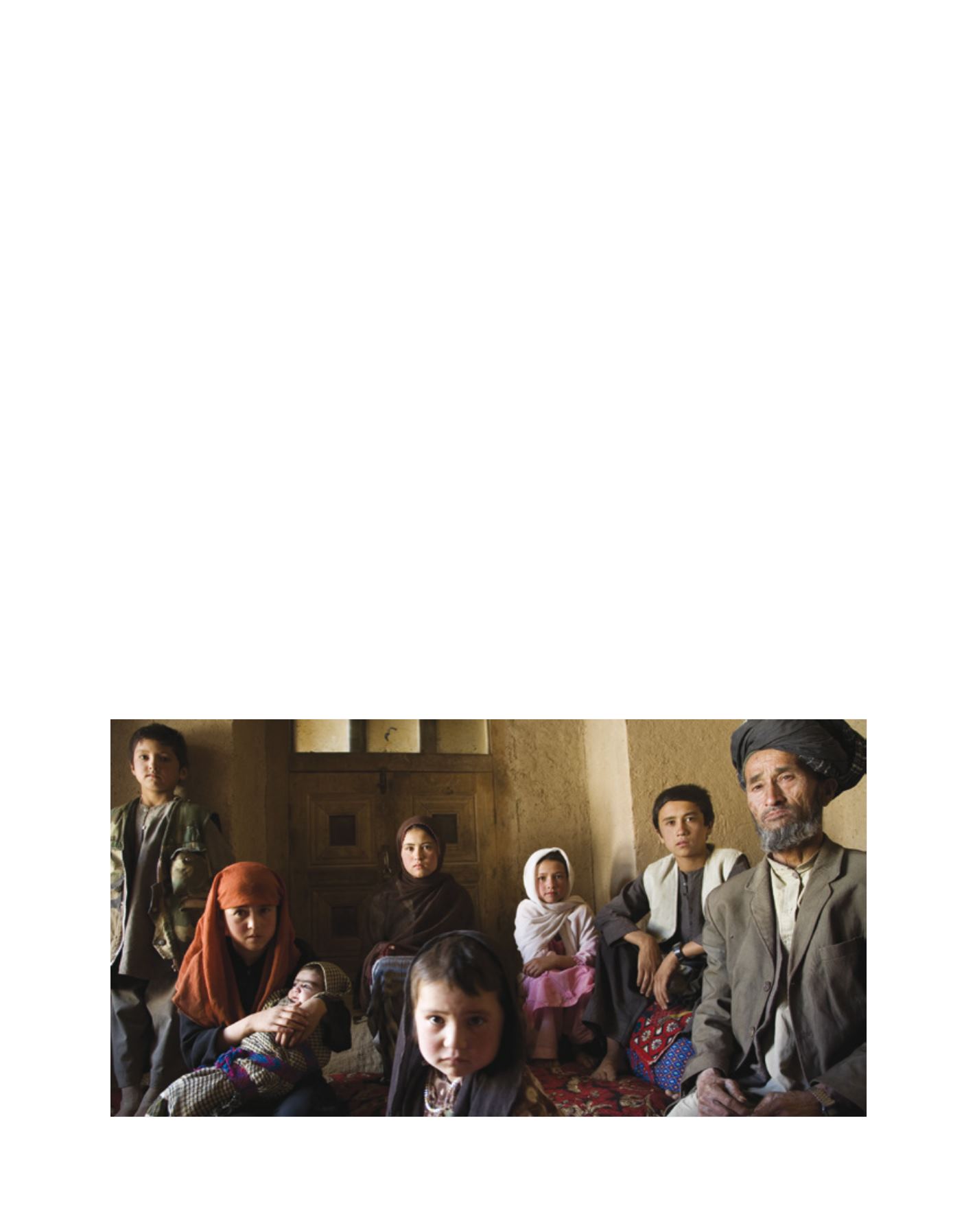
Governments must support positive parenting and defend the rights of children against all threats
Image: © UNICEF/NYHQ2007-1415/Khemka