


 154 / 210

[
] 152
E
nsuring
W
ork
-F
amily
B
alance
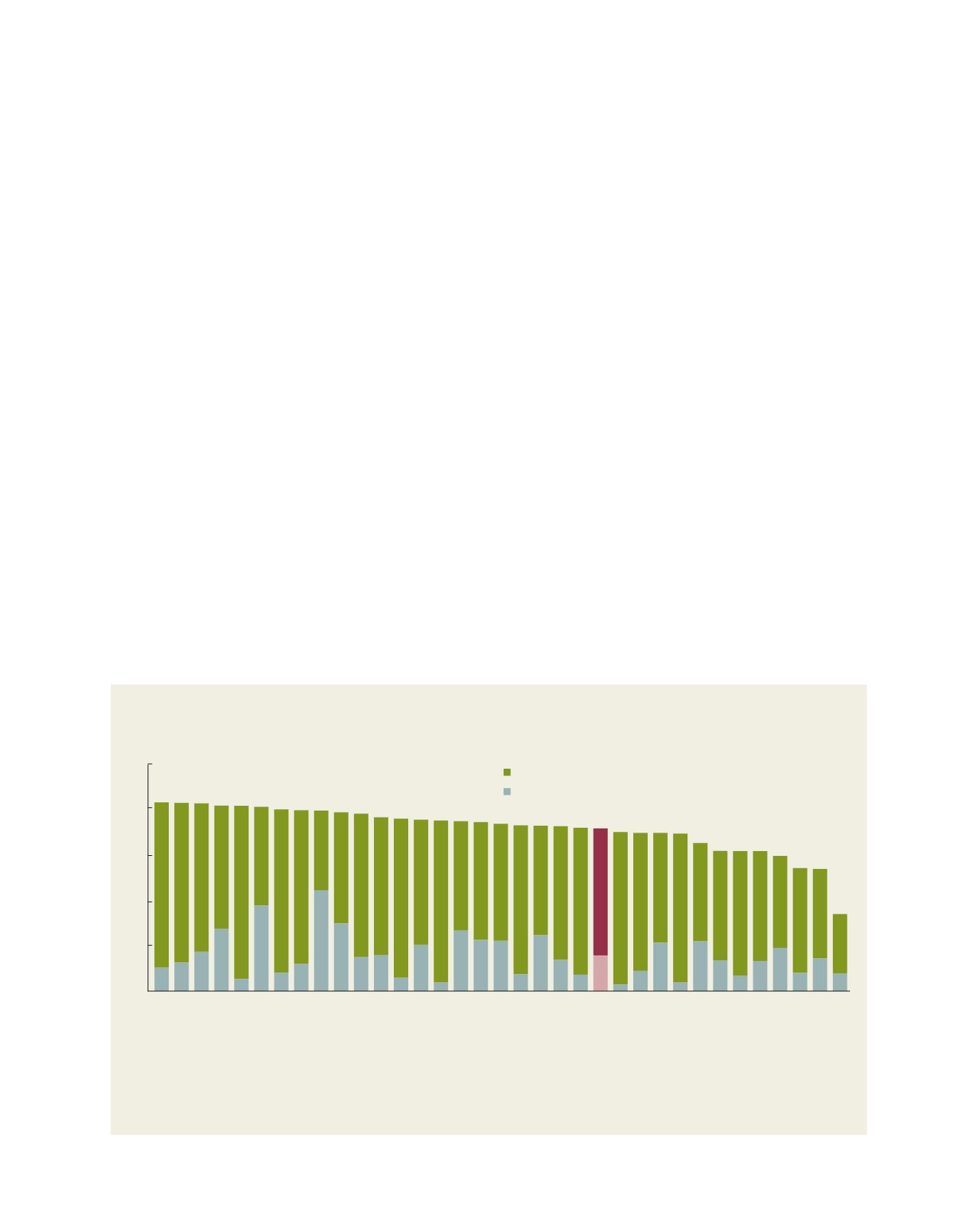
Employment to population ratio, and the share of part-time employment, among women aged 25-54 years
Two-thirds of women (age 25-54) are in paid work often on a full-time basis
Source: OECD (2014b), OECD Employment database
developed economies public spending on child supports
amounts to about 2.5 per cent of Gross Domestic Product
(GDP) and another 6 per cent of GDP is spent on education.
Evidence suggests that the effectiveness of public invest-
ment in human capital is highest when it takes place in early
childhood (before compulsory school), when it is focused on
the most vulnerable population, and when it is maintained
throughout childhood. However, that is not yet what happens
in most countries. Available data for the countries that belong
to the Organisation of Economic Cooperation and Development
(OECD) show that on average, spending per child is lowest
during the early years and increases as children grow up.
Many countries provide tax support and cash allowances to
families throughout childhood, but spending on cash transfers
is highest during the early years with the payment of mater-
nity benefits and income support benefits during parental
leave. In some countries, such as the Czech Republic and
Finland, these benefits can last until the child’s third birthday.
Interventions during the early years should ensure that formal
childcare services are available when parental leave runs out.
However, inmany countries there are gaps in support where there
is a dip in investment when children are around one to four years
of age. Investment in children during the ‘kindergarten years’ (age
three to five) is below levels available in later years, when children
attend compulsory primary and secondary education.
The role of childcare
Investment in a continuum of parental leave and formal child-
care supports as well as family-friendly workplace practices
(such as working part-time) also helps people to realize their
plans to have children at the time of their choice, as these
supports are crucial to combining work and family aspirations.
By contrast, if people have to choose between babies and bosses
it tends to reduce either birth or female employment rates or
both. For this reason in many industrialized countries birth
rates have fallen to 1.2 or 1.5 children per woman. Birth rates
are closest to two children per woman in countries such as
the Nordic countries, France, the Netherlands and the United
Kingdom which appear to have more effective work-family
policy mixes of financial support to families, family-friendly
workplace arrangements and formal childcare supports.
Childcare is particularly important for reconciling work and
family life. Parents are more likely to be in work, and to be
more productive and happy in work, if childcare is accessible,
affordable and when they are confident that their children are
being looked after properly. Since the late 1990s, the propor-
tion of children under six years old in formal childcare has
grown from around 33 per cent to over 50 per cent across the
OECD.
2
However, across countries and families the use of
childcare differs. In Sweden, one of the richest countries in
the world with many dual-earner families, publicly provided
preschool services have universal coverage for children from
age one or two years onwards. Often it is the father who
brings the child to preschool in the morning and they are
usually picked up by their mother in the afternoon: children
in Sweden generally attend preschool for six hours per day.
Because of the prevailing culture of long working hours in
Korea, children with working parents use childcare for more
hours per day: eight hours and 23 minutes per day on average;
and almost one-third of children with both parents in work
attend childcare for more than nine hours per day. Elsewhere
day-care programmes are targeted at low-income families,
Part-time employment as a share of the employment/population ratio
Employment/population ratio
Sweden
Iceland
Norway
Austria
Slovenia
Switzerland
Finland
Denmark
Netherlands
Germany
Canada
France
Estonia
Luxembourg
Czech Rebublic
United Kingdom
Belgium
New Zealand
Portugal
Australia
Israel
Poland
OECD Average
Slovak Republic
United States
Japan
Hungary
Ireland
Spain
Korea
Chile
Italy
Greece
Mexico
Turkey
0
20
40
60
80
100
Note: For example, in The Netherlands, 79% of the women
aged 25-54 are in paid work; 44% of the women aged 25-54 work part-time