


 149 / 210

[
] 147
E
nsuring
W
ork
-F
amily
B
alance
grants highly esteemed certificates to employers whose action
plans and achievement meet nine conditions, and allows them
to use a certification mark called ‘Kurumin’. The conditions
include: encouraging fathers to take childcare leaves (at least
one male employee must take parental leave during the period
of the plan); promoting shorter working hours; and measures
to reduce overtime work.
In terms of macro-level policy interventions there is growing
evidence that employment-based family support measures–such
as maternity and paternity leave following childbirth and paren-
tal leave to care for children in the early years –has the potential
for improving child health. Tanaka (2005) has conducted large-
scale secondary analyses of parental leave arrangements and child
health outcomes for 16 European and 18 of 30 OECD countries
respectively. Both programmes of work suggest infant mortality
and morbidity gains associated with parental leave.
Statutory leave provision for fathers at the time of a child’s
birth (paternity leave) or later, in the early years of a child’s
life (parental leave) are significant policies. A focus on fathers
is timely as the complexity, scope and speed of policy change
since the late 1990s in this area is striking.
Designated father-targeted or reserved schemes enhance
fathers’ utilization rates. Blocks of time which are labelled
‘daddy days’ or ‘father’s quota’ are attractive to men and
their partners. At this point in time fathers (and their part-
ners) may need more explicit labelling to legitimize paternal
access to the care of infants and children. Even when condi-
tions are favourable it takes time for utilization to become
the dominant pattern.
The Iceland ‘3+3+3 month’ model has significantly shifted
male behaviour in a relatively short period of time. It was
introduced early in the 2000s, and by 2006 over 90 per cent of
Icelandic fathers were taking parental leave. Ingólfur Gíslason
3
notes: “Probably, there have never been more Icelandic fathers
active in caring for their children than there are today.”
In the current economic context the future of men’s behav-
iour as fathers, partners and workers is uncertain. There are
countervailing value positions and the preference for the
father as an economic provider-in-chief remains a strong
cultural force in many countries. Nevertheless, governments
and civil societal actors across the world are attempting to fit
fathers into work-family polices and continuing these efforts
despite global economic turbulence.
Expanding national policies and programmes to promote a
stronger engagement of men in family care activities through
the life course will help modernize work-family policies to
catch up with the changing role of women. In the twentieth
century many post-war public polices created systems and
services which assumed a full-time female home carer support-
ing a full-time male breadwinner, a work-family model which
no longer fits the circumstances of twenty-first century families.
MenCare and The Fatherhood Institute
MenCare
is a global fatherhood campaigning organization. Its mission
is to promote men’s involvement as equitable, non-violent fathers and
caregivers in order to achieve family well-being and gender equality. It
works at multiple levels to engage men as caregivers and as fathers:
as program participants in fathers groups, community mobilizers
who push for progressive family legislation, and institutions to see
engaging men as caregivers as a key dimension of gender equality.
Practice areas include: corporal punishment; the rights of immigrant
and incarcerated fathers.
www.men-care.orgTen themes are the backbone of the MenCare approach:
• Be involved from the start
• Share the care work
• Be proud & show it
• Provide health care
• Just play
• Educate
• Be brave: show affection
• Raise without violence
• Teach equality & respect
• Support the mother.
The Fatherhood Institute
works to promote the benefits of involving
fathers in children’s learning, development and well-being. It wants
to change society to ensure that fathers are recognised, included
and supported alongside mothers in all aspects of caring for their
children; and that boys and girls are educated and prepared for
future roles in sharing active parenthood. It works closely with
women’s and family organisations who share their commitment to
involve fatherhood from pregnancy onwards, because the evidence
is clear just how crucial this is for children. Its mission is A GREAT
DAD FOR EVERY CHILD and to:
• ensure that its activities are informed by a balanced and
comprehensive body of evidence, readily accessible through
open access at
www.fatherhood.org• undertake and commission research and evaluate its work, in order
to compile this evidence base and achieve a good understanding of
the addressed issues and the efficacy of interventions
• pay particular attention to families who are disadvantaged,
lobby for changes in the law, policy and practice to enable and
facilitate greater childcare involvement by fathers
• provide employers and public services with information, training and
consultancy to enable them to engage better with men as fathers
• work directly with mothers and fathers to help them manage
their relationship and work together as a parenting team.
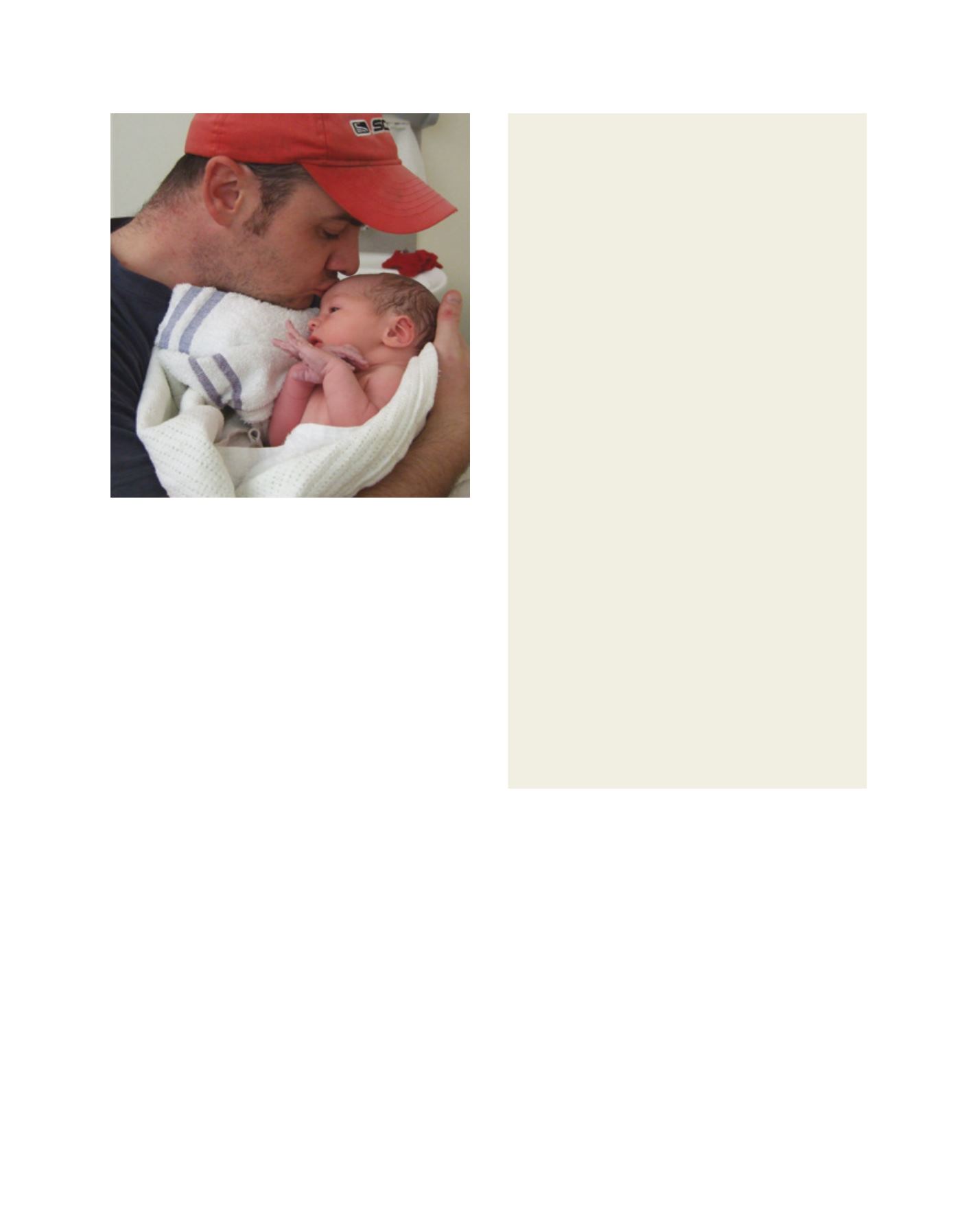
Image: Dr Helen Dodd
Men’s engagement in family is important to their own well-being, as well as
that of their partners and children