


 148 / 210

[
] 146
E
nsuring
W
ork
-F
amily
B
alance
contemporary fatherhood. Divorce rates have now stabilized
and even declined in several countries, partly in connection
with the decline in marriage rates. Nonetheless, divorce, sepa-
ration in consensual unions and re-partnering have changed
the nature of fathers’ families, and they remain a significant
contributing factor in the growth of the number of fathers
living away from their children in different households.
Children are now more likely than in previous generations
to experience more than one father figure throughout their
life course. Some biological fathers may cease to reside with
the children of their first relationship, thereby increasing the
potential for marginalization in family life.
Although non-residential fathers themselves are a mixed
group, evidence shows that they tend to have poorer physi-
cal and emotional well-being (higher levels of depression and
alcohol use) than divorced men without children and fathers
in intact families. It is not known whether the stressful experi-
ences of non-residential fatherhood, as well as divorce, create
these problems or if non-residential fathers themselves have
pre-existing and enduring difficulties.
Working conditions, in particular excessive hours, can be
a barrier to active fatherhood. In rich income countries the
work-family debate of the 1990s was dominated by discus-
sion about the impact on family well-being of long weekly
working hours – the ‘long work hours culture’. Despite the
slowdown in economic activity in many regions of the world,
the working life of parents, particularly fathers and increas-
ingly also mothers, can make sustaining a meaningful family
life hard to manage.
Globally, female participation rates are highest in North
America followed by Europe and Central Asia; sub-Saha-
ran Africa; Latin America and the Caribbean; Asia and the
Pacific; and the Middle East and North Africa.
2
The preva-
lence of the male breadwinner family model has diminished
in those countries which experienced the expansion of female
participation in the labour market. But still, Organisation for
Economic Cooperation and Development (OECD) figures
show that paternal hours in paid work are much longer than
for mothers. For example, while a considerable proportion
(nearly a third) of fathers in couple families work more
than 45 hours per week (especially in Turkey and Poland),
the proportion of mothers working long hours is relatively
small (around 9 per cent), except in Greece (19 per cent)
and Turkey (38 per cent). South Korea, the United States and
Japan make up the top three countries (in order) where the
overwhelming majority of both male and female employees
usually work 40 hours or more per week.
Support measures
There has also been an emergence of specific father-targeted
measures to support parenting and discourage excessive
working in several Asian countries. For example, despite
Japan’s economic downturn and cultural expectation of
work devotion, company-level incentives explicitly signal-
ling changes in fathers’ behaviour have been introduced.
These measures need to be situated in the regional context
of rapid fertility decline since the beginning of the twenty-
first century, with the total period fertility significantly
below replacement level in many Asian countries: lower
than 1.0 in Taiwan and between 1.2 and 1.6 in Japan, South
Korea and China.
Under Japan’s Act on the Advancement of Measures to
Support Raising the Next Generation of Children (2003),
employers are obliged to establish two-to-five-year action
plans by 2015 for improving the employment environment
to support balancing work and child-raising. The Government
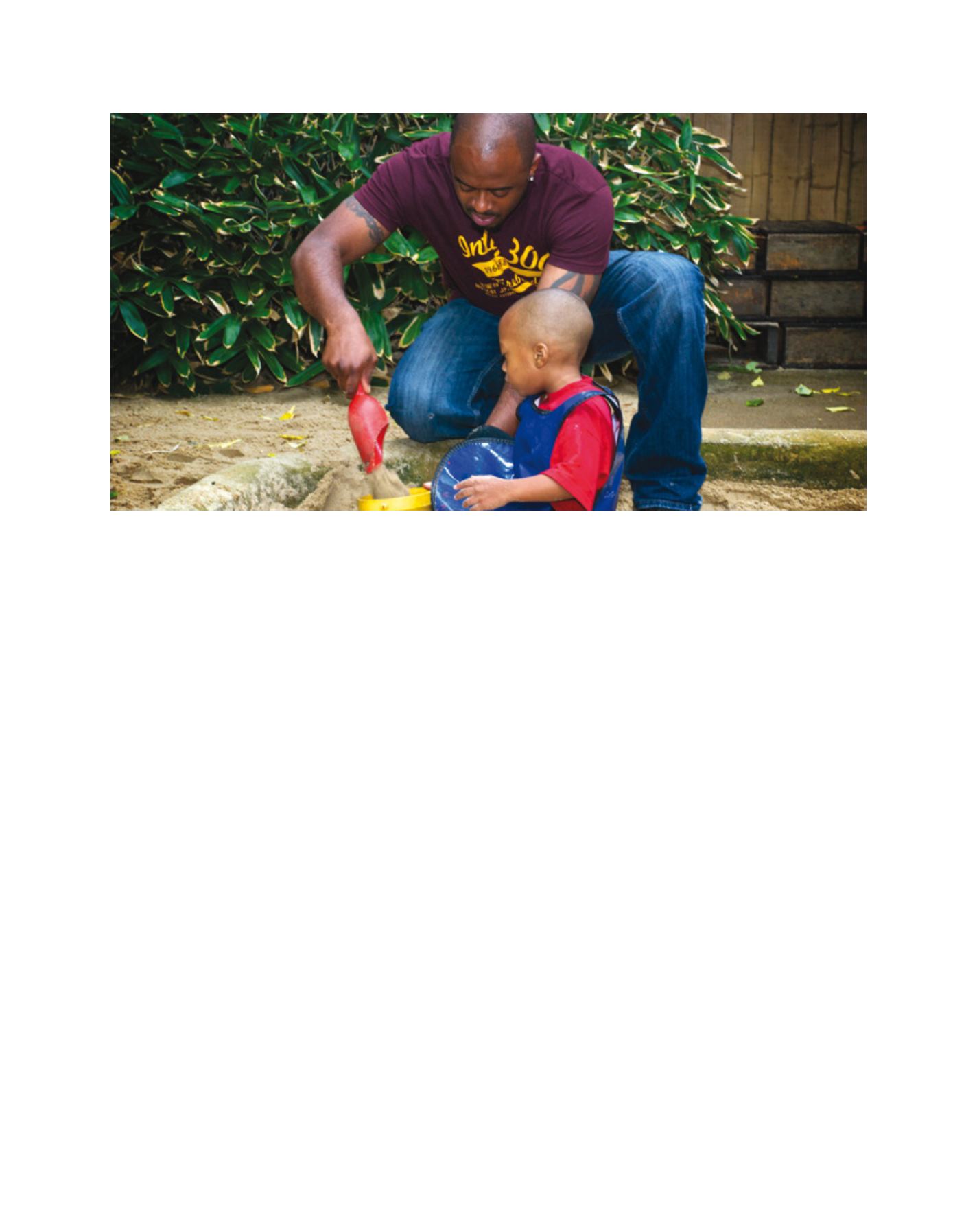
Fathers are increasingly expected to be accessible and nurturing to their children, as well as supporting them economically
Image: The Fatherhood institute