


 157 / 210

[
] 155
Ensuring work-family balance
Agnes Uhereczky, Director, Confederation of Family Organisations in the European Union
E
nsuring
W
ork
-F
amily
B
alance
B
eing able to balance work and family life is an
almost daily preoccupation for many. Achieving
a good balance is key for families to live the life
they aspire to. Too little work will mean less income than
is needed to live in dignity and comfort, and too much
work may compromise the well-being and health of family
members. It is especially important for children that their
parents have enough time to nurture and educate them.
In addition to parenting and household tasks, people also
need time to pursue their interests and hobbies, learn,
play, and recharge their batteries.
What we perceive as the lack of balance in managing work
obligations and family responsibilities – namely a problem of
not enough time – is only the tip of the iceberg in reconciling
work and family life. Our quality of life and subjective well-
being are greatly influenced by the hours we work, both in
paid employment and in our homes. Women and men report
spending different amounts of time on these tasks. According
to the Eurofound European Quality of Life Survey 2011-2012,
women estimate that on average they spend 30 hours a week
providing childcare compared with 17 hours for men, and 14
hours on care for the elderly compared with 11 hours for men.
Housework occupies 16 hours a week for women and 10 hours
for men – all in addition to hours spent in the workplace.
As for the iceberg, whatever we see of it floating above
sea level is tiny compared to its size below the surface.
Similarly, what we perceive as a lack of work-life balance
is the symptom of a greater structural problem that remains
hidden. Unless society manages to collectively tackle the
issues of modernizing the labour market; adjusting it to a
more female workforce; adapting the care system for chil-
dren, the disabled and other dependant family members; and
using innovative solutions to work and family life. All we
will do is scratch the surface of the iceberg, bringing little
change in the quality of life for families.
Before going into detail about the different elements of
work-life balance policies and practices, it is important to
understand how these structural problems developed, and
what are some of the reasons for this imbalance. What is glob-
ally experienced by families, women, men and children as the
conflict between family and work responsibilities, is the build-
ing up of tension between the societal changes of the past 50
years and the inability of the labour market and public policies
to adapt to these changes.
There has been a significant change to family life in the past
years. Europe’s families are working families, and increas-
ingly dual-earner families where both parents want or need
to work. Although women have entered the labour market in
massive numbers, gaining financial autonomy and personal
recognition, they often face different employment condi-
tions to men. They are more likely to be in part-time work,
have employee status or hold a temporary position, and we
know through wage statistics that there is still a significant
gender pay gap of 16 per cent in Europe. Too often, when
there is a family emergency such as an accident, an elderly
parent in need of care or a baby with health problems, it is
the women – the mothers – who leave their jobs to take
on the responsibility. An overwhelmingly large proportion
of informal care is performed by family carers. This is an
invisible workload that can have grave implications for the
out-of-work carer in the long run, such as mental health
issues, physical problems, isolation, social exclusion and
risk of poverty. This is why COFACE-Disability elaborated
the European Charter for Family Carers to recognize the
very important work done by informal carers.
Here is the first important misunderstanding around work-
family balance – it is not only an issue for those in work;
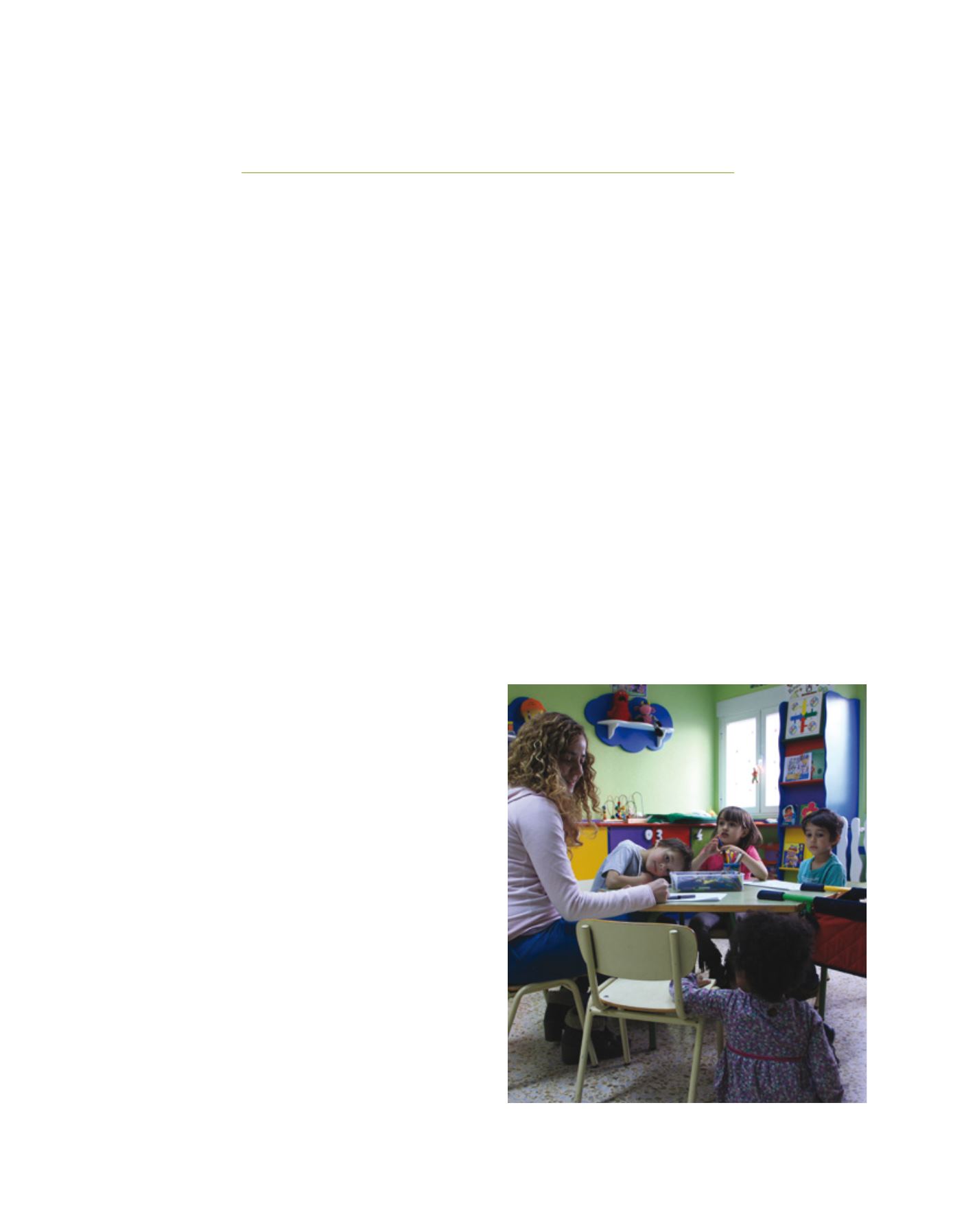
Sectors such as education, health care and childcare have a predominantly
female workforce
Image: FFM Isadora Duncan