


 162 / 210

[
] 160
E
nsuring
W
ork
-F
amily
B
alance
The women of Madagascar
In Madagascar, the involvement of women in money-generating
work is a matter of widespread necessity. In recent years, new
activities have appeared in the countryside which are totally
undertaken by women and children, such as producing and selling
granite chippings for municipal road repairs and construction. This
is very hard physical work, with long days working by hand using a
sledgehammer to break up lumps of granite into chippings. Women
have to carry the materials, balanced on their heads, on foot to the
marketplace where they prepare it for sale and handle financial
dealings with customers. It is the same for other building materials
such as bricks and sand.
This work does not release country women from the traditional
responsibilities of raising children and doing household tasks such
as fetching firewood and water, making meals, grinding rice, doing
the washing and looking after domestic animals – as well as
seasonal tasks like growing rice, transplanting seedlings and all the
jobs related to the harvest.
There are many contributing factors to this exploitation of women,
but the main ones are the submissive attitude and prevailing
general ignorance of country women. Submission to the husband
– to any male – is ingrained by local traditions, ways and customs
and reinforced by religious teaching. It is considered a guarantee of
a harmonious family life and a sign of a successful marriage.
In Madagascar, several generations often live under the same
roof, so the values, principles and traditions of the large family are
transmitted unconsciously and naturally. There are no care homes
for the elderly, and day care is neither widespread nor socially
acceptable – particularly as it is not free.
izing terms: whether a woman is a ‘good mother’ or a ‘bad
mother’, or a ‘good worker’ or a ‘bad worker’. Little consid-
eration seems to be given to the fact that the vast majority
of mothers focus solely on the needs of their family and the
socioeconomic realities they are faced with. They strive to
provide the best for the financial and emotional well-being of
their family. They are neither good nor bad, but rather do the
best they can with the resources and energy they can afford.
The issue of balancing the pursuit of income-generating
activities and caring for dependents is even more acutely felt
by mothers in the poor areas of the world. Here, the majority
of women work extremely long hours either in rural commu-
nities or in the informal economy to make a bare-bones living,
sometimes facing very dangerous work environments while
still having to provide basic care at home. In these countries,
women simply cannot afford not to work, and the question of
their work/family life is posed more in terms of survival than
in terms of striking the right balance.
In rural Madagascar women spend on average 32 minutes a
day fetching water.
6
Thus the time-use in household overhead
production to fill the infrastructure gaps (such as vital water
and energy collection, sanitation and food fetching) dramati-
cally adds to mothers’ already heavy burdens.
7
Mothers around the world face the same crucial pressure of
providing financially for their families’ well-being, while also
needing to provide the nurturing and care-giving necessities
of their household.
It is fair to say that globally, mothers have responded to
this pressure by working even harder and for more hours, to
the detriment of their own personal time. Yet they are still
paid significantly less than their male counterparts or child-
less female cohorts. It has been suggested that mothers earn
less than childless women because they are less productive. In
fact, they are penalized for going on maternity leave, for possi-
bly not putting in as much ‘face time’ at work as their childless
peers, for having to turn down jobs that require overtime, and
for daring to ask for part-time work. They are simply victims
of the perception/stereotype that women with children are not
as much ‘into’ their jobs as others because they are distracted
by the caring and nurturing requirements of their households.
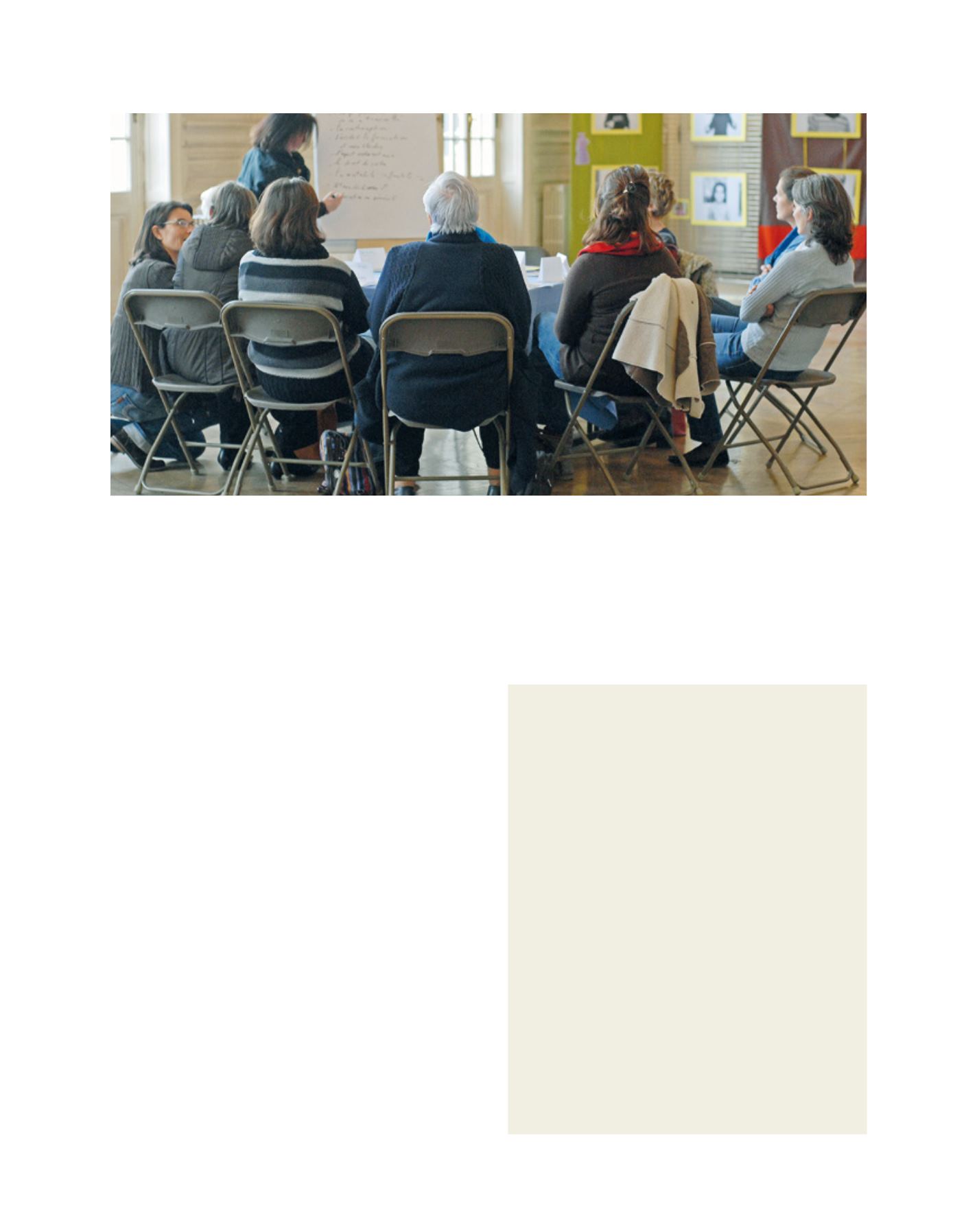
MMM workshops enable mothers to share their best practices, challenges and knowledge
Image: MMM