



 165 / 210

[
] 163
Corporate family responsibility
Mireia Las Heras PhD, Nuria Chinchilla PhD and Esther Jimenez, Researcher,
International Center for Work and Family at IESE Business School, University of Navarra, Spain
E
nsuring
W
ork
-F
amily
B
alance
W
e live in a world undergoing rapid and profound
transformation. Changes have an impact on
the economy and on companies, and affect
the ways in which they compete, work and interact. In
this context, companies frequently react with short-term
strategies, focusing on efficiency and growth parameters.
Work’s worth is equated to financial results and regarded
as a mere means to economic rewards. Thus, under these
assumptions, people are treated as a commodity, a ‘human
resource’ that is rigid and quantifiable.
The short-term and instrumental approach pushes organi-
zations away from their responsibilities to the various
stakeholders affected by their decisions. But it is impossi-
ble to generate sustainable value with such a limited view
of the business and the world. Moreover, considering social
responsibility and sustainable development only from an
economic, social and environmental perspective leaves aside
certain essential variables that affect what is most important
for people: their well-being and their families, their quality of
life and the future of society at large.
Sustainable development is closely linked to human ecology
as it is the person who, with his or her decisions, can enhance
or deplete the ecosystem in which he or she lives. Responsibility
is born out of a more global and anthropological vision of the
company which takes into account the interdependence of the
people and the environment, and considers the benefits of other
aspects that are not purely economic.
To understand and study the human ecosystem, the
International Center for Work and Family (ICWF) at the
Instituto de Estudios Superiores de La Empresa (IESE)
Business School proposes the ‘triangle of sustainability’, a
construct that consists of the family, company and society,
putting the person in the centre.
The company is without doubt the institution with the
greatest impact on the human ecosystem of people, fami-
lies and society. It influences its employees’ quality of life
and their ability to satisfy other vital roles. Therefore, it is
crucial that companies contribute so that work, family and
personal life enrich each other, since they are fundamental,
indispensable and complementary dimensions in the lives
of men and women.
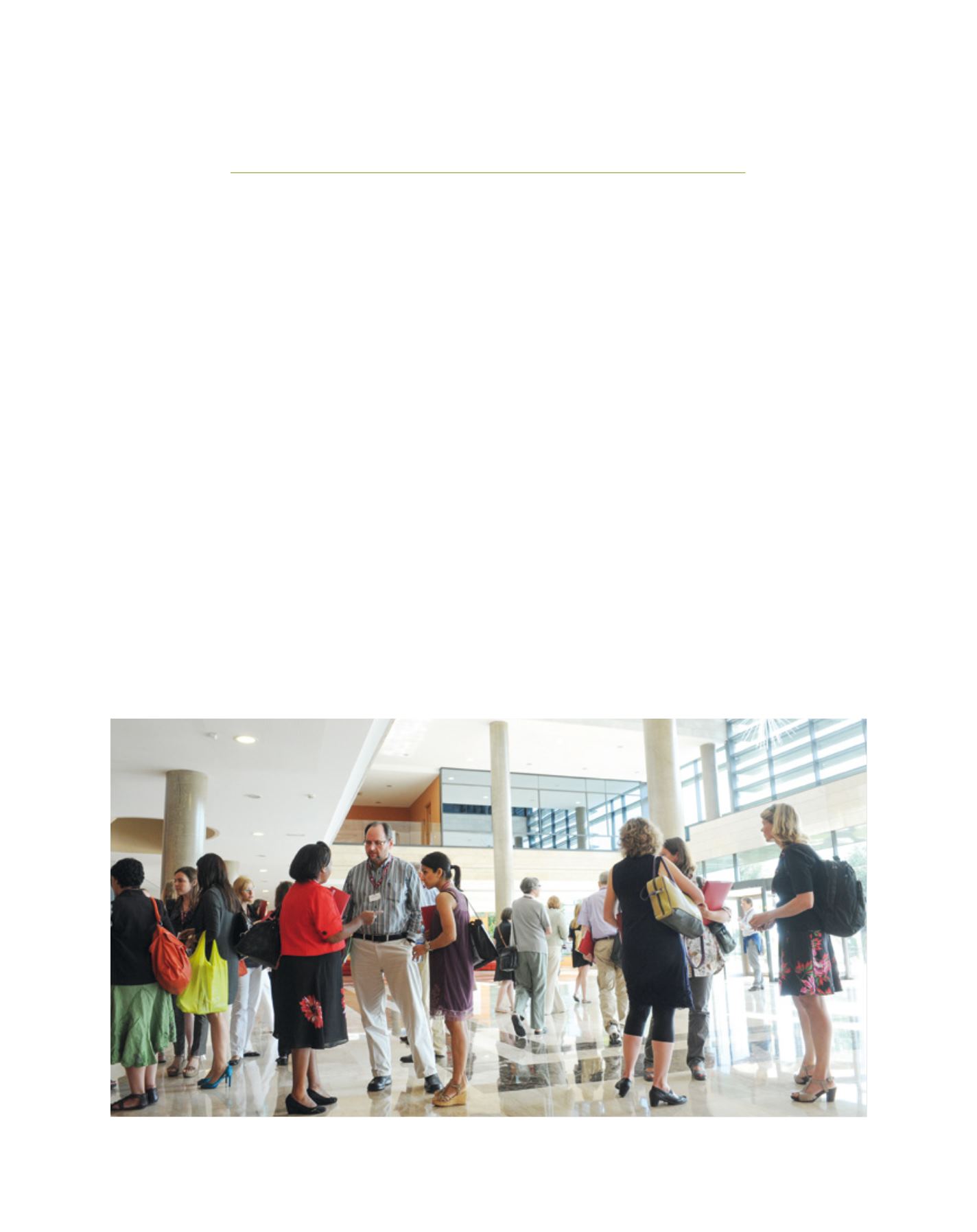
Participants at the ICWF International Academic Conference at the IESE Business School in Barcelona, Spain
Image: ICWF