


 171 / 210

[
] 169
E
nsuring
W
ork
-F
amily
B
alance
subsidized basis. The rates charged by the crèche are also geared
to the number of children in a family and take family income into
account. The price of the midday meal is SwF5.
To complete the services it provides, the municipality has
signed an agreement with the regional association providing
childcare in families during the day, paying a flat rate of SwF2
per inhabitant and the sum of SwF1.80 for each hour of care
actually provided. In 2012, the 16 trained and certified child-
care assistants provided more than 33,000 hours of care for a
total of 94 children.
These figures demonstrate the progress made in providing
care for infants and young children, thanks to federal policy
and the joint decisions of all the cantons. This has greatly
improved the situation for families with young children, even
though there is still work to be done.
In response to the often-voiced criticism that family policy is
not a federal matter, the parliament, supported by the Federal
Council, has proposed a constitutional change that would enable
the confederation, with the cantons, to encourage measures to
improve the balance between family life and gainful employment
or training. The federal authorities at the highest level have thus
recognized the national importance of the problem.
In Switzerland, the desire to have children is not reflected
in the actual number of births. The difficulties inherent in
reconciling family life and employment, and the financial
burdens involved, are still the main reasons for people not
having any children at all or not having an additional child.
The birth rate stands at 1.53, rising slightly but still low. It
is immigration that maintains the demographic balance and
helps fund the social insurance system, which is based on a
distribution model.
There is recognition that both parents need to work to make
ends meet as well as for the sake of the country’s economy, and
a growing awareness that young parents are a source of national
strength. But despite this, the constitutional article on the family,
though accepted by 54 per cent of the population, has been
rejected by a majority of the cantons. Unless the double major-
ity (people and cantons) is achieved, the constitution cannot be
amended. Unfortunately, this vote may have negative conse-
quences for the development of family policy at federal level.
At the same time, some companies offer opportunities
for part-time or home working, or days of parental leave,
without any legal obligation. The sharing of parental roles is
not yet well established in Switzerland, but young fathers are
increasingly interested in being involved in the upbringing of
children and would be in favour of occupational arrangements
to make this possible.
The ambitious idea of paid parental leave of 24 weeks has
been developed by the Federal Coordinating Commission for
Family Affairs and presented to parliament. But it has not
been followed up, mainly because of the estimated cost of
approximately SwF1.2 billion. However, the debate goes on,
albeit slowly, as always in Swiss politics. To succeed, it is
necessary to set priorities, make progress a step at a time,
propose balanced measures and use persuasion.
We are convinced that by achieving a better balance between
family life and gainful employment, we shall be better placed
to combat poverty, encourage the use of people’s skills and
ensure that families flourish, which is the best way of preventing
violence. More flexibly organized working lives for both mothers
and fathers would promote greater serenity in young families.
The right ideas are not lacking, but they must of course be
feasible and must gain acceptance, at least by a majority of
people. The family of tomorrow, in the form it has chosen
for itself or had imposed upon it, will, I hope, be a source of
fulfilment and happiness.
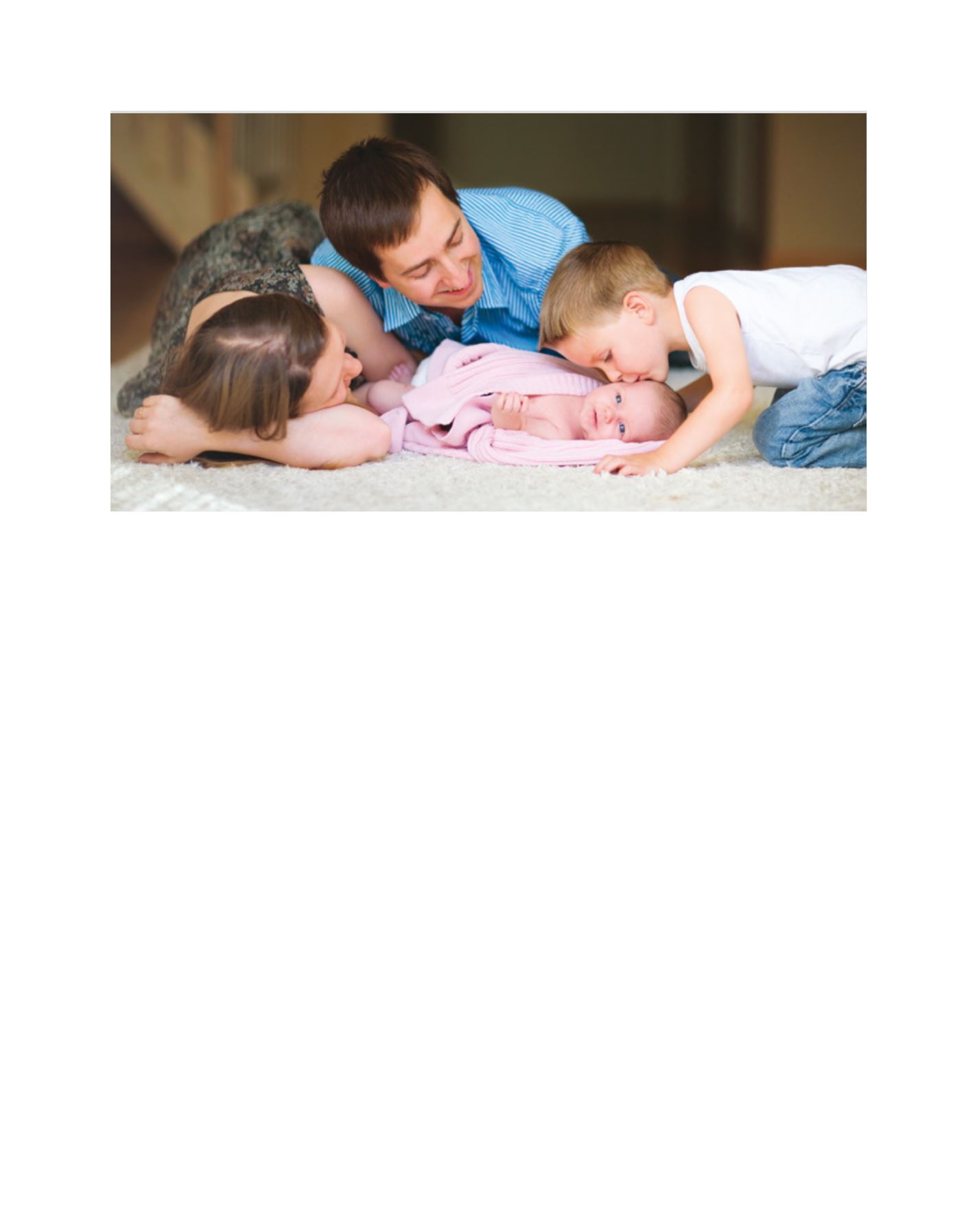
Image: Blue Orange Studio/istockphoto.com
Young fathers are increasingly interested in being involved in their children’s upbringing and would support occupational arrangements to make this possible