


 172 / 210

[
] 170
Balancing work and family life to
improve the well-being of parents and children
Johanna Lammi-Taskula, Unit Manager, and Ronald Wiman, Development Manager,
National Institute for Health and Welfare, Finland
E
nsuring
W
ork
-F
amily
B
alance
W
hen Finland first started building a universal
system of basic social security and essential
services for all, it was still a ‘post-conflict
developing country’. In those days of the late 1930s and
1940s, its gross national income per capita corresponded
to that of today’s low-income or lower-middle-income
countries such as Namibia, Angola or Egypt. The economy
was dominated by the primary sector, with a large share
of small-scale subsistence farming.
Gender equality has a long tradition in Finland’s societal poli-
cies. Finland was the first country in Europe to grant women
electoral rights (1906). During World War Two and after-
wards, rapid industrialization called for social policy measures
that would enable women to join the industrial and service
sector labour force. During the decades since, the evolving
family policy measures have supported both gender equality
and the modernization of the economy.
The right to work is of key importance for gender equality.
One essential labour market equality measure implemented
in 1976 was the move away from joint income taxation for
married couples to a separate income taxation. Because taxa-
tion was progressive, the previous joint taxation created
a strong incentive for couples to keep the lower-earnings
partner – usually the wife – from joining the labour market.
There has also been a long positive cycle in the area of women’s
rights at work. Legislation protecting pregnant women at the
work place has existed for over a century in all Nordic countries.
Maternity leave following the birth of a child has been part of
Nordic legislation for over 50 years. The challenge of combining
motherhood and paid work has been recognized, and solutions
have been sought to protect the health and well-being of both
mother and child.
In Finland, Mother and Child Health (MCH) clinics were
introduced in 1922. Since 1949 they have been operating
nationally. Today all pregnant mothers meet the clinic nurse
12-15 times and have two to three check-ups with a doctor
at the clinic. Both mothers and fathers attend family train-
ing provided by the clinics. After delivery, home visits are
made by the nurse, and during the first year the baby has nine
check-ups at the clinic. During the next period before school
age (seven years old), the child has a further six check-ups.
The Maternity Grant has been provided in Finland since 1938.
The introduction was prompted by concerns over declining birth
rates, high infant mortality and poverty. At first, the Maternity
Grant was for low-income mothers only. Since 1949 the grant,
in cash or in kind, has been available to all expectant mothers
and adoptive parents who are residents in Finland. They can
choose between a maternity pack or ‘baby box’ and a tax-free cash
allowance, which is currently €140. Since the very beginning, the
maternity pack option has been very popular among families. Its
cash value has been far higher than the cash option. The mater-
nity pack was actually a Finnish social innovation, globally the
first of its kind. It contains children’s clothes and other carefully
chosen necessary items such as bedding, cloth nappies, towels
and childcare products in a sturdy box that can be used as the
baby’s first bed. The Maternity Grant or baby box is a condi-
tional benefit: it is granted only if the mother follows a prescribed
schedule of visits to MCH clinics. This is an effective instrument
that has brought infant mortality rapidly down since 1950.
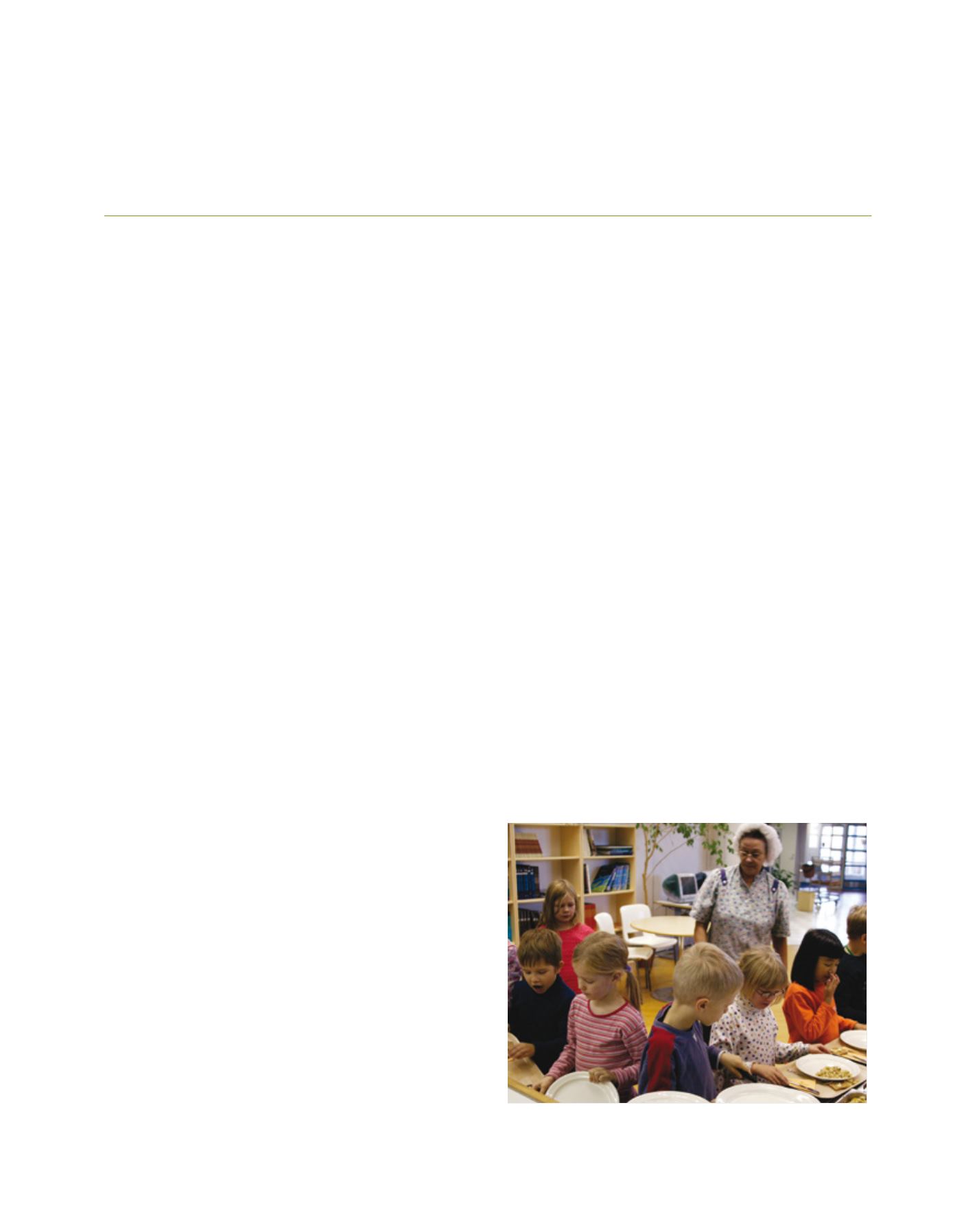
Another early important universal instrument that improved
children’s health – and at the same time lightens the burden of
working mothers –was introduced in 1948 and has been func-
tioning since then. Finland was the first country in the world to
provide free school meals to all pupils. All children get a nutri-
tious warm lunch, and the family does not need to rush with
(often less healthy) sandwich boxes or burden parents (typi-
cally the mother) with preparations for having lunch at home.
Universal benefits for families with children in Finland
include the universal child allowance (since 1949), which is
Lunchtime at a primary school: free school meals for all pupils have been
provided since 1948
Image: Antero Aaltonen