


 169 / 210

[
] 167
Balancing family life and work:
a key factor in personal happiness
Thérèse Meyer-Kaelin, President of the Federal Coordinating Commission for Family Affairs
E
nsuring
W
ork
-F
amily
B
alance
I
n Switzerland, the family is very important. It is the
basic cell, the entity, the crucible in which a human
life is forged and fulfilled, ensuring the development of
the next generation and providing support for the elderly.
The family model has changed a great deal. Nowadays, the
so-called ‘traditional’ family, in which one of the parents cares
for the children, is a minority phenomenon, since more than
70 per cent of mothers go out to work. It is true that many
mothers are employed part-time, but their work represents an
important commitment on the part of young parents. Single-
parent and ‘blended’ families have also multiplied.
The changing face of the family in Switzerland has high-
lighted many people’s need for support where facilities,
organization and the financial burden of bringing up chil-
dren are concerned. The country’s political and territorial
organization, it must be said, has put obstacles in the way of
meeting these needs. Because of Switzerland’s federal struc-
ture and the principle of subsidiarity, the initiative in family
policy lies with the cantons and municipalities. This has led to
inequalities in the framework conditions available to families,
depending on where they are resident.
At the same time, the perception of what help should be
given to families differs according to the partisan ideologies
of politicians, even though all parties loudly proclaim their
support for the family. It is not unusual, even today, to hear
members of federal and cantonal parliaments maintain that
family life is a private matter, not requiring state intervention.
Finally, it should be pointed out that Switzerland is a very
democratic country and people vote very often. Amendments
to the constitution must be voted on, and to be accepted, the
amendments must be passed by a double majority – that is,
by both people and cantons. People vote for laws which are
put to a referendum, and this has been true of all the impor-
tant projects affecting the family.
Now that this framework has been established, it is easier
to understand why family policy was practically nonexistent
at federal level until the early 2000s. The parliament then
became aware of the importance of establishing a federal
family policy to do away with the blatant inequalities in the
area of maternity leave. After several setbacks in popular
votes, in 2004 the Swiss people finally gave the green light
to a standardized period of 14 weeks’ paid maternity leave in
all parts of the country. It was a very moderate proposal but,
even so, the outcome of the vote was uncertain. Finally, the
motion was passed by 55 per cent.
This success spurred parliament on to introduce:
• standardized family allowances throughout the country
• tax relief with deductions for the cost of childcare
• reductions on children’s sickness insurance premiums
• a federal programme to encourage the creation of
non-family childcare places
• standardized school hours in most of the cantons
• the right to breastfeed during working hours.
Each of these positive measures was introduced only after a
struggle, despite the obvious needs.
The federal programme to promote the creation of non-family
childcare places, introduced in 2003, has resulted in the crea-
tion of approximately 40,000 new places. This programme
supports and encourages local communities to create new places,
on a public or private basis, by providing funding for facilities
and running costs during at most the first two or three years.
Initially planned to run for eight years, the programme has been
prolonged for a further four, until 31 January 2015. A possible
extension of the programme is currently being looked at.
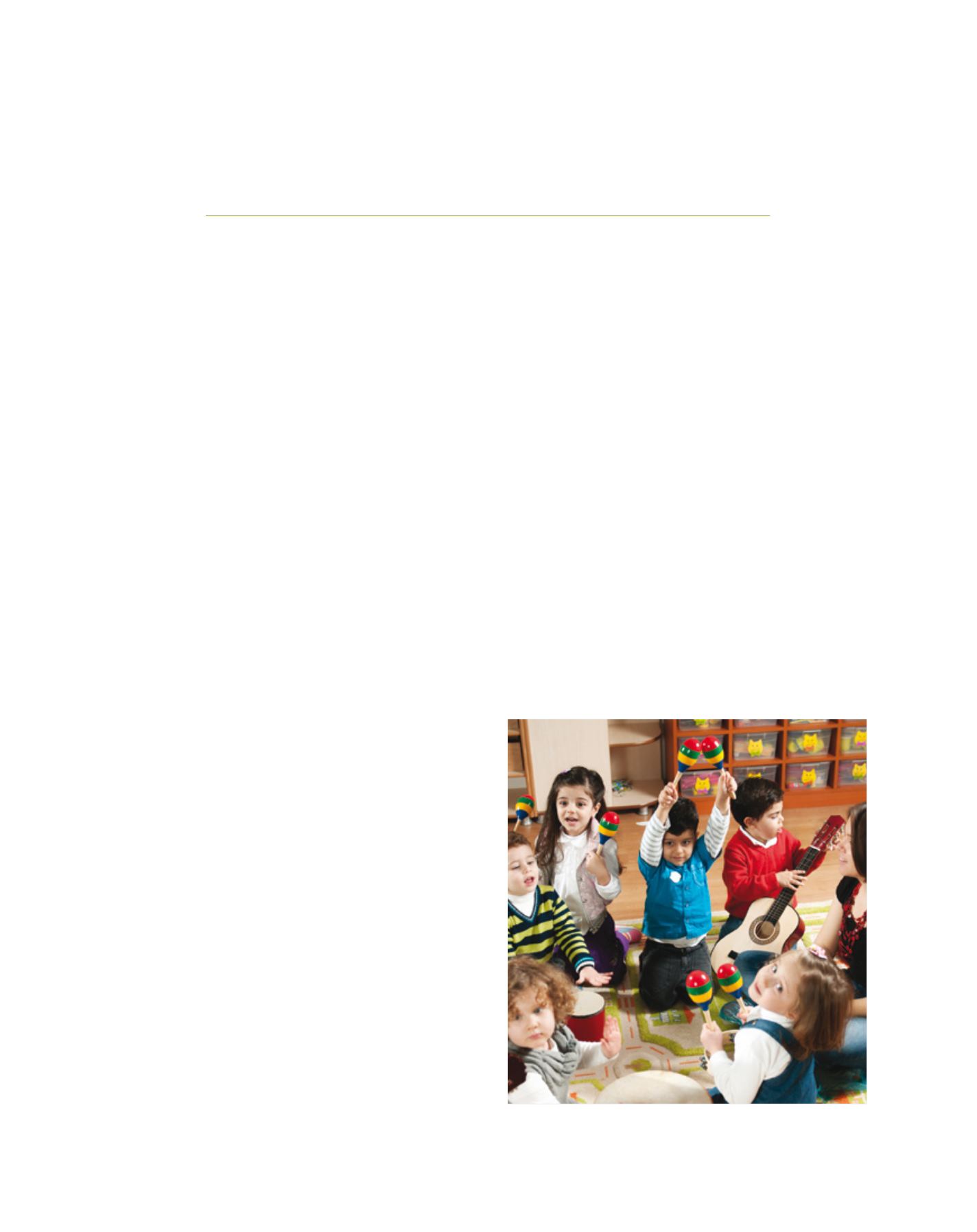
Playing music in a crèche: assistance in creating crèche places has been a
major step in reconciling family life with the working needs of parents
Image: fatihhoca/istockphoto.com