


 166 / 210

[
] 164
E
nsuring
W
ork
-F
amily
B
alance
To make this possible, companies must respond with flex-
ibility to the personal and family needs of their workers.
Without time, energy or adequate compensation, employees
are not only less productive, but also incapable of raising
children, caring for their elderly and participating as active
citizens to improve society. And that loss has great repercus-
sions both for the person and for the whole of society.
Hence the necessity for a new responsibility arises: Corporate
Family Responsibility (CFR) as the internal, essential and
nuclear dimension of Corporate Social Responsibility (CSR).
CFR, a term coined by the ICWF of IESE, indicates that a
company counts on the leaders, culture and policies of flex-
ibility that foster the integration of work, family and personal
life. A company with CFR has managers that:
• make sure every decision made takes people into account
• create flexible and equal opportunity policies and practices
• foster worker commitment and satisfaction
• increase the competitiveness and sustainability of
the company.
In 1999 ICWF created the IESE Family Responsible Employer
Index (IFREI) to measure CFR and its impact on people,
society and the results of the company. It is a model based on
a system that puts the person at the centre of the company.
IFREI diagnosis, which is used in 21 countries on five conti-
nents, contrasts information provided by the managers with
that provided by its collaborators.
The CFR level is determined according to three dimen-
sions: policies, supervisor support and the organizational
culture, which affect whether or not the worker may recon-
cile their professional, personal and family life. These factors
make up and contribute to the environment in which the
employee works.
A low level of CFR hinders the systematic integration of
professional-family-personal life. This situation produces
what we call a ‘polluted environment’ that in turn creates a
high degree of dissatisfaction, stress and loss of motivation in
employees, leading to the desire to leave the company.
On the other hand, companies that promote CFR create
‘enriching environments’ that foster satisfaction with the
reconciliation of work and family; this in turn creates high
commitment, higher quality of life and a higher level of
general health. CFR also facilitates a greater amount of time
dedicated to raising small children, caring for the elderly and
other dependent people, and tending to different commit-
ments in various fields of social life.
The IFREI study analyses the environment in which
people work. Our data demonstrate that, within the same
organization, some employees may develop their tasks in an
environment that allows them to integrate work and family
life, while others find that their environment systematically
makes it difficult for them to achieve this integration. What
are the causes of this contrast? The data of 16,000 people from
all five continents, who so far have participated in the study
and represent a universe of more than 100,000 people, indi-
cate a lack of flexibility policies available to workers, as well
as the poor communication of them or difficulty in accessing
them. Diverse management styles among supervisors mean
that, while some may facilitate employees’ ability to recon-
cile, others in the same company may hinder it. The data also
pointed to the existence of cultures, or subcultures, which
generate different microclimates within the same organization
that may value and respect family to a different extent.
Less than half of the population surveyed in the study (46
per cent) find themselves in an environment that promotes
the integration of work and family (15 per cent in an
A project with Compartamos Banco, the biggest microcredit institution in
Latin America, to increase the CFR of its employees
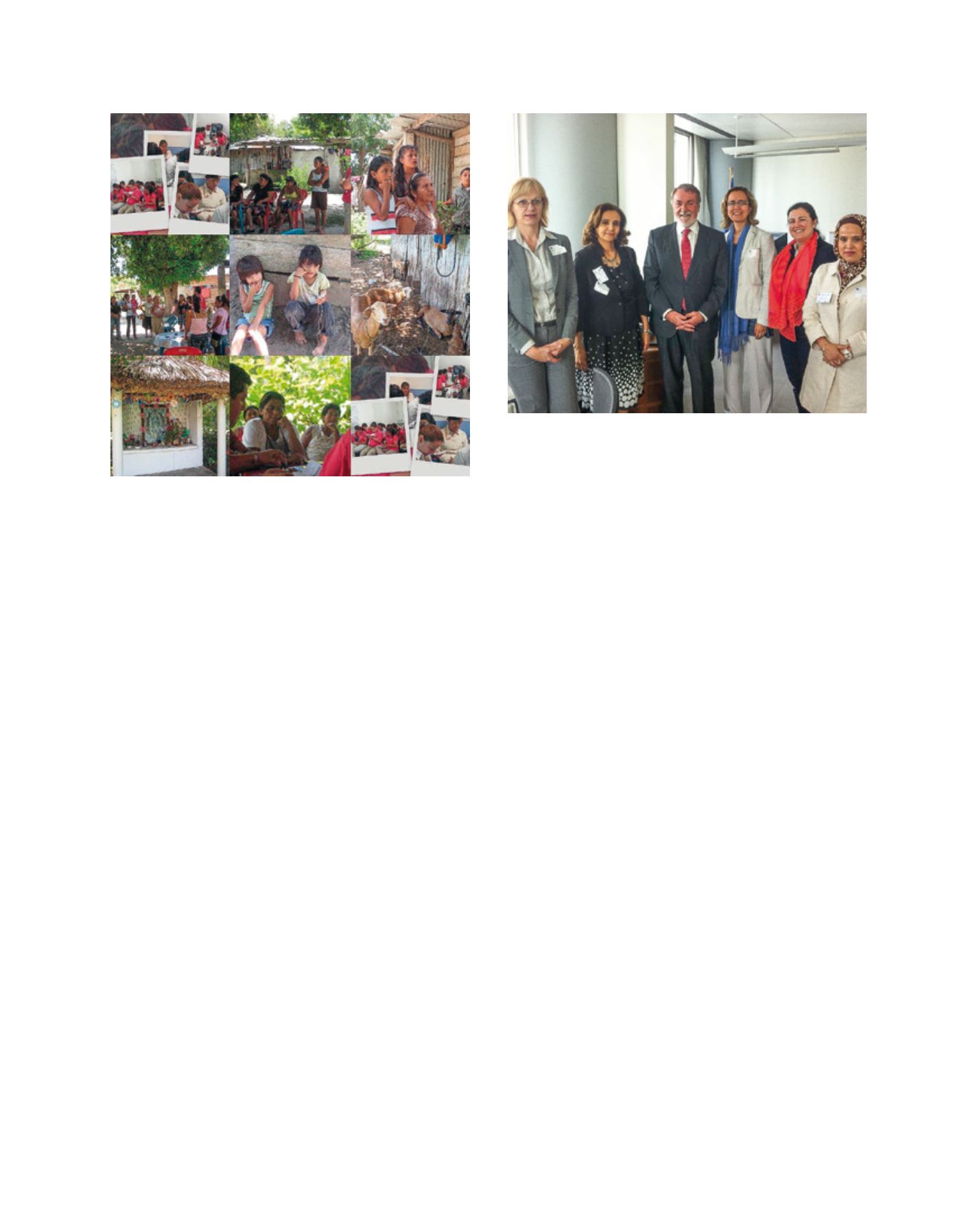
A meeting at the European Parliament. From left, Renata Kaczmarska,
Focal Point for the United Nations Programme on the Family; Jaime Mayor
Oreja, Head of the Spanish Delegation to the European People’s Party of
the European Parliament in Brussels; Mireia Las Heras, IESE Professor; Ada
Garriga, Researcher for ICWF at IESE; and Noor Al-Malki Al-Jehani, Member
of the Board en Qatar Foundation For Social Work and the United Nations
Committee on the Elimination of Discrimination against Women
Image: ICWF
Image: ICWF