


 163 / 210

[
] 161
E
nsuring
W
ork
-F
amily
B
alance
Many mothers, in stable and economically supportive rela-
tionships, end up finding the stress too taxing or the expense of
childcare too high compared to their after-tax income –particu-
larly after having a second child – and simply chose to leave the
workplace, thus perpetuating the cycle of future limited oppor-
tunities and lower pay. Studies have shown that when childcare
is scarce and costly, if women earn less than their partners, they
are more likely to drop out of the workforce. And if they do so for
two or more years, they may not be able to get back in at anything
approaching their prior job level or pay, unless they are protected
by progressive national social policies.
In many developing countries, reconciliation of work and
family life policies competes with development priorities,
with funds more readily spent on economic development and
productivity than social policies. But the lack of social services
(childcare in particular) perpetuates poverty and hinders devel-
opment. Faced with a dearth of affordable childcare, parents all
too often have no other choice but to leave preschool children
alone at home – sometimes locked in for their safety – or
under the supervision of very young siblings or in substand-
ard but cheap childcare. Empirical evidence has shown that
there is a very deleterious emotional and developmental impact
on children who do not benefit from good early childcare and
proper interaction with adults. The consequences are often
lower learning and developmental abilities and literacy. Thus,
children start life at a disadvantage, perpetuating an intergen-
erational cycle of marginalization, exclusion and poverty. A
recent study on selected Latin American countries found that
women aged 20-24 years stated their responsibilities at home
as the main reason for not seeking a job in the labour market.
8
Unpaid work
Many economists and policymakers are uncomfortable with
the idea that work related to home management and care of
dependents should be counted in Gross Domestic Product
(GDP) statistics, instead favouring the notion that only market
labour should be quantified. This runs counter to the notion that
human capital is the most important asset in the development
of a nation. It is puzzling not to value the care, education and
nurturing given to human capital formation. At a time when the
implementation of a Gross National Happiness Index is gathering
traction, it is disconcerting that unpaid domestic service is not
recognized as work and made visible in GDP indices. This lack of
recognition has two glaring consequences. The first is the impli-
cation that our societies do not value contributions to human
welfare and well-being or human capital formation. The second
is an economic consequence: since uncounted care-giving is not
measured, parents do not earn any social protection, particularly
retirement benefits, when they choose to stay home to tend to
dependents. This directly affects their livelihoods and increases
their risk of falling into poverty, especially in old age.
In fact, the time mothers take off from the labour force to
care for their children and elderly parents carries very hefty
financial consequences. Not only do these mothers forfeit
income, but their opportunities to re-enter the labour market
are dramatically diminished, seriously denting their upward
mobility and jeopardizing access to retirement benefits.
All these factors contribute to these mothers acquiring an
inferior status: as long as their care work is invisible, they
Image: Dahame
Best practices in France
Maternity leave
– 16 weeks for a first or second child and 26
weeks for a third child (34 weeks for twins), paid at the equivalent
of the net salary (with a
€
3,000 monthly cap). In the public
sector and most private firms, female executives receive a wage
supplement to reach their net salary.
Paternity leave
–14 days to be taken within four months of the birth.
Flexible parental leave
– one year, renewable to up to three
years. During leave, the employee receives a benefit equal to
approximately 60 per cent of the minimum wage for the one-year
option down to 35 per cent for three-year leave (
€
388 per month).
The employer pays nothing but is mandated to keep the position
available to the employee.
Childcare choices
– parents in France have many childcare options:
• licensed professional or ‘maternal assistants’ (MAs) who offer
care services for 1-4 children in their own homes
• free preschooling –starting at at age 2 in certain areas
• day care – the most favoured choice of parents, with facilities
highly subsidized by the Government
• nanny services – rather expensive and chosen only by 2 per cent
of parents.
The French Government offers subsidies and tax breaks for parents
using a live-in nanny or an MA:
• reimbursement of social security contributions for MAs
• 50 per cent social security tax subsidy for hired nannies
• tax breaks for parents for childcare expenses (day care,
MAs and nannies).
The Government also helps parents return to work by facilitating
access to job centres and any training needed. Validation of
Acquired Experience takes into account the experience and
responsibilities exercised as parents and provides access to
specific professions or government positions for mothers of three or
more children.
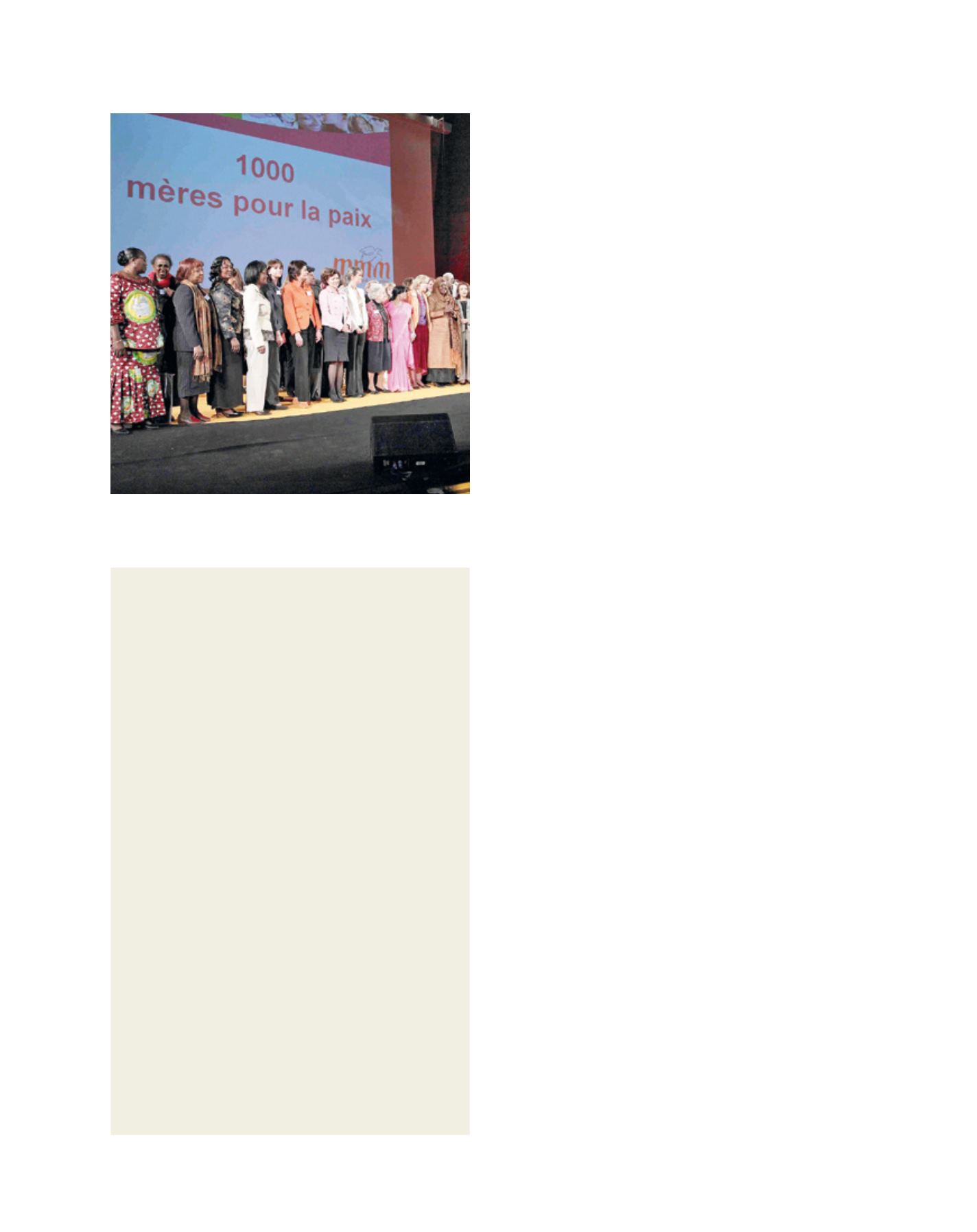
MMM strives to listen to mothers’ voices around the world
and amplify their message