


 164 / 210

[
] 162
E
nsuring
W
ork
-F
amily
B
alance
remain invisible in the distribution of benefits. This seems
a high price to pay for taking the decision to raise a child,
a decision that contributes to the general good by adding a
future educated and productive person to the nation.
The vulnerability of mothers does not stop at their commit-
ment and involvement in nurturing children. It continues
through another season of their lives, when they often become
the caregivers for elderly parents.
In its ‘Availability of Family Caregivers’ 2012 study, the
American Association of Retired Persons Policy Institute found
that the average family caregiver is a 49-year-old woman who
works outside the home and spends about 20 hours per week
providing unpaid care to her mother for nearly five years. Nearly
two-thirds (65 per cent) of family caregivers are women. This
study also acknowledges that the majority of long-term care
to older persons is provided by family caregivers. Currently,
the family caregivers support ratio (defined as the number of
potential family caregivers aged 45-65 for each person aged 80
or older) in the United States is of seven potential caregivers for
every one aged 80 or older. By 2030, this number is expected to
decline sharply to four, dropping to three by 2050.
Inequality between the sexes has narrowed over the last
decades, and women now have more freedom to pursue paid
work outside the home. But a different kind of social injustice
has emerged between those with and without children. When
childless people retire, they will rely on the labour of the next
generation to provide for them. But the childless will not have
contributed as much as those with children to the cost of raising
that next generation. Mothers, by devoting time to raising and
educating the next generation of workers, are helping to make
everyone’s retirement more comfortable. Our societies, however,
make mothers pay an unwarranted penalty for that choice. To
many, the opportunity cost of being a mother is too high.
Often, societal changes are predicated by economic neces-
sity. Thus, the ‘unfinished business of the women’s movement’
may be resolved by a stark economic reality: the sea change in
demographic trends that will affect the world economy and devel-
opment in the twenty-first century. The developed world needs
women to have more children: the fertility rate for Organisation
for Economic Cooperation and Development countries is at 1.7,
well below the replacement rate of 2.1, while the United States
registered its lowest rate in 2012 since birth rates began being
recorded in 1909. At the same time, however, the developed
world needs women to participate in the workforce to contribute
financially to the retirement benefits of baby boomers, while also
ensuring their care-giving. In 2008 there were 4.7 working-age
Americans for every retirement-age American, and by 2050 that
number is projected to drop to 2.6. In Europe, the numbers are
even more worrying, dropping to 2.1.
9
By contrast, in the developing world, while some fertility rates
are declining, they remain well above the replacement rate. But
the challenge here is to ensure that parents, and notably mothers,
are in environments where poverty, failing local infrastructure,
cultural and religious beliefs do not adversely impact and burden
their already fragile ability to care for the economic and emotional
well-being of their children. Mothers need to be supported and
helped in their quest to bring up future generations of educated
and empowered adults who will bring development to their
economies. If human capital is the ultimate fount of progress, as
most economists and sociologists agree upon, then mothers –
and other caregivers – are the most important producers in the
economy, for they are the ones most responsible for nurturing
and growing this capital, particularly in the early years.
Conclusion and recommendations
Our research has shown that more than 70 per cent of
mothers wish to work outside the home, but privilege above
all the ability to have flexible work schedules. Countries that
make it easier for working parents to look after their own chil-
dren – for example by extending parental leave, shortening
the work week, encouraging flexible work time, implement-
ing high-quality and affordable public childcare, offering
‘homecare allowances’ and allowing stay-at-home mothers to
benefit from social security and retirement schemes – would
reap the fruit of their investment by ensuring a current and
future vibrant workforce, a stable and productive society,
less stressed parents and, in the case of poorer countries, an
opportunity to break the cycle of poverty.
We call upon policymakers and employers to make a
concerted effort to analyse and implement ways that the
workplace can truly embrace flexible time or re-entry after
extended absence due to family care. It is time to listen to
those of us who have innovative solutions, think outside the
box and understand the issues first-hand.
MMM: role and mission
MMM is an international non-governmental organization in general
consultative status with the United Nations Economic and Social
Council and Department for Public Information. For 65 years MMM
has federated associations from widely different backgrounds working
for and with mothers to ensure at least the basics of human security
and improved quality of life. The input of mother and father into
bringing up children is – or should be – symbiotic, equal, different
but complementary. However, research has shown that it is mothers
who have the most profound – and lasting – influence from a child’s
earliest moments. For this reason MMM seeks to address many social
issues through the natural authority of mothers. To reinforce its open,
inclusive character, MMM defines itself as an independent, apolitical
and non-denominational movement. MMM is managed by mothers
who volunteer to support the work of representation and the activities
of its member associations throughout the world. MMM is run by
mothers, for mothers and their children and families.
The founding document of principles of MMM states:
“A mother is the most powerful influence on the life of the family
and, therefore, on the cultural, economic and social life of the nation.
It is vital that public opinion and policymakers recognize and value the
irreplaceable contribution of mothers throughout the world.”
10
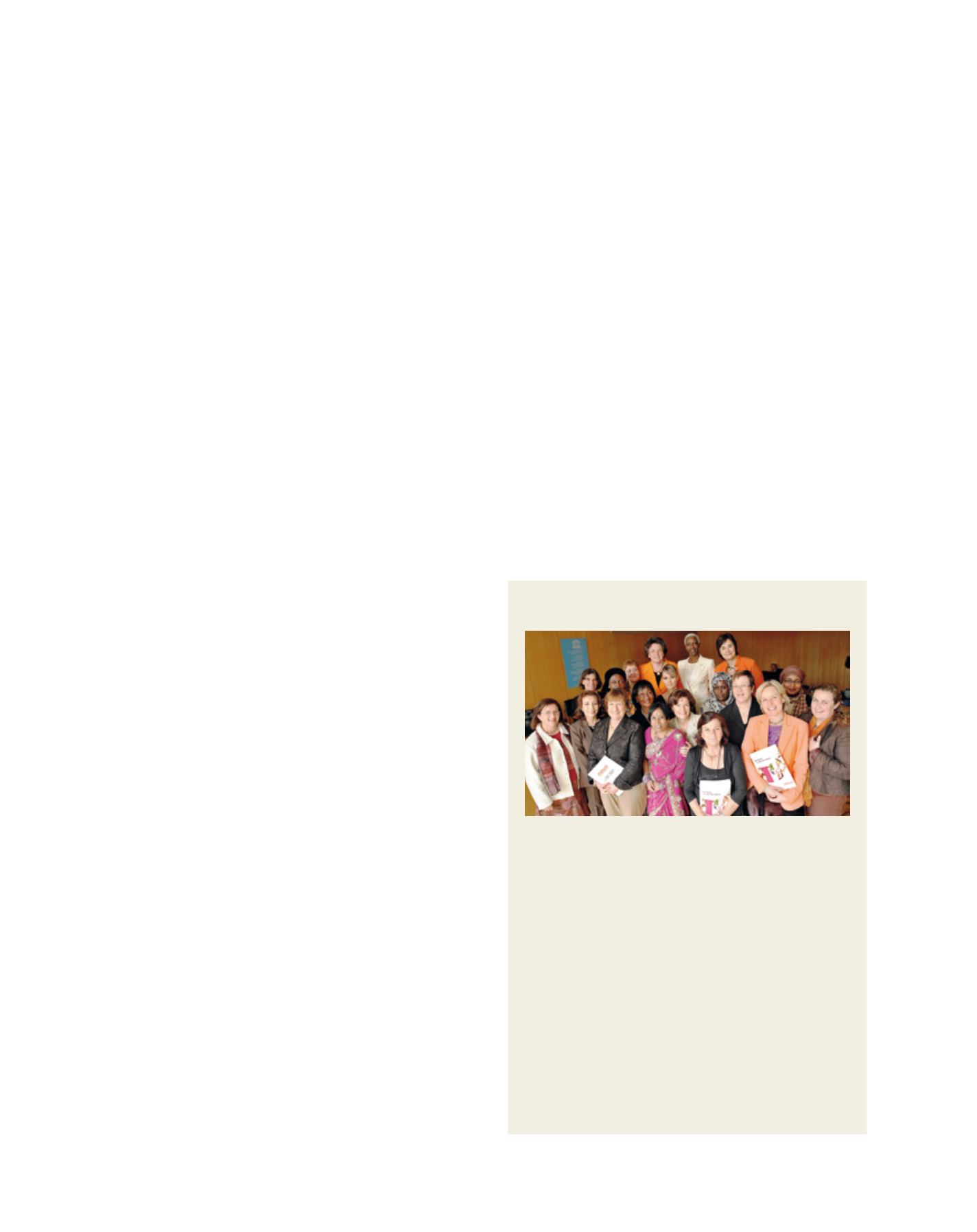
Image: MMM