


 161 / 210

[
] 159
Making mothers matter
Florence von Erb, President, Make Mothers Matter
E
nsuring
W
ork
-F
amily
B
alance
I
n the 2010 Survey of Mothers in Europe, Make Mothers
Matter (MMM) asked mothers to give a description
of their transition into motherhood. In answer to the
question, ‘what does it mean to become a mother?’, one
respondent replied: “Before it was just ME; now I am US.”
The birth of a child constitutes a major and irreversible change
in focus, priorities and life-course. One never again sees life
as one did before becoming a mother.
1
This transformation is
experienced by all mothers in the world, rich or poor, married
or single, young or old. It alters the perspectives of women for
the rest of their lives as they face new realities and challenges.
Globally, it is estimated that over 75 per cent of women of
child-bearing age are mothers.
Believing that no one should presume to speak for them,
MMM strives to listen to mothers’ voices around the world and
amplify their message. Its advocacy work is complemented
by workshops where mothers share their best practices, diffi-
culties and invaluable knowledge of dealing with the daily
commitment of being the best ‘us’ they can be.
MMM has found that mothers do not feel they have the
support to achieve the difficult task of reconciling work and
family life, and they also continue to crave the recognition
that their work at home – their unpaid care-giving – is as
valued and respected as work outside the house.
In her book,
The Price of Motherhood
,
2
Ann Crittenden states:
“as the twenty-first century begins, women may be approach-
ing equality, but mothers are still far behind. Changing the
status of mothers by gaining real recognition for their work
is the great unfinished business of the women’s movement”.
The difference in achievement between mothers and child-
less women has prompted researchers and sociologists to talk
about the ‘family pay gap’ or the ‘mommy penalty’ (the wage
inequality between women with children and those without).
A study showed that by the late 1990s American women
without children were earning 90 per cent of men’s wages,
while similar aged women with children were making the
equivalent of only 70 per cent.
3
Were the analogous statistic
available for other countries, it is highly probable that this
gap – if not a larger one – would apply to most women in
the world. How is this discrepancy explained?
The MMM ‘Realities of Mothers in Europe’ study
4
showed
that the majority of mothers – 64 per cent – wish or need
to combine paid employment with family care, while only
11 per cent express preference for a full-time career (the
remaining 25 per cent wish to be full-time homemakers).
Similarly, in the United States, the labour force participation
rate (per cent of the population working or looking for work)
for all mothers with children under the age of 18 stood at
70.5 per cent in 2012.
5
According to the 2012 International
Labour Organization report on ‘Global employment trends for
women’, women’s participation in transition economies is well
above 50 per cent, while in the Middle East, North Africa and
South Asia, the number falls below 35 per cent (in the formal
economy). In summary, when allowed to, most women want
or need to participate in the workforce.
MMM’s research shows that this participation is not linear.
There is a pattern to the seasons in the life of most mothers:
seasons when family concerns call for more presence and
investment in their children or elders, and seasons when they
feel free to work longer hours outside the home. This pattern
is often disregarded or altogether dismissed by policymakers
and companies who, favouring economic growth over labour
market needs and wishes, contribute to the cycle of unequal
work opportunities and wealth distribution.
Most mothers want the possibility to commit service away
from their children
only when they are satisfied that their chil-
dren will not be diminished by the diversion of their focus.
Much has been written about the conflicts experienced by
working mothers in industrialized countries, and the debate
seems only to have intensified in the last decade with the
discourse of work and family all too often presented in polar-
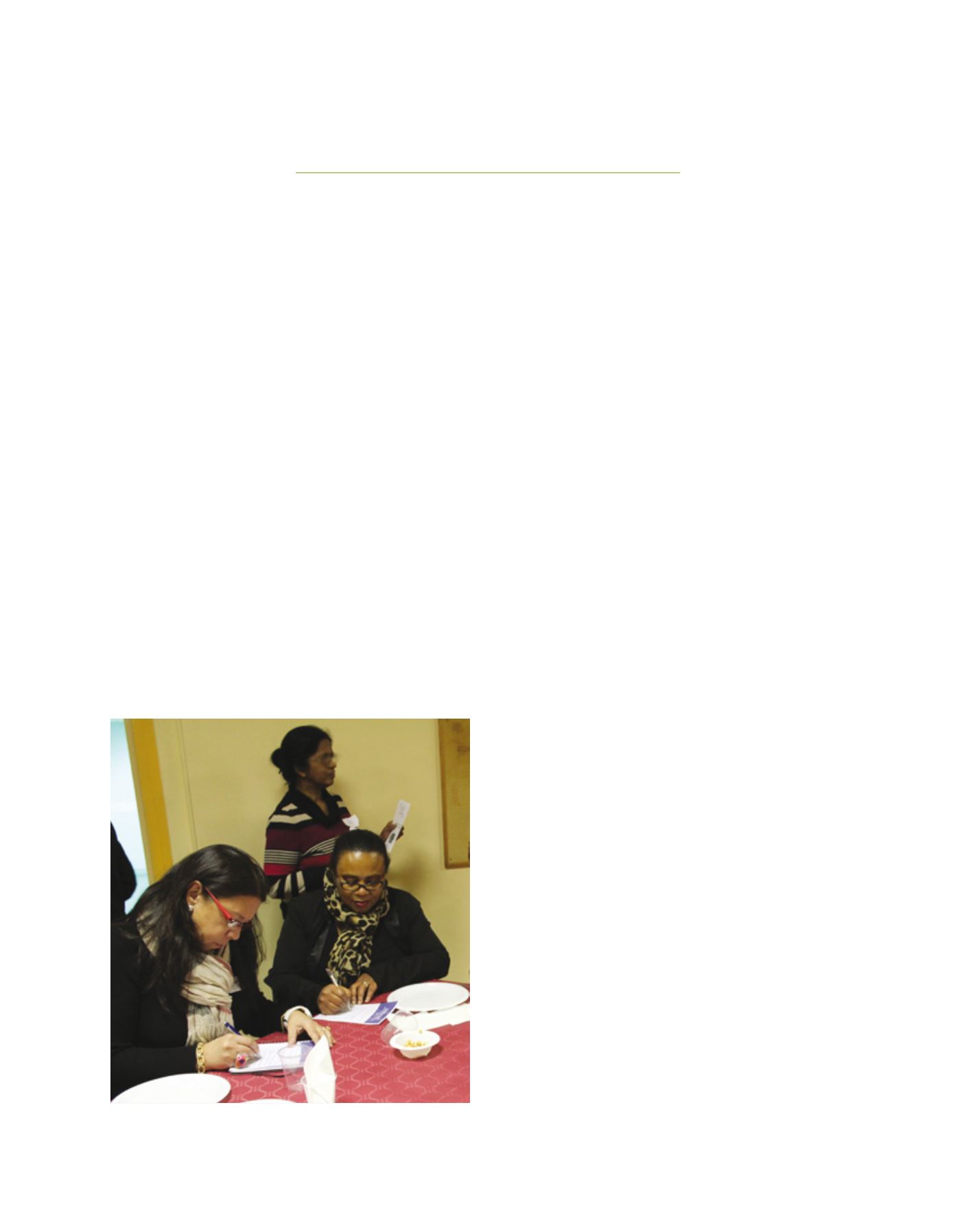
Mothers around the world face the difficult task of reconciling work with
caring for a family
Image: MMM