


 140 / 210

[
] 138
C
onfronting
F
amily
P
overty
Families with no wage, with one or two unemployment
benefits and excluded temporarily or chronically from the
economic system, are confronted with severe poverty.
4
Dwelling in the countryside might provide some sources of
food and some conditions to cope easier with the shortcom-
ings. The existence of small agricultural plots, but the lack of
necessary means to carry out agriculture, provides conditions
of subsistence but in chronic poverty.
Migration to work abroad, particularly if it is illegal,
provides an answer to the imperatives of the moment, but
exposes the immigrants to a lack of social and health insur-
ances. Furthermore, a segment of the immigrants is confronted
with illegal and degrading activities.
Young people lack personal resources, as unemployment
among the young is high. In this case, the traditional support
of the family is an essential condition for everyday living. The
impoverishment of the adult generation, and of the elderly in
particular, decreases the support for the young. Poverty among
young people has been studied less than other sectors of society.
Victims of the current crisis include employees with average
or higher wages and pensioners, who benefited from the
stability of the pensions system and who took out loans. These
people are now confronted with poverty: decrease of incomes,
wage cuts and the risk of sickness. The phenomenon reaches
practically all the age categories, with real estate loans or loans
for personal needs taken to meet minimal, decent dwelling
conditions or consumption needs.
The numbers are supplemented by the victims of swindling
activities not protected by the police/legal system, such as
thefts, loans with usury (the only available loans when there
is no stable income in the family) and the loss of dwellings by
retrocession or deceit.
For modern societies, particularly for the EU, poverty is not
a problem of the people. Rather, it is a problem of the entire
community. It is an illusion to think that poverty is a state
produced exclusively by the economy. For the EU, the social
aspect is also an important direction of policy.
In 2010 the Nobel laureate for economy, Paul Krugman,
showed that in some economic analyses, Europe was often
used as negative example to support the thesis that if you try to
make the economy less brutal and to protect the citizens better
when they are cornered, you end by smothering economic
progress.
5
This conception is totally wrong, according to
Krugman, with the European experience showing exactly the
opposite: that social policy and progress can coexist.
In the EU, social transfers contribute to the reduction of
relative poverty, on average by 60 per cent. Therefore, more
than half of the people at risk of poverty due to economic
activity leave the risk area due to the social protection poli-
cies. The efficiency of social transfers to reduce poverty was
highest in Hungary, France, Sweden and Austria, with reduc-
tions in excess of 70 per cent.
The efficiency of the anti-poverty policy in Romania, with
the same structure, is below the European average in a year
when the effect of alleviating poverty by social protection,
at the national level, increased compared to previous years.
During the past three years relative poverty decreased in
Romania, while poverty resulting from productive activ-
ity (pre-transfer) increased. Pensions played a progressive
compensating role in the alleviation of poverty (two to three
times higher than all the other social services together).
In 1997 the Romanian Presidency adopted an anti-poverty
strategy which has been, nevertheless, ignored by the
Government and was not transformed into a governmental
project. A better attempt in this direction was made only in
2001 by the construction of a national system: the Commission
on Anti-poverty and for the Promotion of Social Inclusion
(CASPIS), the County Commissions on Anti-poverty and
for the Promotion of Social Inclusion, and the Government’s
decision to adopt the National Plan on Anti-poverty and for
the Promotion of Social Inclusion (PNA-inc). In 2004, as a
condition for accession to the EU, CASPIS developed the Joint
Inclusion Memorandum. This was adopted by the Government
of Romania, approved in 2005 by the European Commission
and signed as a commitment by the Government of Romania
towards the European Commission during the pre-accession
process.
6
With this, the narrower objective of reducing poverty
has been included in a wider social policy to promote inclusion
in all the spheres of social life. The expansion has been stimu-
lated by the European context, which has introduced the new
concept of social inclusion as a core concept of social policy.
The institutional structure, the anti-poverty programmes
and the programmes for the promotion of social inclusion,
which had started to function and to be applied, were aban-
doned in 2005 when the governance changed. The governance
of 2009-2011 stressed this negative trend, launching an attack
on the social functions of the state and taking practical meas-
ures to withdraw the state from social support. Paradoxically
in 2010 – the year which the European Commission declared
as the European Year for the Fight Against Poverty and Social
Exclusion – the governing strategy ran contrary to these
priorities by promoting hard measures of austerity, obsessively
invoking the reduction of social expenditure as a precondition
of escaping the crisis.
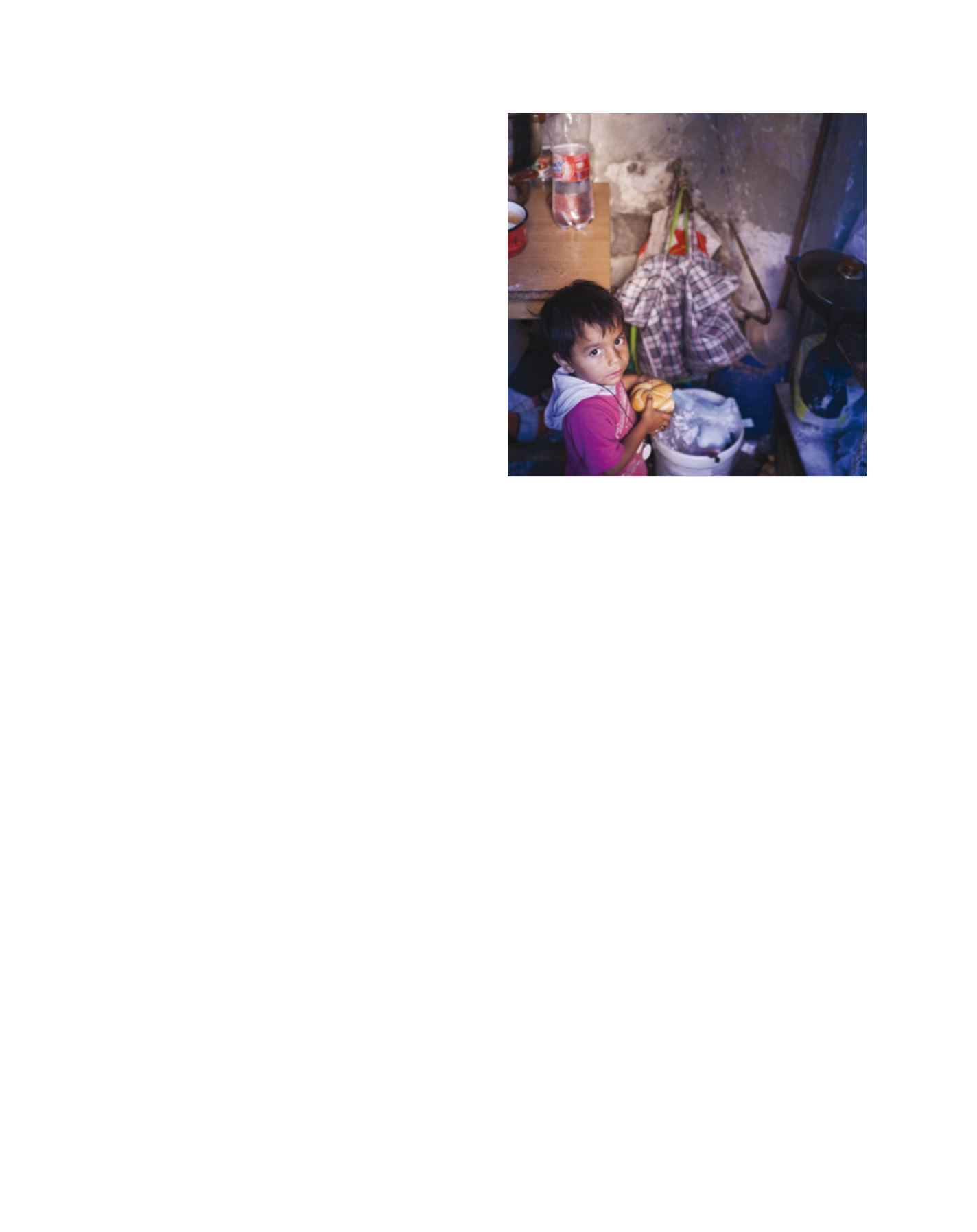
Poverty affects all social groups in Romania, to varying yet significant degrees
Image: www.mmuncii.ro