


 138 / 210

[
] 136
Confronting family poverty in Romania
Codrin Scutaru, Secretary of State, Ministry of Labour, Family, Social Protection and Elderly, Romania
C
onfronting
F
amily
P
overty
A
s a country with a specific social profile, Romania
has faced the challenges of poverty for a long
time. Since 2013, poverty alleviation has again
become one of the most important points on the govern-
mental public agenda, after more than nine years. The
family itself became a priority for the new social-liberal
Government in May 2012, after more than three years of
social austerity measures.
The world crisis found Romania with an already weakened
economy and with a structure which does not provide oppor-
tunities for rapid recovery. Hence, the crisis in Romania is
one of the deepest in Europe. Payment of the debts incurred
during the past two years will affect the future economic and
social situation even more.
The crisis started in the context of an impoverished society
– the poorest in Europe – and that poverty is predicted to
continue this year. The fast degradation of the standard of
living also affects the fragile middle class, many of whom
are being pushed below the poverty line. In addition, the
social state is undersized. Intervention is directed towards
the continuous reduction of support from the state. In this
context, the former governance of 2009-2011 has launched a
programmatic attack against the social state.
Currently, the level of relative poverty in Romania (22.4
per cent) is second only to that of Latvia, while the European
average is 16.3 per cent. The dynamics of subjective estima-
tions of poverty show that the population feels the crisis at a
high intensity, the highest in Europe. The perception of gener-
alized poverty is higher than in 2009 (90 per cent). A 10 per
cent increase was observed in the segment of the population
who consider that this poverty is due to social injustice (61
per cent in 2010), a proportion which puts Romania in the top
position among European Union (EU) countries.
1
Poverty affects, in various yet significant degrees, all the
social groups.
2
A large segment of the economically unoccupied
population lives ‘a day at a time’, the unemployment system
providing largely for minimal conditions of subsistence.
Most worrying is that poverty has also reached the economi-
cally active population, including employees. Having a job
doesn’t take one out of poverty. The risk of poverty for the
working people of Romania is the highest in Europe (17.9 per
cent compared to the European average of 8.4 per cent). This
is far ahead of countries such as Czech Republic, Slovenia,
Sweden, Hungary, Norway and Denmark, which have very
low levels of risk of poverty and inequality.
The low wages don’t guarantee a way out of poverty. Rather
the contrary: the standard family, with two minimal wages,
lies far below the minimum level for a decent standard of
living, compared to the international data already mentioned.
This is further evidence of the low capacity of work to ensure
a decent standard of life in Romania.
There is a clear trend of polarization in poverty: besides
the higher proportion of employees with low wages, there is
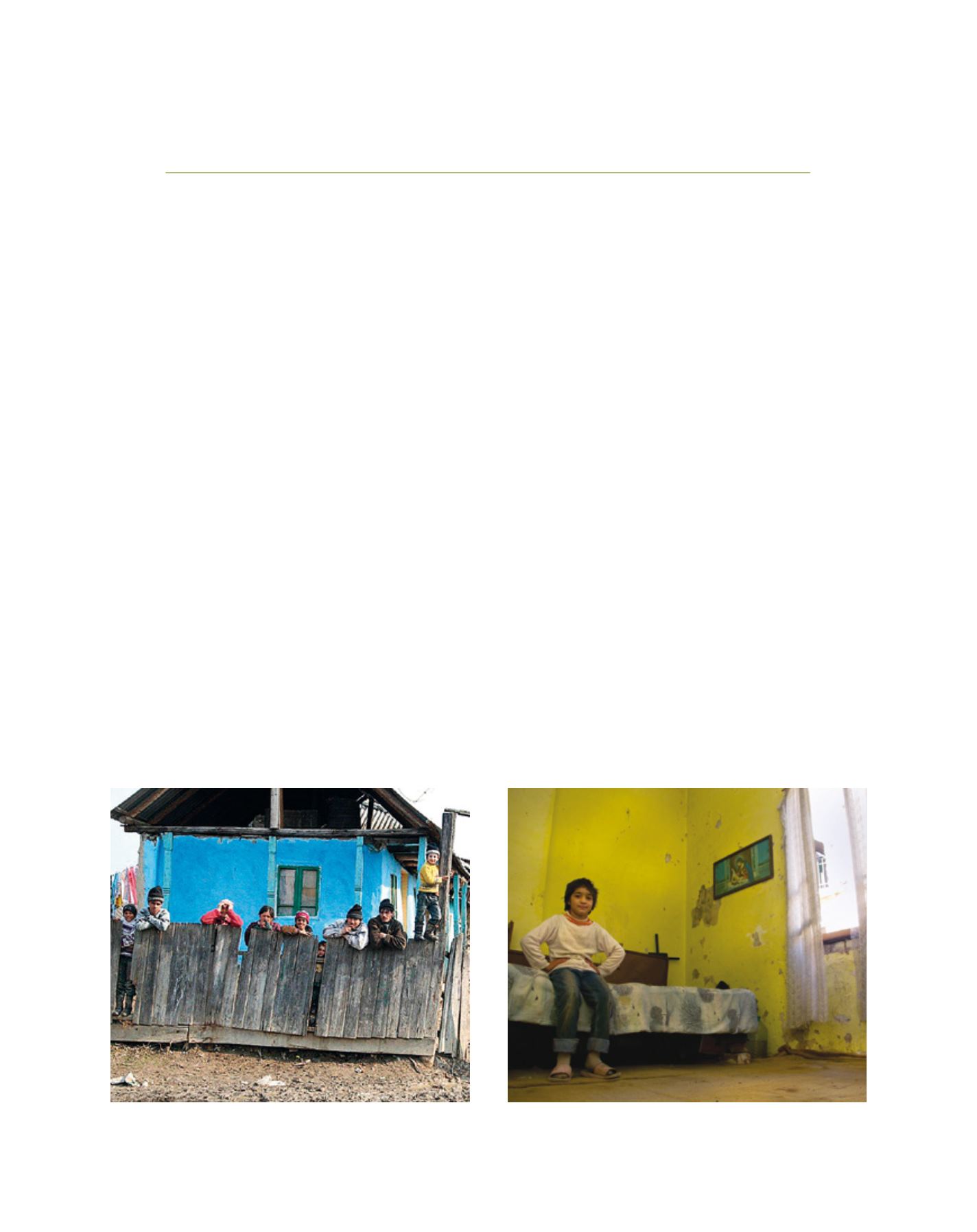
A growing proportion of employees in Romania have low wages and there is an
increasing gap between families on a medium wage and those with low wages
For families on minimal wages, the standard of living is consistently and
significantly below the minimal level
Image: www.mmuncii.ro
Image: www.mmuncii.ro